collaboration

Step Up: SCM is not a Game of Horseshoes

by Lora Cecere on October 20, 2011 · 3 comments

Open letter to Kinaxis

Dear Kinaxis.

You know that I am known as a tough love analyst.  I have the reputation of being as hard as nails: a curmudgeon that tries to side-step hype to tell it like it is.  I am the old analyst gal that has watched the supply chain management market explode, ebb, collapse and struggle.  I feel that it is my responsibility to sort through the hype and help early technology adopters understand how to best use disruptive supply chain (SCM) technologies. It is in this spirit, that I send you this letter.

By and large, I hate and avoid vendor sponsored events.  I have little patience for self-serving vendor speak, and it is for this reason that I avoid events like Oracle Open World and SAP Sapphire.   However, you know that I made an exception to attend a Kinaxis event this week.  I follow you closely because you are one of the only successful Software as a Service (SaaS) SCM solution providers and your in-memory optimization and pattern recognition engines were an early form of disruptive technology for the supply chain that is not well-understood.

It is in this spirit that I share feedback on your event, Kinexions, which happened in Phoenix this week. My tough love is designed to help both you and the greater supply chain market.

Get beyond Antics, Bells and Whistles

Your event has a lot of bells and whistles.  To infuse fun, you created a version of “the Late, Late Night Show” complete with active, sometimes irreverent, skits.  Quite frankly, most of it is lost on me.  I don’t get into the grins and giggles and stunts.  I am the old gal that sits in the back of the room pushing back on the celebratory marketing tweets trying to drive higher value for the greater supply chain market.  I think that the “what” you do–the differentiation of the approach and the value of the solution –can get lost in the fun and games. A little is good, but your clients came to hear more than grins and giggles.

My challenge to you is that you can be better than this.  Yes, you have many of the trappings of success– a room full of happy customers, more system integrator attendees than ever before, and some great speakers –but your potential is SO much more.  Let me explain:

Be Proud. Please get rid of the chip on your shoulder.  Help the supply chain market at large by working through your own issues. Over the ten years that I have followed you, I have experienced the many “chips on your shoulder”.  First it was because you were a Canadian vendor.  Then it was because you are trying to carve out a new solution space in the Advanced Planning Solution (APS) space.  You have fought hard for attention.  I understand all of this, but I wince each time that I hear a Kinaxis executive throw barbs at Oracle, SAP or ERP in general.   …or when hear the Kinaxis team dismiss the importance of tactical or strategic supply chain planning.   At the event, it was often.   …too often for my taste.  My question is, “Why waste your time to dismiss another system when you have the biggest room full of happy customers that I have ever seen at a Kinaxis event?  My point of view is that you no longer have to prove yourself.  Can we get rid of the chip on your shoulder for tomorrow? It is limiting your potential.

Let’s reflect back. In the 1990s, the go-go years of supply chain planning, the market collapsed because the focus became solution vendors competing with each other. We have learned that it takes a village to solve a supply chain problem.  There is a need for ERP, and SAP does a great job at many things; and you, Kinaxis have a lot to be proud of.  You are an important and complimentary solution to tactical planning. You fill a void in operational planning.   I think that it would be more valuable to share how the applications fit together and how you uniquely add value to customers.  This got lost in the rhetoric at the event.

Focus on what you are good at.  You understand that supply chain management is not a game of horseshoes.  You know that approximate answers are not good enough.  You also have unique ability to quickly collect and harmonize disparate data into in-memory models to drive what-if simulation, sense exceptions and provide visualization of supply chain operations in new ways.  I applaud your investment in Tree Maps, I love the Time Machine concept, and it was great to see the diversity of companies at the event.  I also enjoyed seeing the use of your solution in new and novel ways like the monitoring of expiring product code dates by Amgen. I will list you in my cool technologies blog post because of your advancements in Supply Chain Business Intelligence.

Dig in where you have an opportunity to do more.  I give you a challenge. With all of the power of your engines and your technologies, it is time to do more.  I would like to see you provide even greater value for the supply chain community.  Please consider these opportunities:

  • Help build the community.  You now have over 5,000 members in the Kinaxis community.  You have successfully used Jive to build it.  The site allows open engagement by thought leaders on supply chain management.   This was a great first step, but take it further.  Where is the data that you could share from your aggregated sensing in your Software as a Service (SaaS) data center?  Where is the Kinaxis content?  Why can you not be more like Ariba and signal potential risk issues with suppliers, tightening of commodities based on changes in lead time and aggregate trends?  Please get in touch with what I think is unharnessed potential—the aggregate data in the SaaS data center—to help the community.
  • Recognize it takes a village.  As an upcoming supply chain leader, help to build a village through viable partnerships, and complimentary offerings.  It is time to stop tearing down the completion and focusing on how your solution helps to build a better village.  You are complimentary to SO many offerings.  Is it time to make this part of your value proposition?
  • Drive true collaboration:  While you have successfully deployed Jive, you have not embraced community technology in your own application.  Why is your application still faceless?  Why are you not the Salesforce chatter of the supply chain management space?  Especially for the supplier community?
  • Improve demand and supply sensing.  Because of your aggregate presence and position with your customers, you have the data to know the true risks of the supply chain first.  Why is there no risk index for supply chain shifts?  Or early warnings on potential sources of failure—slippage by suppliers or tightening of parts—for your customers?
  • Unleash new supply chain value.  You have been pushing product for so long, I don’t think that you understand the potential opportunity of your CONTENT.  I feel that there are 5-6 aggregate benchmark indexes that you could provide your customers and the supply chain community at large that could answer some unique questions on supply chain excellence.
  • Take master data off the table. It was mentioned three times on stage by your customers.  Why can you not use your technology to solve the problem?  I urge you to take the MDM issues off the table….
  • Identify your own Supply Chain Top 25.  You and I agree that the supply chain AMR Research Top 25 is wrong.  We agree that you just cannot put a list of companies into a spreadsheet and shake it up and assess who is best at supply chain management.  However, I assert, that through the data in your system, you could assess new levels of achievement in supply chain excellence.  You have a unique opportunity to make your customers heroes and to help them improve their supply chain processes.

 Take the Challenge.  Become Market Driven

I have watched your progression from a product-driven, to a sales-driven, to a marketing-driven approach.  My challenge to you today is to become market driven.  Get the chip off your shoulder, harness your assets in new ways, and help bring new innovation to the supply chain market.  Get beyond self-serving marketing messages and cute skits because the challenges of the supply chain market needs more.  It needs what you have to offer to help solve the growing problems of complex supply chains. We need technology companies in SCM that know that supply chain excellence is not a game of horseshoes.  It is time for you to grow up.  And, yes, I look forward to seeing this skit on the Kinaxis “Late, Late Night Show.”

Time to Broaden the Knot on your Bow Tie?

by Lora Cecere on August 17, 2010 · 6 comments

With the current economic uncertainty, is it time to step out and to make lasting and meaningful supply chain relationships and unleash the opportunities in the end to end supply chain? However, before you take that step, do you need to broaden the knot in your bow tie?

I have been writing about supply chain collaboration for the last fifteen years.  The term is bandied about. Supply chain strategy documents drip with it.  Conference presentations are ladened with the concept.  They include phrases like collaborate with your trading partners, build collaborative networks, implement collaborative technologies, and collaborate to build value….  Can you imagine how unpopular I am, when I give clients the feedback that “true supply chain  can only really happen when you have a lasting win-win value proposition.”

My goal of this blog:  stop the madness.  Reset expectations.  Stop fooling yourself.  What most people call collaboration is really data sharing.  Collaboration can only really happen when you have a lasting win-win value proposition; and in this changing world of power structures, constraints, and demand volatility, this is harder than ever.

 By and large, we have failed in the creation of true collaborative relationships in Supply Chain Management (SCM).  Here I share insights on how to turn the tables and make true collaboration—a lasting win/win value proposition – a reality.   It is enabled by technology; but technology alone is not sufficient.

Peeling back the Onion

In reviewing history, there have been a lot of well intended initiatives.  Before we look at how we go forward, let’s examine what went wrong and how we learn from history:

CPFR:  Continuous Planning Forecasting and Replenishment failed for three reasons.  Aspirations were greater than capabilities. (Retailer’s forecasting processes and demand accuracy was not up to the test.)  It was labor intensive; and the planning processes was not connected well to execution.  It was over-hyped by industry professionals which delayed a correction course for salvation.

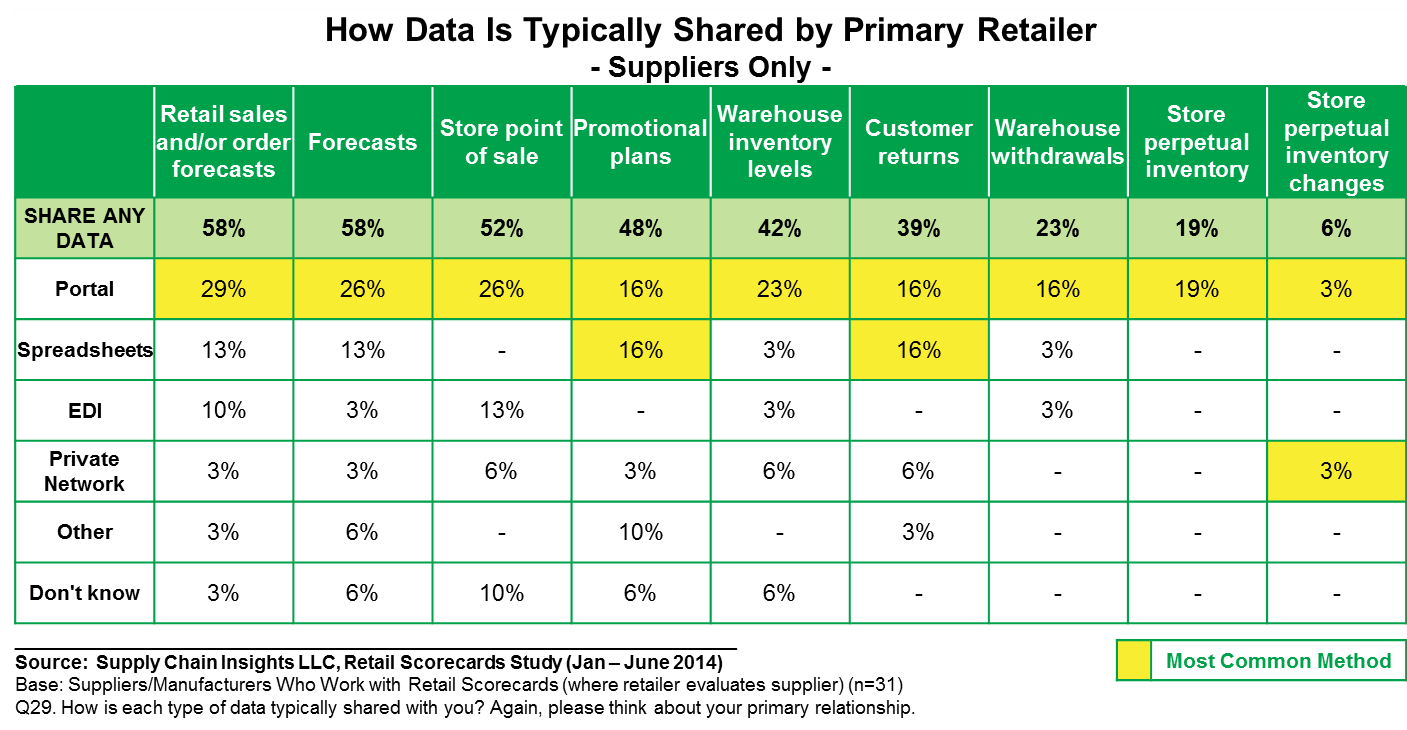
Scorecards:  This effort failed to reach potential due to a lack of standardization and connection of the output back to buying behavior.  E.g. Over 95% of companies do not align scorecards with commercial buying processes.  As a result, they are there (often there are many), and they are they are talked about; but they fall short in driving TRUE collaborative behavior.

Collaborative Design: Collaborative design efforts have been the most successful tactic for collaborative SCM, but there have not be escalated to strategic importance. They are growing in importance in companies green initiatives and micro-marketing efforts for packaging design; but most companies do not know how to break down the walls between R&D and supply chain to make collaborative design systems work for them more holistically.
VMI/SMI: Vendor managed and supplier managed inventory programs have also had limited success. Why? For 80% of companies the focus was on SHIFTING inventory responsibility as opposed to improving value in the value chain.  Companies that have gone the extra mile to focus on reducing demand latency and downstream data sharing have achieved the greatest advantage.

An additional problem has been the labor required to support VMI initiatives and the sequence of VMI orders in the order stream.  A little known fact is that VMI orders while usually the most strategic, get a lower priority on tight inventory.  Why?  Due to the amount of time to calculate replenishment constraints, they are usually processed as the last orders in the day letting orders processed earlier in the day drain tight inventory requirements.

Kaizen Events:  Kaizen events where two parties are focused on improving the value chain through lean methods can be effective if both parties are aligned against the same goals, but if they are not, it is merely another program.  While, I am a big supporter of this type of initiative, it requires a focused team and aligned objectives which are usually tough obstacles to conquer.

Building True Collaborative Practices

So, what does it take to have true collaboration?  The key is to broaden the knot in your bowtime, align goals and develop deep cross-organizational relationships. While traditional approaches have focused on data sharing or transactional efficiency, the use collaborative technologies allow you to connect people to people across the value chain to build more long-lasting relationships. Consider three tactics:

If you are a Buyer.  Put your Money where your Mouth is:  If you are a buyer, tie scorecards to buying decisions through multi-variant bid techniques from companies like Ariba, Emptoris, Oracle and SAP.  Reward suppliers for supply chain excellence, contribution to open innovation and cash-to-cash improvements.  Tie scorecards to real money and review them monthly. 

If you are a Seller.  Teach Sales how to Pitch a Winning Menu:  While most incentives for sellers are volume based, work with sales to build a menu of options that can reduce costs and improve the trading relationships. Experience shows that this is not the place for dictating policy.  It is impossible to implement standardized practices that can be adopted equally by all trading partners. Instead, focus on a menu program where you incent the partner for buying like option A, option B, option C and then reward the trading partner for taking these options through the use of buying incentives.  Include tangible items like shipping programs (backhauls, continuous moves, private fleet utilization, etc) to reduce costs and improve carbon footprint, use of standards, taking new products, quick unloading of shipments, payment schedules, and sharing of downstream data.

Broaden your Bowtie:  Conceptually this concept has been around for along time, but it has been difficult to execute.  Just too time consuming to connect trading partner warehouse managers, traffic managers, customer service personnel, etc.  Not any more. Use social technologies like Lithium and Jive as a core on partner extranets to connect people to people.  Complete with pictures, interests, microblogging, instant messaging, and fan pages.  Who says that supply chain cannot be more social?

One of the most successful collaborative efforts that I ever accomplished was when I was a warehouse manager.  I started a customer advocacy program where each lift operator owned a client.  The energy of having direct customer/supplier contact to clarify shipping issues that transcended orders was an unmeasurable, and wonderful benefit.  I close my eyes and imagine how much easier my life as a customer service manager, warehouse manager or transportation manager would have been if I could have broadened the knot on my bowtie.  Then I laugh….  I am imagining the discussions with the union steward to prep for the training and helping the organization to become an open organization. It makes me ponder.  While we have technologies, can we ever break the barriers to truly build collaborative relationships and broaden the knot on our bow ties to build long-lasting supply chain relationships:  people to people?

What do you think?  Any tips to share on how you have broadened your bowtie? 

This week I am off to help a client with Sales and Operations Planning.  You will find me blogging on Delta go-go at the end of the week.  Look for my insights.

I am also close to publishing two reports:  Overview of Sales and Operations Planning Technologies and the Rise of Social Commerce.  <I do the most writing on the plane.>