Lora's Latest Post

Why Organizational Alignment is Critical to the Supply Chain Response

Typing away on a beautiful May morning, with the flowers blooming and the birds nesting in the garden, engages my mind. Mondays are my day to post my Shaman blog and compose a podcast. The Shaman blog is now over eleven years old.

I remember my first post like it was yesterday. New then to WordPress, it took me a week to finish the post. (It was a struggle!) Now the writing follows the research. I mix the quantitative research with my observations and interviews, and the posts seem to roll from my fingers. I appreciate you as a reader and enjoy your comments. Over 28,000 readers read this blog. I give thanks.

My goal is for me to give to you and for you to give to the community. Let me explain, if you fill out one of my surveys on LinkedIn, I share the research results in front of the paywall (I believe that supply chain research should be readily available and not locked behind a paywall.) (If you would like to participate in a current research study, we would love your help and participation in the contract manufacturing study. We are trying to assess the value of a network in managing contract manufacturing.) When I use the research, I keep the information on the respondent–name, company, title, and individual comments–confidential. I only share the results in aggregate.

A Closer Look at Organizational Alignment

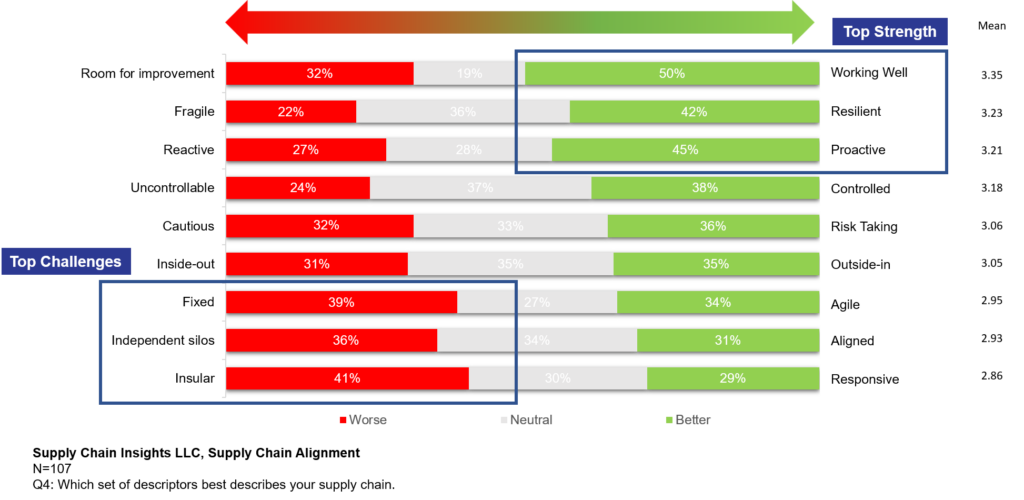
In a recent survey on organizational alignment, I asked the respondents to rate their supply chain based on counter-opposing adjectives. Note that the respondents in Figure 1, 50% see their supply chain as working well, 42% view it as resilient, and 45% see it as proactive, but only 31% feel that their supply chain is aligned. Most see their supply chain as fixed and insular.

Figure 1. Use of Supply Chain Descriptors
Most organizations are locked into functional silos driven by functional metrics. Stuck in a rut, supply chain leaders try to punch their way through a set of conflicting metrics and priorities each day. Functional excellence throws the supply chain out of balance decreasing results on a balanced scorecard of growth, margin, inventory turns, customer service and ROIC (Return on Invested Capital).

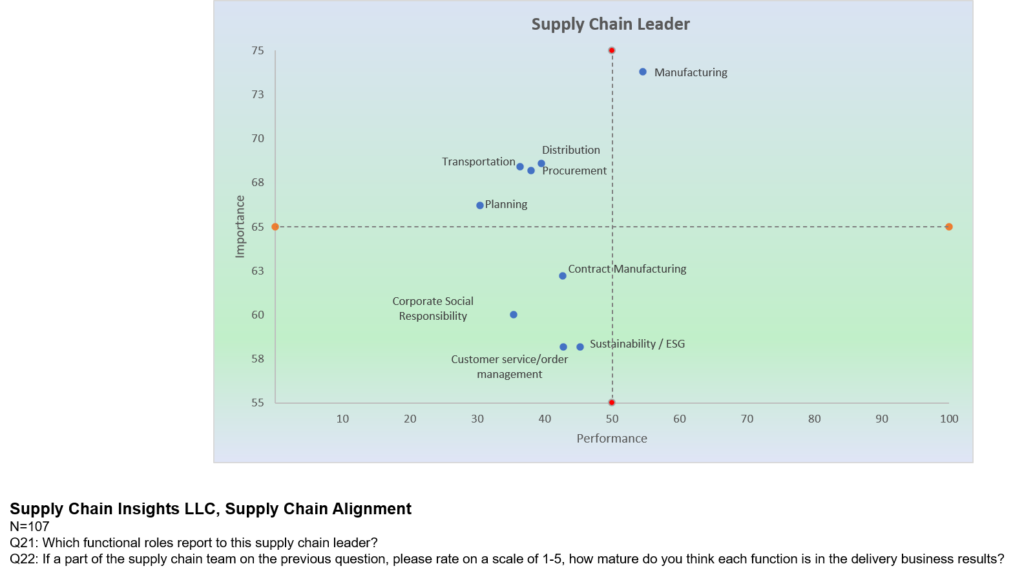
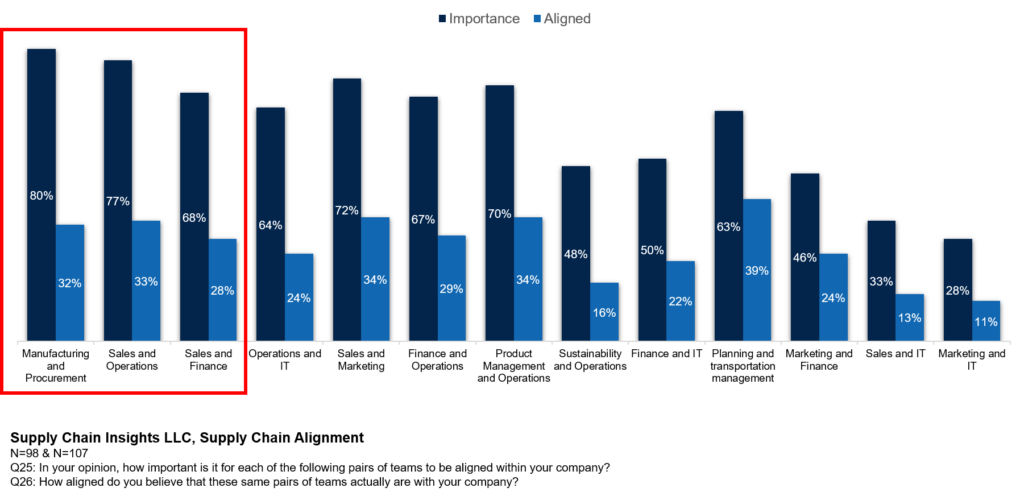
One of the alignment gaps that is growing and is unfortunate is the gap between procurement and manufacturing. This gap of 48% between manufacturing and procurement is the highest seen in studies across the decade. The metrics defining success in manufacturing and procurement do not align.

Figure 2. Current Organizational Alignment
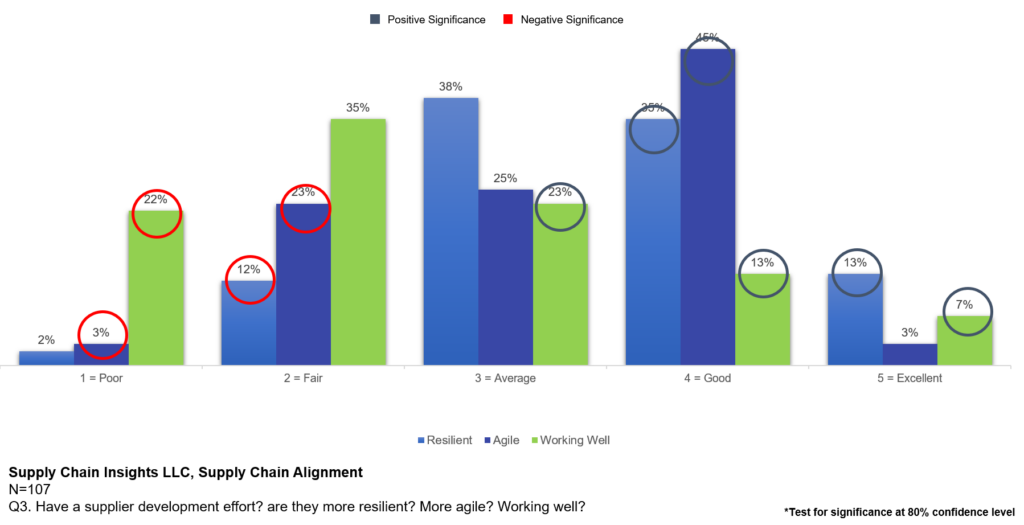
Let’s take the example of supplier development. I feel that supplier development– the practice of an organization to work with the supplier base to help drive improvements– is as important as an effective Sales and Operations Planning (S&OP) process. In the research, an effective supplier development program significantly improved resilience and agility. 56% of the respondents reported an active supplier development program.

Figure 3. Impact of Supplier Development Programs on Organizational Descriptors
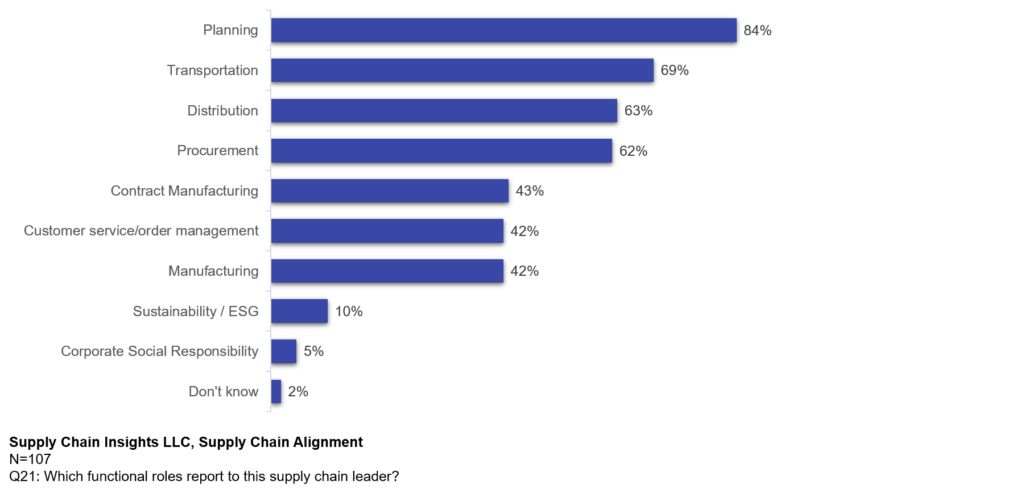
One in two manufacturing organizations report outside the supply chain leader: supply chain organizations typically have the functions of planning, transportation, distribution and procurement as direct reports. When manufacturing and procurement report through the same leader, they are better aligned.
Reporting relationships to the supply chain leader typically include distribution and transportation roles and are less likely to include manufacturing. Note that the respondents rate the manufacturing organization as mature but the areas of transportation, distribution, and procurement significantly lower. Sadly, the area of customer service–the lifeblood of the organization–rates the lowest.
So, you might say, so what Lora? I believe that the traditional functional metrics of lowest manufacturing cost and OEE (Overall Equipment Effectiveness) throw the supply chain out of balance. A company cannot perform well if manufacturing is focused on the lowest manufacturing cost, transportation is focused on the lowest transportation cost and procurement is seeking the lowest procurement cost and customer service is an immature capability.

A Need for A Supply Chain Reset

Most groups do not realize that they are out of balance. They operate daily within their ruts, not realizing that their views of excellence sub-optimize performance. Planners and customer service are caught between the alignment cracks trying to improve reliability in a dysfunctional organization.

Reset: An act or instance of setting again. an act or instance of setting, adjusting, or fixing something in a new or different way.

Merriam-Webster

If you have not checked it out, here is my latest report. In this report, I call for a supply chain reset: a need to redefine supply chain thinking. The goal is to improve the resilience of metrics performance in times of high demand and supply variability. For most, this requires the unlearning of traditional supply-centric concepts. The most critical element for organizations that rated themselves as “working well” during the pandemic phases was organizational alignment—hopefully a call to action for all.


Search the Archives
Search
Share this Post
Email
Twitter
LinkedIn
Facebook
Pinterest
WhatsApp
Featured Image
Recent Posts

Is your Supply Chain AI Ready?

A simple quiz to assess an organization’s AI readiness.

The pace of change is fast and furious. Every day, technology advances faster than we can digest. A great challenge to have.

Determining whether a supply chain is “AI-ready” is less about technology and more about the gray matter between the ears of supply chain leaders. Leadership, alignment, and clarity of goals matter.

Too few companies are clear on the definition of supply chain excellence. Measuring and rewarding functional metrics reduces the firm’s value. Putting agentics on top of today’s processes can make bad practices run faster, reducing value.

The toughest job for the supply chain leader is challenging existing supply chain paradigms that were defined by the limitations of decades of supply chain technologies. As the curtain lifts on the potential of new forms of technology, process redefinition is our opportunity, but only if we are clear on what drives value. (Here, I link to the Supply Chains to Admire reports to help you define value. The next report will be published on June 23rd, along with my Dynamic Benchmarking Product, to help you define value in the face of your AI readiness. More information about the launch is at the bottom of this blog.)

Read More »

Case Study: A Scrappy Demand Management Approach

This study of Franklin Sports shines a light on the work that needs to be done at the sales account level to challenge a retail forecast, and also highlights the importance of a new technique for a forecast engine — reinforcement learning.

Artificial intelligence comes in many forms — large language models, generative AI, machine learning, unstructured text mining, deep learning, neural networks, reinforcement learning, agents, and agentics. While the industry is wigging out about agentics, I think reinforcement learning is a great step forward in the journey of Artificial Intelligence.

Read More »

Can We Side-Step the AI Spin Cycle?

When it comes to combining tech, 1+1+1 should equal more than 1. The impact should be exponential. Unfortunately, today, the answer is 0.

What do I mean? Let me explain.

I find that the supply chain technology market moves slowly along traditional technology lines. Conferences are usually focused on the use of technology, not on redefining work. This bothers me. I want it to bother you as well.

Here I share some insights to drive change.

Read More »

Supply Chain Health Check: The Power of an Orbit Chart

An orbit chart is a powerful tool for understanding the “health” of a supply chain and its potential for improvement. The supply chain is a complex, non-linear system with limited trade-offs. The relationship between trade-offs varies by industry, region, and size. The orbit chart is a diagnostic we use in the Supply Chains to Admire work. Here I explain the use case.

Read More »

Are You Writing a Check You Cannot Cash?

Don’t let a well-intending, but ill-informed consultant or technologist set an expectation that you cannot meet. No when wins when there is a check written that cannot be cashed. In this case, the consultant will move to the next account leaving you holding the bag. Fight back with a data-driven argument. Help the organization think about inventory more holistically.

Read More »