When it comes to combining tech, 1+1+1 should equal more than 1. The impact should be exponential. Unfortunately, today, the answer is 0.
What do I mean? Let me explain.
I find that the market moves slowly along traditional technology lines. This bothers me. I want it to bother you as well.
AI Here. AI There. But, no Meaningful AI Anywhere
As I wrap up this spring conference speaking tour, I feel a sense of emptiness. Over the past month, I attended the Kinexions conference hosted by Kinaxis, the P44 Velocity Conference by Project 44, and the Opticon conference by Optilogic. The conferences were very different: each was a good conference in its own right. Each technology company demonstrated tangible improvements in its own product portfolios. Bravo! (Side-step the AI hype shuffle and move forward.)
So, net: net. The conferences were better than most I have attended over the years, and I am a tough critic. Each conference was forward-looking, acknowledging that the current state of technology is insufficient. (But, I hope to never return to Vegas.)

As an attendee, I was struck by the differences in how the term Artificial Intelligence was used, often overused, and also by the lack of clear definitions. Buyer beware. We are in a spin cycle. Technologists, for some reason, hate straight talk. Clear definitions are seldom on the dance card.
Optilogic gets my vote for Fun!, networking, and engagement. P44’s event gets my vote for polish, professionalism, and content. And, Kinaxis gets my vote for grit, determination, and tenacity. (Can you believe that a company that turned over most of its executive committee has continued to drive forward motion in the way that they have?) The new Kinaxis is just starting. I find that exciting.
My concern is that each conference focused on redefining the host’s solutions through an AI vision, but no company detailed a roadmap to drive interoperability between solutions and unleash unparalleled value. Or a vision on how to redefine work. The discussions were largely tech for tech’s sake. So, I ask: did the companies meet the market’s needs? I think not. If I were a client attending all three events and asked how to build a technology solution that would redefine work processes by using all three together, I would scratch my head. It would not be obvious.
I was also struck by the fact that no company focused on redefining work. The largest constraint in driving value through new technology is the gray matter between the ears of the supply chain professional. It is not the tech. We need to challenge existing paradigms. We don’t need faster horses. The opportunity is to help companies be more proactive, make better decisions, and improve value-based outcomes. This is not easy, and we are just beginning.
Steps to Take:
On many of my calls, clients ask me how to integrate supply chain planning and network design. My answer to him is, “With all due respect, please recognize that you are asking the wrong question.” The goal should not be integration. Instead, the focus should be on interoperability and improving work.
Integration Versus Interoperability. To understand my answer, let’s start with some definitions. While integration creates one-to-one data exchange through APIs, interoperability enables scalable collaboration across multiple organizations and technologies. One of the advantages of machine learning is data cleansing; one of the great benefits of agentics is workflow automation. The creation of a semantic reconciliation layer and rule-based ontological frameworks improves interoperability.
Interoperability requires synchronization and data harmonization. Think of integration as the plumbing, and synchronization as the flow of consistent information through it. Harmonization is the process of standardizing, reconciling, and aligning data from different sources so that it has a common meaning, structure, and format across an organization or ecosystem. I call this semantic reconciliation. I am firmly convinced that our AI journey needs to start with redefining our relationship with data. Instead of complaining about data quality, we need to focus on driving interoperability through a planning master data layer fueled by semantic reconciliation. I give Kinaxis kudos for starting us on this needed journey. While there is much, much more work to do, at least Kinaxis is starting.
When the client asks me about redefining work using AI, my answer, based on attending these three conferences, would be:
- Redefine the Use of Network Design Technologies. The network design analyst usually sits at a low level in the organization, focusing on projects that drive functional outcomes, such as logistics or distribution. You might also find them doing projects in the Supply Chain Center of Excellence. My advice? Redefine the role. Push to use the network design technologies systemically; analyze the trade-offs of make, source, and deliver at the same cadence as your S&OP process. Don’t waste your time on periodic ad-hoc functional projects.
- Build A Plan of Plans. Pair the network design analyst with the financial strategic planner in the finance organization, and embrace the concept of the plan of plans. Produce multiple plans in the strategic time horizon (maybe 20-40) and present these at the S&OP meetings. Consume the network design plans into the tactical planning horizon using tools like Kinaxis, and reduce the plans to the most probable (maybe 4-5 plans). In the S&OP execution environment, consume plans informed by market drivers and narrow the options for the executional role. Use the probabilities and ranges from the plans in the tactical horizon to drive aggregate buying plans and design network strategies. Pull the levers on contracts and Purchase Orders as the market becomes clearer across time horizons. Net/net: Don’t consume data. Instead, consume plans enabling a planning environment where the plans can learn from each other.
- Shift Planning Responsibilities to Line-of-Business Leaders. I was proud of the Optilogic team for building a digital assistant using their AI agent, Ada. (A platform named after Ada Lovelace, who is widely regarded as the world’s first computer programmer. Lovelace recognized the broader potential of computing long before modern computers existed, as Don Hicks, the Founder, states that Optilogic’s vision was to combine human expertise and advanced computing to solve complex supply chain problems.) The use of the digital assistant allows business leaders to run what-if analysis on their phones to understand outcomes. Sounds nice, right? The problem is that organizations are not aligned on the definition of supply chain excellence. For example, today, a decision made by a logistics leader to reduce costs could massively affect customer service. I was impressed by Ada and encourage you to ask the Optilogic team for a demo.
- Train Your Organization on the Importance of Lead Time. The importance of lead time permeates supply chain planning decisions—affecting replenishment lead time for Vendor Managed Inventory (VMI), Just-in-Time (JIT), and Distribution Planning (DRP), promise dates for ATP, the determination of safety stock requirements, and raw material buying decisions for procurement. Many companies have invested in visibility solutions for transportation/logistics primarily to predict on-time delivery, but the data is not widely used to inform decisions. Instead, in most organizations, lead time is treated as a constant—a set-and-forget element—in supply chain planning. If I attended all three conferences, I would have a laser focus on bringing signals from companies like FourKites and P44 into a planning master data layer, as Razat Guarav, CEO of Kinaxis, describes in his opening presentation. Embrace lead time as a variable and educate the team on how the shifts in lead time change safety stock values, purchase plans, and go-to-market planning with customers. Shift the paradigm from a static, set-it-and-forget-it approach to a dynamic, proactive planning approach to help the organization move forward.
- Clearly Define Value. Build a balanced scorecard and a clear definition of supply chain excellence, and pair a network design analyst with a partner in finance to drive strategy. This is very different from the current organizational design in many organizations, where the network design analyst performs ad hoc assessments in response to functional requests.
I hope this helps you to get from 1+1+1 to equal unparalleled outcomes. Please do not AI-stupid by sprinkling AI all over existing planning taxonomies. Instead, lift the discussion to embrace the power of the technology evolution. In the process, side-step the spin cycle. The goal is not faster decisions; instead, it is about driving better outcomes.
Launch of Dynamic Benchmarking
So, in closing, I want to share some big news.
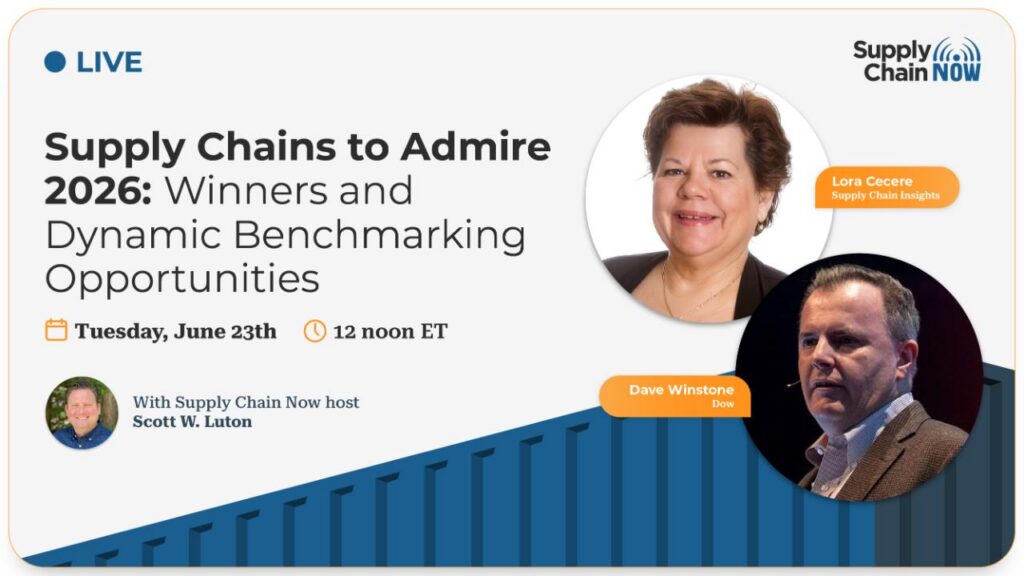
I have worked for fifteen years on the Supply Chains to Admire methodology. The benchmarking is independent and trusted: it is not a beauty contest of underperformers. The 2026 report will be published on June 23rd. The report takes three months to build. We have done this for fourteen years. It is my annual gift to the supply chain community.
In 2024, the methodology was validated through two years of work with a Georgia Tech IYSE team led by Dave Goldsman. This month, I am proud to share the methodology with #supplychainleaders everywhere by launching the Dynamic Benchmarking solution through my LLM Ask Lora.
What is Dynamic Benchmarking? Wael ABDELMALEK and the Uthereal team have built agentics on top of my LLM, drawing on my decade of research, to help you understand the gap between your current state and that of a Supply Chains to Admire Award Winner in 8-10 minutes. Start by answering 20 questions and receive a detailed plan of action that adapts to the market. Financial and maturity benchmarking for all based on Y-Chart data. Over time, the model learns to give greater insights.
Watch for the announcement, and join the launch podcasts. Then get your own orbit charts, and build your own river of demand to help your team gain insights into possibilities, while benchmarking to top performers defined by the Supply Chains to Admire. For kicks, grins, and giggles, you can also compare your performance to the Gartner Top 25 Performers. 🙂 Gotta love it!
As we wrap up two rounds of testing, I give thanks to the people in my network who have made this possible. The testers are currently going through their second wave of testing before release. I give thanks to Alex Pradhan, Bram Dresmet, Christine Barnhart, Christian Kroschl (and the E&Y team), Dave Winstone, Laura Koxholt, Lukasz Zieba, Margo Cohen, Mathew Spooner, Nicole Miara, and Peter Bolstorff for their help and for giving us the gift of time through the testing process. I don’t think that I could have had a deeper and more diverse group to push us over the finish line. #proud, #thankful
Thank-you Scott for hosting us on your Supply Chain Now podcast.