The pace of change is fast and furious. Every day, technology advances faster than we can digest. A great challenge to have.
Determining whether a supply chain is “AI-ready” is less about technology and more about the gray matter between the ears of supply chain leaders. Leadership, alignment, and clarity of goals matter.
Too few companies are clear on the definition of supply chain excellence. Measuring and rewarding functional metrics reduces the firm’s value. Putting agentics on top of today’s processes can make bad practices run faster, reducing value.
The toughest job for the supply chain leader is challenging existing supply chain paradigms that were defined by the limitations of decades of supply chain technologies. As the curtain lifts on the potential of new forms of technology, process redefinition is our opportunity, but only if we are clear on what drives value. (Here, I link to the Supply Chains to Admire reports to help you define value. The next report will be published on June 23rd, along with my Dynamic Benchmarking Product, to help you define value in the face of your AI readiness. More information about the launch is at the bottom of this blog.)
What is Artificial Intelligence?
Artificial intelligence comes in many forms — large language models, generative AI, machine learning, unstructured text mining, deep learning, neural networks, reinforcement learning, agents, and agentics. While the industry is wigging out about agentics, I believe that companies need to start the journey by redefining their relationship with data — embracing and loving semantics and different data types. When you realize the potential of redefining your relationship with data, it is freeing.We no longer need data lakes or the goal of clean, pristine data.
There are many “experts.” I deliberately put the term expert in quotes. Most are technologists or consultants. Building the tech is easy. Driving value requires a redefinition of how we work.
A Framework to Drive Your Journey
Here, I share a framework to help you understand your AI readiness to unleash improvements in your supply chain.
Knowledge. Artificial intelligence comes in many forms — large language models, generative AI, machine learning, unstructured text mining, deep learning, neural networks, reinforcement learning, agents, and agentics. The first step for your team is education. Training is essential to driving outcomes. The second is clarity of definitions. When your organization speaks about the power of AI, is the discussion clear? Are they aligned on the technique to be deployed and the desired outcome? Is there a clear link to value?
In the process, sidestep vague discussions and ensure clarity. The more mature your company is in critical thinking, systems thinking, and design thinking, the faster the progress. If your organization is mired in politics and chasing shiny objects, sound the alarm: you are not AI-ready.
A second pitfall is when teams get caught in a hype cycle — failing to define terms and outcomes — falling prey to buzzword bingo. Alas, pretty words and pictures do not drive successful projects. Chasing shiny objects is a recipe for failure. Clarity on business objectives, definitions, and outcomes is essential.
The most successful teams are driven by a clear goal and fueled by a curious, diverse team. The greatest challenge for the supply chain team is to challenge traditional paradigms embedded in the gray matter between supply chain professionals’ ears.
Successful projects avoid vague terms such as control tower, digital twin, continuous planning, and real-time decision-making. Instead, step back and ask yourself, “What is a good decision? How do I know if the technology is recommending a good and feasible plan? Who should make a decision? What is the right cadence of a decision? How do I drive learning to improve the next decision?” These answers are not easy.
Curiosity and Innovation Culture. If your company is an early adopter, there is a higher likelihood of success. If the company is a late adopter, mired in technologies that do not work, and is primarily using spreadsheets to make decisions, sound the alarm. You are not AI ready. If this is you, focus on why the organization is dependent on spreadsheets and fix the issues before moving forward.
The pace of technological change in our personal lives, driven by digital transformation and artificial intelligence, is fast and furious. As hard as business leaders try, this shift cannot be duplicated in enterprise applications. The gaps are growing. The issue? Foundational supply chain architectures are a barrier to redefining work to unleash new levels of value. Just like a house cannot be built on a bad foundation, our current definitions of planning and execution architectures need to change to take advantage of new capabilities.
Organizational Capabilities. Organizations with a high level of readiness can easily access and trust data within enterprise systems. The organizations are aligned to drive outcomes. Few are.
In planning systems, there is clear governance over which decisions need to be made and who should make them. Companies are also clear on what makes a good decision.
When AI initiatives are reported by business leaders with a focus on clear outcomes, there is a higher chance of success. Diverse teams with business leaders, IT teams, data scientists, and finance representatives are more likely to succeed.
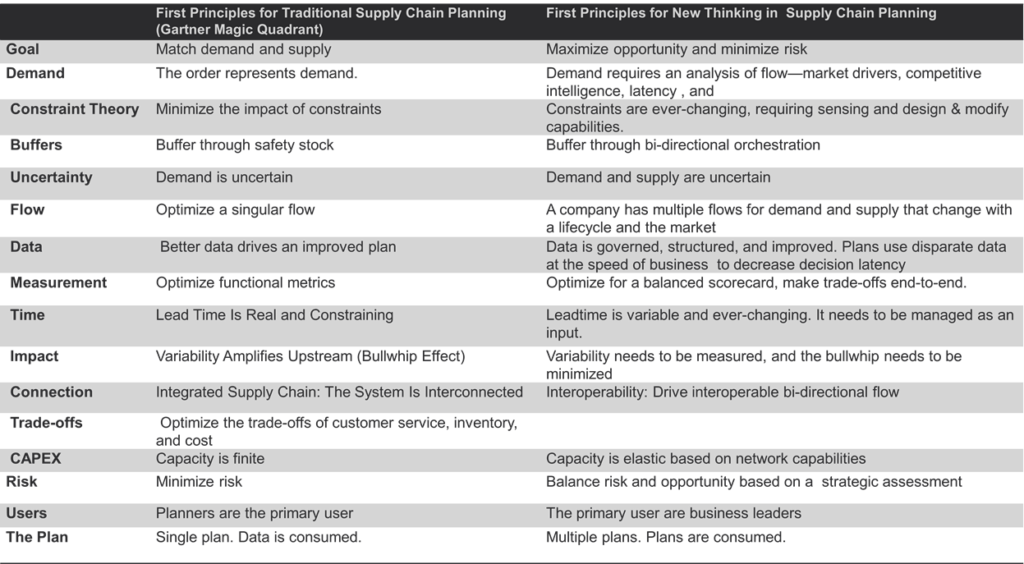
There needs to be a focus on learning while accepting that failure is sometimes the best teacher. A fail-forward mentality penetrates the winning team. The team is naturally curious with a focus on first-principle thinking. Here I share a chart of first principles that I drafted over coffee a couple of months ago. Use it as a starting point.
Process Readiness. A successful team starts with a clear charter focused on process innovation success. The greatest benefit happens when the funding is not based on a fixed Return-on-Investment mentality. Instead, the funding is seen as an investment in innovation. Progression from concept through testing to adoption occurs through a stage-gate approval process.
Build an innovation fund and a governance board for teams to create and redefine process capabilities with AI. Use the packaged technologies on the market and test and learn. Side-step custom code.
Artificial Intelligence performs best when processes are defined and repeatable. Focus on building a solution against a goal, and ensure repeatability to improve outcomes. Define success before you start, and align outcomes with a balanced scorecard.
Technology. A winning team knows the difference between integration and interoperability, and understands the value of synchronization and harmonization. Knowing that data will never be perfect, the group focuses on defining a semantic layer for demand and supply translation to minimize the bullwhip effect. Most companies discover their biggest AI challenge is not model development but connecting fragmented systems.
The teams work to gain benefits from technology partner advancements, but never hold themselves to fixed IT standards. Instead, the focus is on delivering business results.
Network and Supplier Relationships. AI requires visibility beyond the four walls of the enterprise. Has the winning company built robust bidirectional canonicals with major suppliers? How good is your forecast for suppliers? (Measure it using FVA analysis.) They use supplier development programs for supplier onboarding and network design/usage.
After you do this assessment, take the quiz.
First question. Are you clear on what defines supply chain excellence? If the answer is no, stop and define it before taking the quiz. After a clear definition, as a team using the criteria above, rate your readiness.
Rate each category from 1 (just starting) to five (perfect)
| Area | Score |
| Knowledge | 1-5 |
| Curiosity and Innovation | 1-5 |
| Organizational Capabilities | 1-5 |
| Process Readiness | 1-5 |
| Technology Acumen | 1-5 |
| Network and Supplier Relationships | 1-5 |
If your score is low (6-10), focus on knowledge and cultural elements. Educate the leadership team on their role in driving success.
If you have a mid-level score of 15-20, start your journey by forming the cross-functional team and a governance board with stage gates and learning. Train the organization to fail forward.
If your score is above 20, form teams to focus and co-develop with existing technologists. Focus a few projects driven by business outcomes.
Remember that no one knows the future. The potential of technology to improve supply chain processes is evolving before us. Stay centered in the core principles of driving value, building teams, and questioning the status quo.
Launch of Dynamic Benchmarking
So, in closing, I want to share some big news.
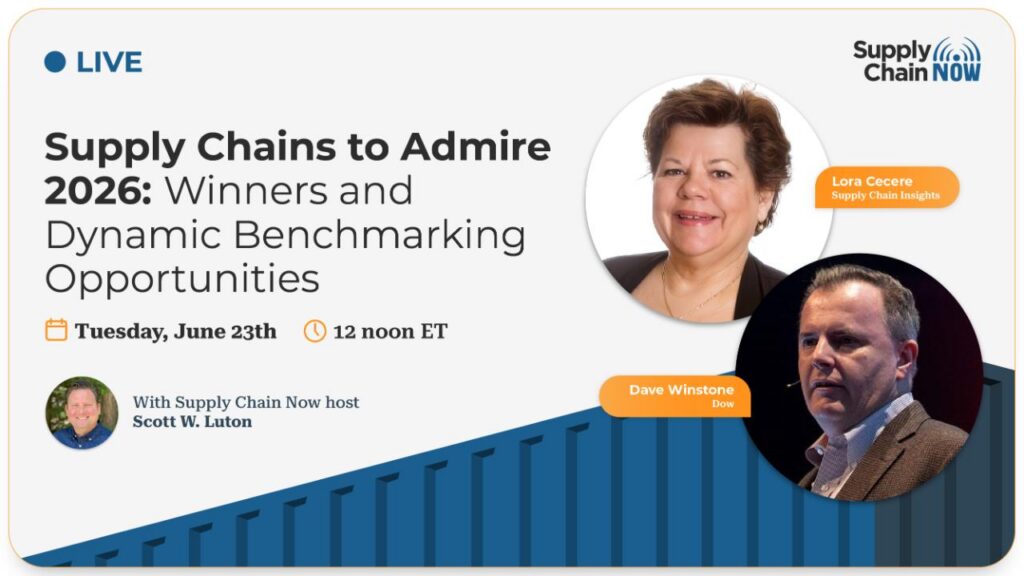
I have worked for fifteen years on the Supply Chains to Admire methodology. The benchmarking is independent and trusted: it is not a beauty contest of underperformers. The 2026 report will be published on June 23rd. The report takes three months to build. We have done this for fourteen years. It is my annual gift to the supply chain community.
In 2024, the methodology was validated through two years of work with a Georgia Tech IYSE team led by Dave Goldsman. This month, I am proud to share the methodology with #supplychainleaders everywhere by launching the Dynamic Benchmarking solution through my LLM Ask Lora.
What is Dynamic Benchmarking? Using my Supply Chains to Admire research, I worked with the Uthereal team to put agentics on top of my LLM, drawing on my decade of research, to help you understand the gap between your current state and that of a Supply Chains to Admire Award Winner in 8-10 minutes. Companies start by answering 20 questions and receive a detailed plan of action that adapts to the market—financial and maturity benchmarking for all based on Y-Chart data. Over time, the model learns to give greater insights. The model even assesses your AI readiness to your peer group.
Watch for the announcement, and join the launch podcasts. Then get your own orbit charts, and build your own river of demand to help your team gain insights into possibilities, while benchmarking to top performers defined by the Supply Chains to Admire. For kicks, grins, and giggles, you can also compare your performance to the Gartner Top 25 Performers.  Gotta love it!
As we wrap up two rounds of testing, I give thanks to the people in my network who have made this possible. The testers are currently going through their second wave of testing before release. I give thanks to Alex Pradhan, Bram Dresmet, Christine Barnhart, Christian Kroschl (and the E&Y team), Dave Winstone, Laura Koxholt, Lukasz Zieba, Margo Cohen, Mathew Spooner, Nicole Miara, and Peter Bolstorff for their help and for giving us the gift of time through the testing process. I don’t think that I could have had a deeper and more diverse group to push us over the finish line. #proud, #thankful
Thank-you Scott for hosting us on your Supply Chain Now podcast. I hope to see you there.
Other Articles to Consider
The Courage to Jump – Supply Chain Shaman
Zac, Don’t Waymo My Supply Chain – Supply Chain Shaman
The Courage to Jump – Supply Chain Shaman
The Beat Goes On – Supply Chain ShamanCase Study. Franklin Sports: A Scrappy Demand Management Approach – Supply Chain Shaman