So, it happens. The boardroom conversation that turns into a check you cannot cash.

The narrative goes like this: a strategic consultant with the term supply chain in their title comes into the boardroom, looks at your Company’s balance sheet, and, with a wave of the hand, convinces the Chief Financial Officer (CFO) that a new deployment of a tech solution can radically improve cash-to-cash. The focus is on inventory reduction.
When you are brought into the discussion, the deal is made. You are asked to manage a project that is doomed from the start.
Few companies actually step back to understand the role of inventory in the context of the established strategy or to analyze industry potential. Here, I explain both in case you are the unwilling protagonist in this well-established narrative.
Understanding Industry Potential
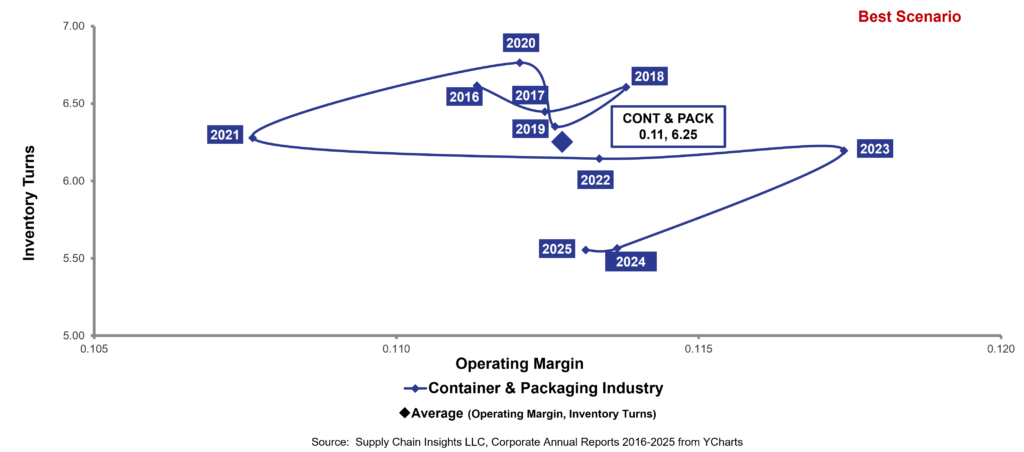
In my last post, I shared that the industry potential for inventory turns in the food industry fell by 30% (after a 28% decline in the prior decade), and in the chemical sector by 20% during the period of 2016-2020 (after a 20% decline in the prior decade). In a similar manner, as shown in Figure 1, the Container and Packaging Inventory Turns Fell 15% over 2016-2025, after a prior decline of 10% over the prior ten-year period. A mistake many organizations make is letting a misinformed consultant set unrealistic goals. My recommendation is to use the Supply Chains to Admire report series to set reasonable recommendations by peer group.
In the upcoming Supply Chains to Admire report, this pattern is omnipresent in the patterns of Aerospace & Defense, Apparel Manufacturing, Automotive, Automotive Aftermarket, B2B Technology, Beverages, Chemicals, Consumer Packaged Goods, Food, Furniture, Medical Devices, Personal Products, Pharmaceuticals, Semiconductors, and Trucks & Heavy Equipment. Only a few retail sectors improved inventory turns.
This contradicts the claims that the investment in supply chain processes and technology radically improves the company’s ability to lower inventory levels. The issue? Industry potential has declined in all industries except Diversified Industries. As a result, history is not a good predictor of the future. In addition, setting targets based on results in another industry is not effective. (For example, Unilever needs a different operating strategy than Dell.)
Figure 1. Orbit Chart for the Container and Packaging Industry for the Period of 2016-2025
Shifts in the Operating Model
The answer to effective inventory management lies at the heart of understanding the changing operating model. What most uneducated consultants see as a process improvement project is actually the redefinition of the role of inventory in an emerging operating model. The paradigm shift is major. Effective inventory management can no longer be seen as an implementation of a better technology engine for safety stock or process improvement from the improvement of demand error.
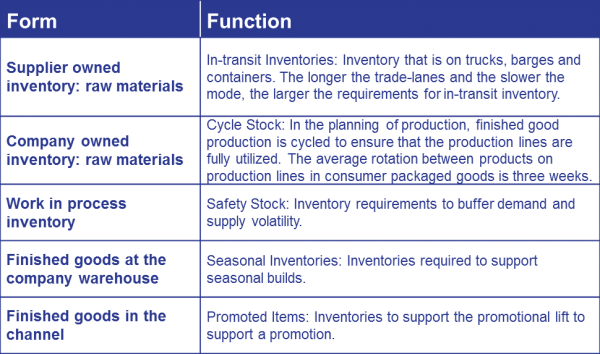
Table 1. Understanding the Form & Function of Inventory
Let’s start with the fundamentals.
Inventory is both the most important buffer and the largest source of waste. The key to driving improvement is to understand the difference between the form & function of inventory by demand stream. The form & function of inventory is explained in Table 1. This analysis is best accomplished through the use of network design technologies like Gains, Lyric or Optilogic.
In contrast, demand Stream Analysis plots forecastability, demand latency (time from channel purchase to order visibility), and volume. The goal is to align each demand stream with the right inventory tactics.
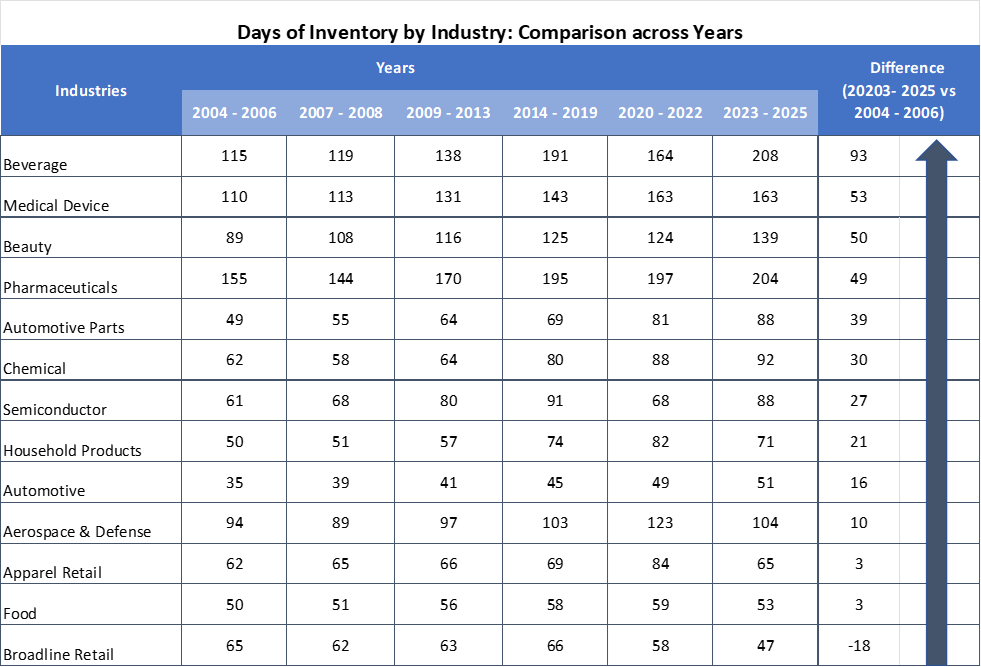
Inventory potential has declined across all industry sectors. Use the data to make a convincing argument. Compare your results to YOUR peer group within an industry sector.
Navigating the Change
To make improvement, do the analysis to understand what is required for form and function of inventory by demand stream and then help the organization understand how choices affect inventory levels. Examples include:
- Growth In-transit Inventory. With more inventory on ships and at ports, in-transit inventories rose. As lead times grew, in-transit inventories ballooned. Yet, the primary focus of most organizations remained on safety stock only. Most companies attempt to improve safety stock the old-fashioned way by reducing demand error or the use of inventory optimization engines. Few focus on understanding the requirements of the shift on the form & function of inventory.
- Unchecked Complexity. The rise in product complexity decreases item forecastability, increasing the need for safety stock, and amplifies the bullwhip effect for raw materials. Complexity management remains an opportunity. Use network design tools to help the organization understand the impact.
- Dependency on Outsourcing. The longer and more unpredictable the lead time, the greater the need for inventory as a buffer. Is low volume, and unpredictable items are outsourced with longer lead times, expect higher inventories and lower customer service levels.
Bottomline
Don’t let a well-intending, but ill-informed consultant or technologist set an expectation that you cannot meet. No when wins when there is a check written that cannot be cashed. In this case, the consultant will move to the next account leaving you holding the bag. Fight back with a data-driven argument. Help the organization think about inventory more holistically.