“The man who moves a mountain begins by carrying away small stones.”
Confucius, born Kong Qiu, the revered Chinese philosopher
This quote isn’t about literal mountains—it’s about tackling challenges. Even the most daunting tasks are achievable when tackled gradually, one small effort at a time, turning patience and persistence into remarkable progress.
In this picture, we depict a forward path surrounded by small stones. Your journey as a supply chain leader is a journey of carrying small stones.

Climbing the Mountain
I am not patient, but I am persistent.
My goal is to help supply chain leaders get unstuck. My observation is that despite technological evolution and the promise of capabilities, we are having the same discussions, not realizing that most of the current dialogue centers on groupthink — focused largely on symptoms rather than fixes. Here, in the words of Confucius, I want us to focus on identifying and carrying small stones.
Let’s start by focusing on the mountain the leaders are trying to climb. Simply put, our systems do not know how to talk to each other. It is hard to put data to work without semantic reconciliation, a common data model, and an ontological framework.
Here are two examples. (I can list many. The current white paper that I am writing is capped at twenty-five, but I will not bore you here.)
DRP and TMS Lack a Common Data Model. Companies want to be customer-centric and share order-reliability data, but the lack of a common data model between Distribution Requirements Planning (DRP) and Transportation Management Solutions (TMS) is a barrier. In DRP, lead time is usually set to a constant value. (Time to travel from point A to point B on a lane or a route.)
In reality, lead time is a constantly changing variable in supply. Actual lead times should feed into Available-to-Promise, inventory safety stock calculations, and deployment logic, but it doesn’t. Transportation data stays in logistics, and shipment data stays in DRP. Moving data from one model to another requires a common data model and a planning master data layer. The two solutions are not aligned at a goal or a first-principle level.
Table 1. Shifts in First-Principle Thinking for Supply Chain Planning
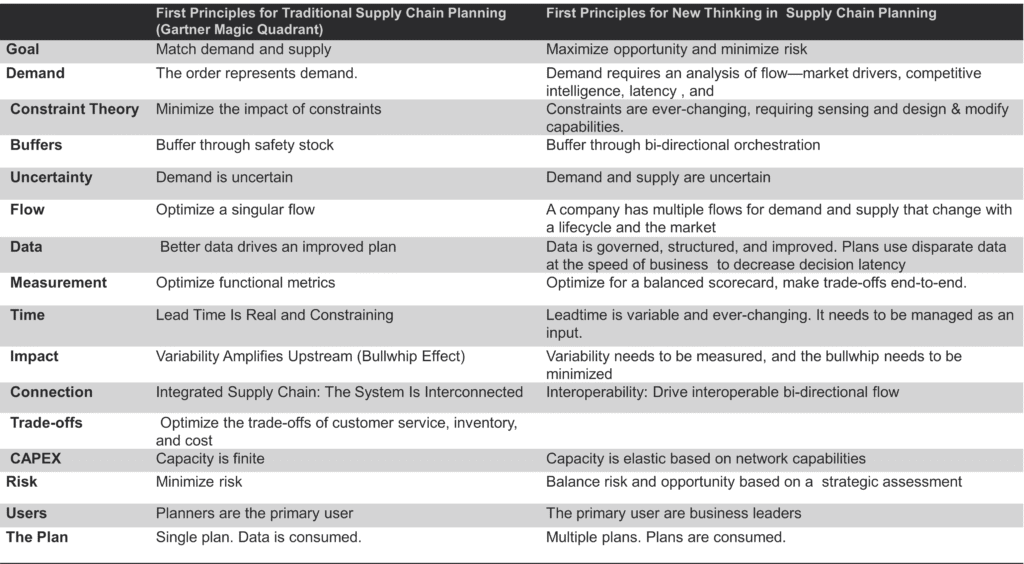
As the global multinational evolved, the first-generation planning solutions focused on demand variability, assuming that supply variability would be low. It is not. The new requirement is to embrace the fact that both demand and supply are variable, and to use machine learning on transportation data to help map supply uncertainty.
–Mapping Ship to and Ship From Information. In mapping demand data, using consumption or point-of-sale data, a successful solution needs to bridge the ship-to information (customer distribution network logic) to the ship-from information (supplier distribution network). The answer lies in ontological modeling to map customer and supplier logic, drive semantic reconciliation of the item number and the definition of the saleable unit (selling unit of measure), understand dependent demand (items within a shipper or a package), and the shipping instructions. CRM data cannot be used in Supply Chain planning without translation.
While many use the terms agents, agentic, and agentics interchangeably. They are not the same. Agents are the actors; agentic acts are autonomous decision-makers; and agentics is the construction of systems with agents governed by system design. A focus on agents without resolving semantic reconciliation is a fool’s play.
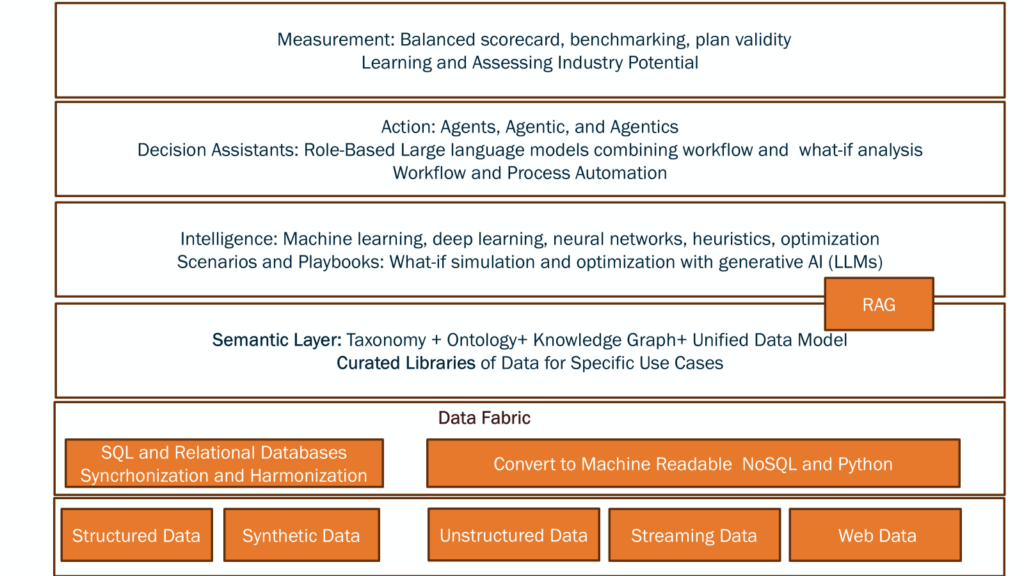
Take a look at the architecture in Figure 1. This type of architecture is required for AI enablement. An investment in agents without semantic reconciliation has limited value.
Figure 1: Architecture for AI Enablement
Moving Mountains
So, if you are a business leader and feeling stuck (as most are in my discussions), side-step the discussion of agents and ask, “Is this a semantic reconciliation opportunity?” Followed by: “How are we aligning architecture requirements with shifts in first principles?”
Lead by asking the organization to build an architecture that enables artificial intelligence. Current architectures are insufficient. Solutions with our favorite acronyms — CRM, APS, ERP —evolved from schema-on-write architectures with a focus on transactional data.
As business requirements have changed, the answer is not integration, but interoperability. AI enablement requires investment in schema-on-read architectures that support the use of unstructured data and new forms of analytics.
As most of you know, I am a supply chain gal. I cut my teeth believing that the answer to supply chain problems lay in better math. At the beginning of my career, this was the promise of Advanced Planning (APS). Life has taught me to think more broadly. Supply chain professionals are laser-focused on better engines, but architectural interoperability remains a barrier for the industry.
So, how to carry your small stones? Educate your teams. Work with data scientists to understand new capabilities. Ask your lawyers to focus on the interoperability of data models in licensing. Build architectures to enable AI capabilities. Don’t fall prey to vendor hype of agents on top of outdated architectures.
Here Me Speak
If you want to know more and gain a greater understanding, I will be speaking at:
Definitions
Agentics. Multiple agents working together through governance and workflow to drive autonomous process automation.
Synthetic Data: Synthetic data attempts to preserve the patterns and relationships of real data without exposing the original data.
Retrieval-Augmented Generation (RAG). A technique used in AI systems to make language models more accurate and up-to-date by retrieving external information before generating an answer.