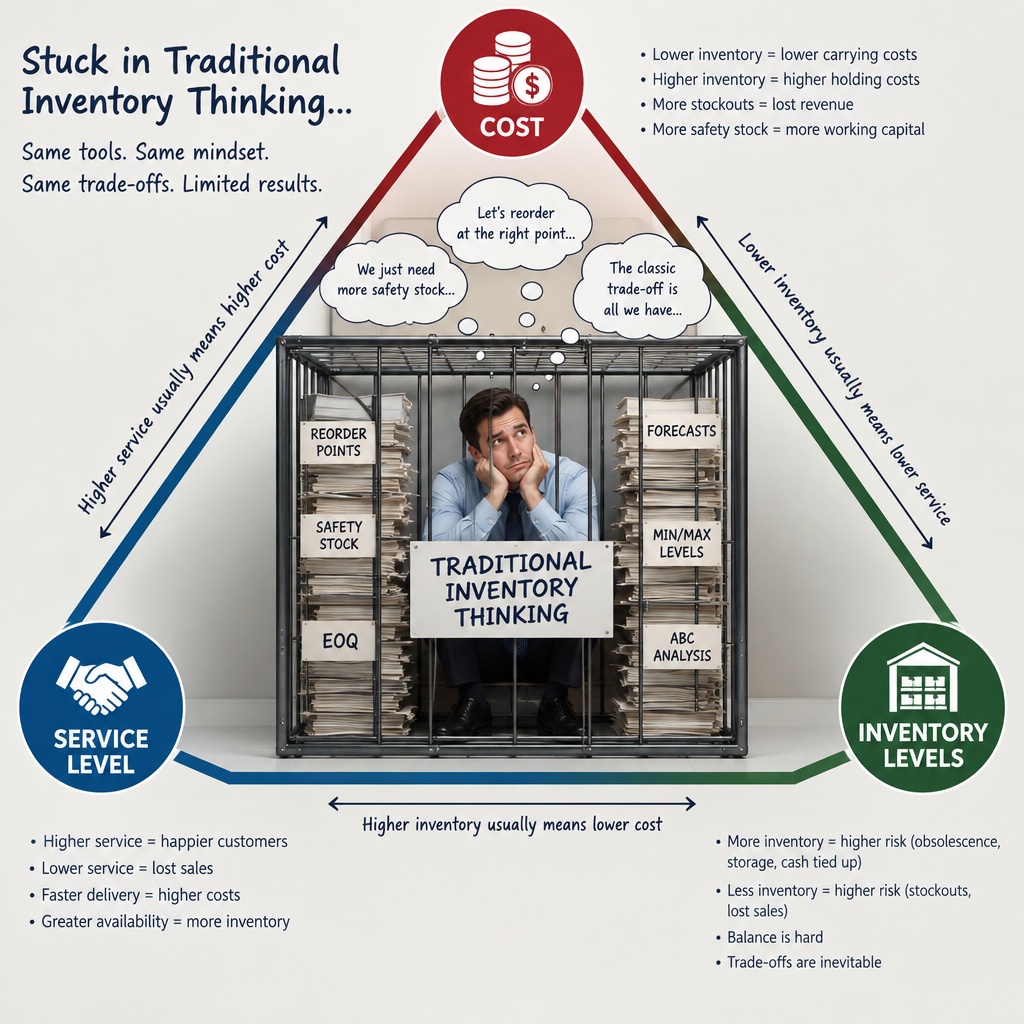

I scratch my head sometimes when I follow the evolution of supply chain planning. Here are five things that I do’t understand:
1. Relationships Should Matter. Processes Should As Well. Yet, Technologists and Implementation Teams Lead with Feature Function. The world I see is technology first and process as an afterthought. I’ve noticed this gap is widening with the AI hype. Disastrous. Right?
When you read that statement, you are probably nodding along, thinking it’s obvious. However, in this super-hyped AI redefinition of supply chain planning, the focus increasingly is tech for tech’s sake. This is unfortunate. We are missing the opportunity to redefine work and drive a step change in supply chain processes that don’t work well in today’s increasingly volatile world.
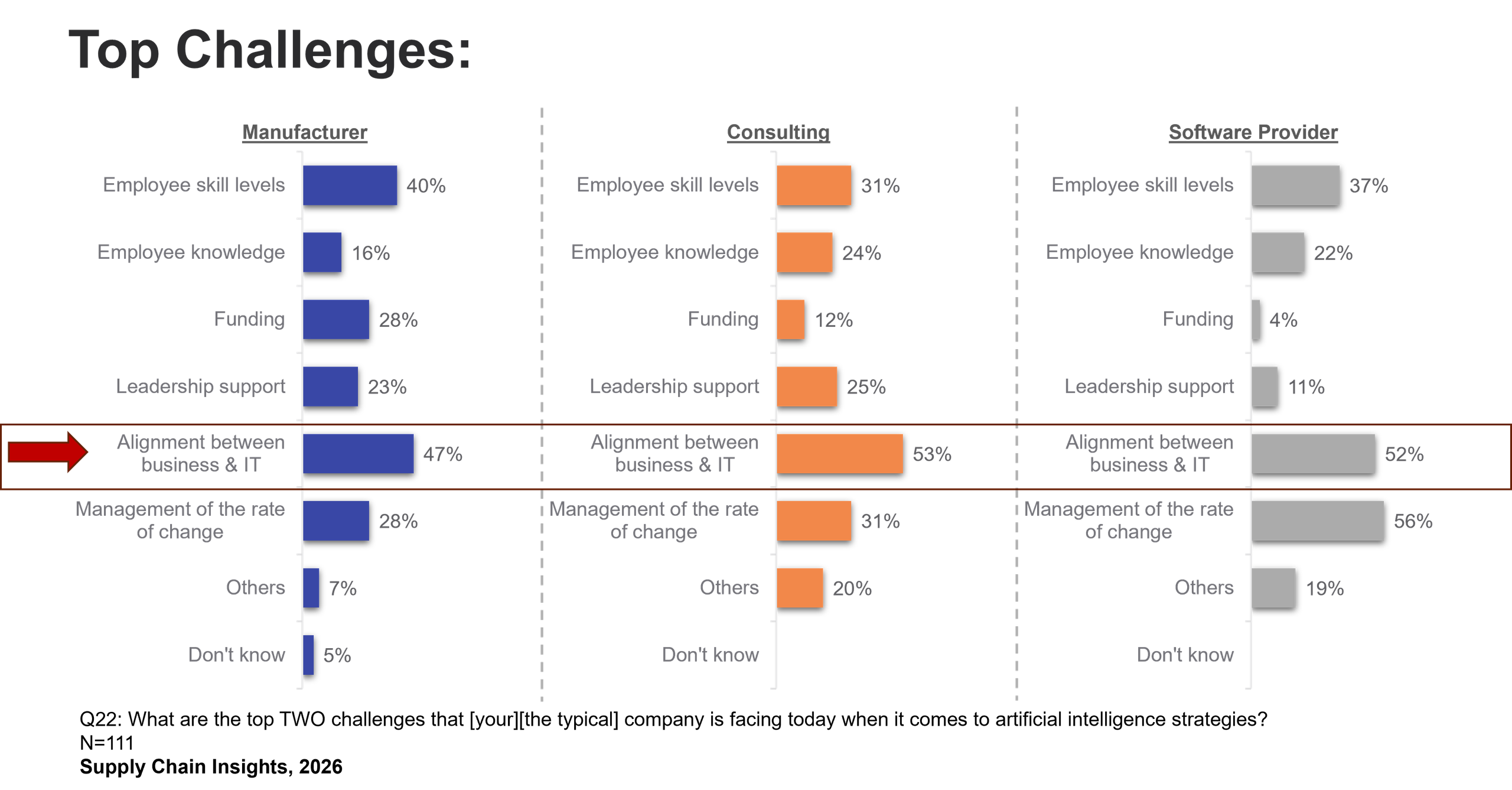
As shown in Figure 1, the gap between business leaders and Information Technology (IT ) leaders is widening. IT is saddled with diminishing budgets, rising software maintenance costs, and a lack of appreciation of the challenge of running the business. (AI increases the need for security and business continuity.)
Business leaders are fascinated by new tech and often lobby for technology choices that aren’t a good fit. Data science teams are wedged between the groups like jelly on bread, arguing, “Why not just write custom code in Python?” I find that few can clearly define the business problem.
To make the point, let me share some context. At the recent CSCMP Edge conference, I spoke to two clients. I think that these are typical scenarios.
One works in IT for a large multinational manufacturer. Her challenge is navigating the contracts and obligations. and interfaces for more than 100 ERP systems — legacy IT architectures largely inherited through M&A. She wants to talk new tech but is mired in day-to-day upkeep. She manages an Oracle environment that is not synchronized at the planning master data layer. (When I speak of planning master data, think lead times, run rates, conversion cycles, etc.) Her focus is getting legacy Demantra (Oracle purchased Demantra in 2006) running. A great engine at the time (but requires a more advanced user to make it successful) for a make-to-stock environment. Someone in the organization decided to purchase Kinaxis (the top contender in the Gartner Magic Quandrant) without considering fit within the IT architecture. The Kinaxis selection, chosen without backcasting testing, requires augmentation.
Consider another case: a client has largely failed with six demand planning solutions. They have decided to roll their own solution and build a custom application to sit on top of their current solution (OMP). Their focus is on error reduction, not accuracy or prediction. The analytics group is enamored with the capabilities of Python and Databricks, but is blind to the issues of system evolution and the risk of building custom applications.
Let’s face it, the out-of-the-box capabilities of the major supply chain planning solutions are largely complementary. They should never be put on a four-box grid for comparison, and teams should test their business scenarios before purchase.
However, in this rush to be “AI Cool,” reason and rationality are often an afterthought.
2. Risk. Why Aren’t We Controlling the Inputs? Managing Risk Holistically? At CSCMP Edge, there were many sessions on risk management, but none mentioned the risk implications of bad inputs into supply chain planning on bullwhip impact. These include negative Forecast Value Added (FVA), lead time (set-it-and-forget-it policies), use of only enterprise data (inside-out processes), or increased demand latency (the time from shelf takeaway to order receipt).
I believe our risk management journey needs to start by redefining our relationship with data—using market data with frequent updates, testing and challenging plan validity, and measuring the bullwhip impact.
I question, “Why do we religiously play the beer game to see the impact of the bullwhip, but yet, in real-life scenarios, it is never measured?” And when it is measured, the AH-HA moment is that today’s conventional supply chain processes make the bullwhip worse, not better. My POV is the need to test and learn to prevent and mitigate the bullwhip. This is where I think risk management should start. However, I never see this in practice.
3. A Forecast is not a Plan. Most of my clients are confused. I see a myopic focus on making the imperfect plan perfect. Teams cheer when a forecast improves by 2% MAPE. (Which, for me, is meaningless. I encourage all my clients to fire the APES — MAPE, WAPE, etc. I like Stefan de Kok’s TPE metric.)
In this work, the astute implementer learns that accuracy and precision are different. Accuracy measures how close a forecast is to actual demand. Precision measures how narrow or consistent the forecast outcomes are. In supply chain planning, the distinction matters. A forecast can be precise but inaccurate—or accurate on average but highly uncertain. The lack of precision (repeatability and explainability) increases risk.
The mature planning processes evaluate a plan’s feasibility and reliability based on a conscious choice of optionality. In this work, business judgment is not a bad thing.
The demand forecast is an input into the plan, not the plan itself. This distinction matters.
4. Need for a Planning Master Data and a System of Record. The average customer has 7-9 planning systems. Each is loaded with assumptions (supply chain master data), but planning assumptions aren’t synchronized across the organization. To synchronize flows, companies need to recognize the need for a planning master data layer and write the plan to a system of record for comparison and future analysis. I am always amazed at how many clients do not store their plans.
5. Root Cause Analysis. Continuous DAG Learning, JEV, and context graphs are steps forward in helping us move beyond predicting what is likely to happen and analyzing root issues. Too few companies are trying to understand how good the prior-period plan was, what would have improved it, and what was lost. One highlight of the o9 AIM10X event for me was their new after-action review capability. This type of analysis is now possible. Companies should push for it.
Summary
I love the pace of technology change. I bask in the glory of new techniques and marvel at the unfolding of solutions we never imagined years ago, but I pause when companies are unwilling or unable to roll up their sleeves and redefine work. Historic practices are not best practices, and there is a wealth of opportunity for those that do.