A forecast is not a plan. A budget is a financial plan, but not an operational plan. A plan is not a decision. The operational forecast is an input to the supply plan. The financial plan is an input to corporate reporting and evaluation. How do we bridge the two? It is not easy, and requires leadership and trust to drive organizational alignment.

Should the budget be tightly connected to the operational plan? How should the organization make decisions? What defines value? In answering these questions, the organization has many choices, all of which must be addressed before tightly integrating the financial budget and the supply plan.
Technology is the easy part. Aligning the organization, designing incentive structures, building trust, and facilitating cross-functional discussions on optionality as market conditions change are the critical factors.
Getting Started
Start by defining the role of the budget. Is it a constraint? Or is it an input into the planning process? And, if so, is the feedback loop between the two plans bi-directional?
Regognize that financial and supply chain plans are both complex non-linear systems with many dependencies. Does the first drive the latter? Or should they mutually inform each other?
Help the organization understand that budget compliance is a different goal than optimizing enterprise value. The biggest factors are changing market potential and impact on product mix. Each has great uncertainty.
In organizations, working together is tough. Navigating the political landscape is tougher than implementing a technology. The languages of the two plans are different: supply chain speaks in volumetric lingo, and finance defines a plan in terms of currency (cost and price). Both teams lack cross-functional understanding.
So, If we improve connectivity between operational and finance teams, does that improve organizational alignment? The answer is maybe.
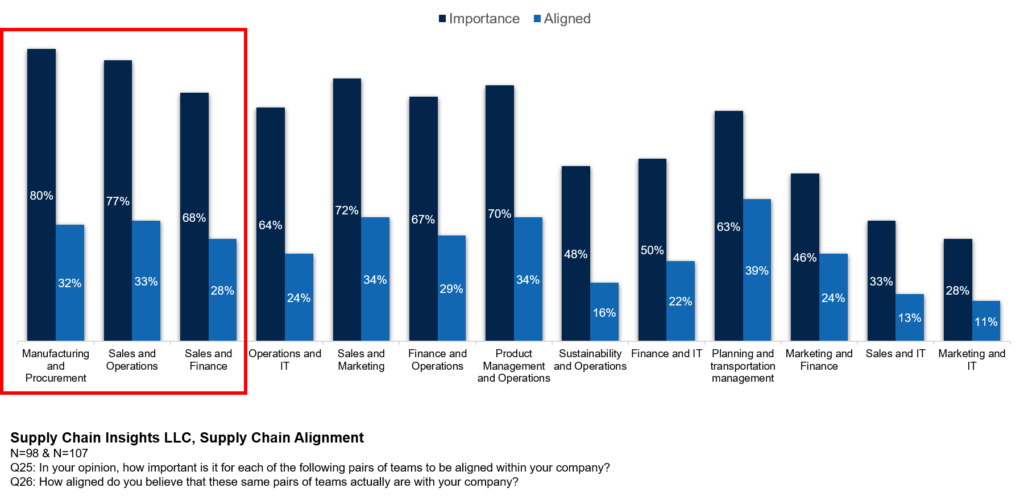
As shown in Figure 1, the alignment gaps between financial and operational leaders loom large. As organizations grew larger in the last two years, the gaps widened. (I have asked this question in surveys for the past fifteen years.)
Figure 1. Organizational Alignment Gaps
If the financial budget is a fixed target and the supply chain is tasked with conformance, the organization is in trouble. The reasons are many:
- Static assumptions: Annual budgets are often based on assumptions that become outdated as markets change.
- Functional optimization: When creating the financial budget, procurement, manufacturing, and logistics optimize their individual budgets rather than total business performance.
- Disconnected planning cycles: Financial planning and operational planning frequently operate on different timelines and with different assumptions.
- Growth. If the goal is growth, constraining operations to the financial plan can hamper growth. The result is a supply chain that is financially constrained rather than financially optimized.
The operational and financial plans should be connected, but not constrained or confused. That is why I recommend visualizing the financial plan as an indicator in supply chain planning, not as a constraint. Pushing the constrained supply plan back to finance is critical. But it is fundamental to get clear on the definitions before discussing technology.
Can AI Help?
Yes, using a Large Language Model or a Context Graph can enable cross-functional collaboration to understand the impact of interdependencies. This is easier and less intimidating to finance than a what-if optimization analysis or a digital twin evaluation. (I am less bullish on agents and agentic frameworks.) Using these techniques, teams can ask questions like:
- How is forecastability changing, and what is the impact on cash flow?
- How is lead time changing and what is the impact on cash-to-cash? Inventory?
- What is the impact of product complexity on the plan?
- What was the impact of product mix changes in our last plan on the contribution margin? What patterns do we see in market data that we should anticipate in the next planning cycle?
- What can we learn from our last planning cycle to apply to this new one? Where did our last plan fail?
- What decisions did we make? How effective were they?
- How do we balance operating margin, service, inventory, capital investment, and cash flow?
Case Studies
Yes, AI can help, but the organization needs to build trust, increase data sharing with semantic insights, and align bonus plans to cross-functional goals. Let me share some case studies I have experienced. The names are anonymous.
Company 1. This global food company faced increasing commodity costs for sugar, fats/oils, cocoa beans, nuts, flavors, and packaging materials. They operated thirty-three divisions, and each division’s bonus was based on beating their revenue targets. Based on feedback from a strategic consulting firm, they implemented tight integration of the budget with the supply operating plan. To maximize their bonuses, the divisions deliberately under-forecasted. They were great at sandbagging. The commercial teams ran the divisions and did not want to get penalized for capex spend, and as a result, the organization was running 110% over utilization.
The division president made the decision that each plant would shut down and changeover for inter-plant orders from other divisions. This made the capacity issues worse.
When the teams attempted to get capital to improve the plants, the budgets were shut down because the forecast was low and did not support the CAPEX requests. The North American team spent 21M in deductions to retailers for short shipments, but the 21M was written to the promotion budget and as a result, was not seen as an expense.
Relationships between the divisions and corporate were strained. No region wanted to risk missing its lucrative budgets.
Company 2. The second company operates in the chemical industry. The organization is vertically integrated and operates 21 divisions. The products from the divisions roll up into three main value streams. However, the divisions are rewarded for sales to external customers. As a result, the divisions short their downstream internal divisions and allocate products preferentially to external customers. Because the CEO has a sales/marketing background and does not understand manufacturing constraints, all orders are processed and promised even when asset utilization is high, and the plan is not feasible at the S&OP level.
The divisions do not trust corporate — especially the finance division (seen as big brother) —and, as a result, operate their own set of books. The company has struggled for the last five years to deliver orders as committed, and just laid off 25% of staff.
Company 3. A large strategic consulting company talked a CEO into tightly integrating the budget into planning (See the pattern?). With every S&OP run, the operational teams line up in the parking lot at 5:00 AM to start overriding the S&OP plan to drive growth. The organization operates in silos.
My Perspective
The budget should be an input and reference point for supply chain planning, not the governing constraint that dictates every operational decision. In building the connected plan, implementing technologies is the easy part; aligning functions, building trust, and designing incentives to balance balance sheet performance with operating performance requires recognizing that both finance and supply chain plans are complex, non-linear representations of the organization with multiple interdependencies. This work is not easy.
Yes, AI can help — visualization of what-if scenarios, discrete event simulation, context graphs, and LLMs for ask-and-answer collaboration —but we are a LOOOOOOOOOOOOOOOOOONG way from being able to make something this complex autonomous. Start with answers to the basic definitions and then build an understanding at a leadership level, trust at the divisional level, clear governance across the organization, and analyze plans continually to understand:
- Did we have a good plan? -Did we deviate from plan? And what was the impact?
- What can we learn from the prior plans to improve the next one? How can we use market data to improve decisions and make better decisions at the speed of market shifts?
Please recognize that this is not easy. If you want to know how aligned your organization is with the industry, input your data into the performance models in Asklora.AI and let me know what you find.
As the United States Thanksgiving starts, I give thanks for my readership and all of the supply chain leaders around the world. Thanks!
I hope that this blog gives you something to think about every time a hand-waving consultant or technologist enters the room and espouses building a connected plan between finance and operations teams. It is not easy.