
On November 8th, Bram Desmet, CEO of Solventure and a Professor at Vlerick Business School, posted and posed the question, “Did we Kill Inventory Management through PowerPoint and BI?” He was developing materials for a new class and received feedback from 37 companies. His conclusion was, “We don’t need more education on inventory formulas. We need to get much better at applying them.”
I read the article over and over again. It bothered me.
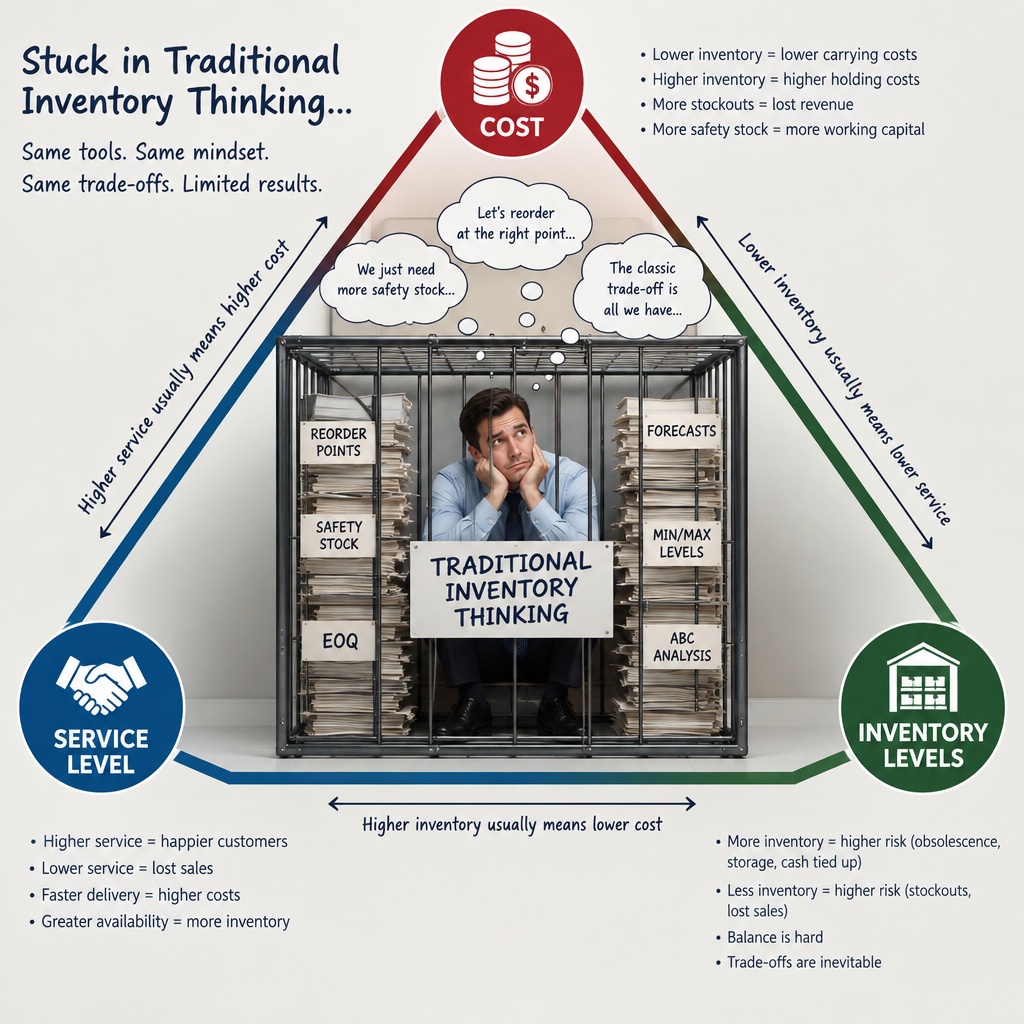
Out of respect for Bram, I did not post in the comments. My answer? We need to free ourselves from traditional supply chain inventory management concepts.
With that said, there are many points in the article that I agree with:
- Bram: We manage shortages. We accumulate excess. My POV: We reward reactive behavior.
- Bram: Have we built equally strong mechanisms for preventing excess? My POV: No, there is too much focus on safety stock and too little on managing the form and function of inventory.
- Bram: Have we built equally strong mechanisms for preventing excess? My POV: No, we have not. This is the focus of this post.
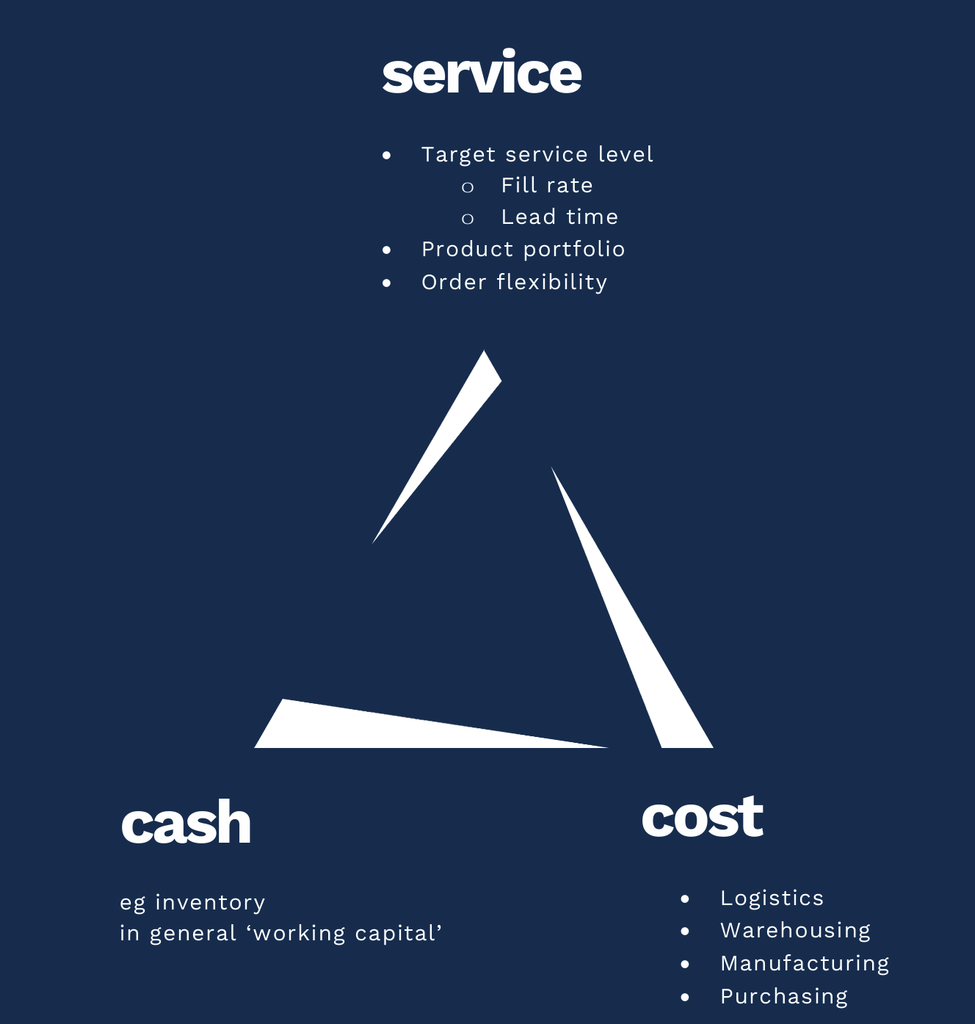
- Bram: Because using the same service level for every customer and every product can never be the optimal solution. If we don’t explicitly design the Service corner of the Supply Chain Triangle, we cannot intelligently manage the consequences for Cost and Cash. My POV. This is where Bram and I disagree most. I do not believe in the simple triangle of cost, customer service, and inventory. The reason? It is too simplistic. This model applies only to make-to-stock industries and to determining safety stock levels, trying to improve customer fill rates.
Figure 1: The Inventory Service Triangle
The article reflects the common industry perspective for managing inventory. When you say inventory management, the traditional supply chain manager immediately thinks safety stock. The knee-jerk reaction is to find a better optimization engine. I say, “WRONG.”
This perspective (typically in a make-to-stock industry) focuses on inventory safety stock management, reorder points, and replenishment. My Point of View (POV) is that traditional thinking is not sufficient. Here, I argue that inventory management needs to be more inclusive and holistic in this changing world.
My Feedback
Bram, you didn’t ask for my opinion, but I am going to provide it anyway to encourage an industry debate.
For context, I like Bram. We collaborated on some research years ago, and I stay in touch. However, my perspective is quite different from his.
To start, if we accept the current supply chain planning taxonomy as a starting point, there are five root issues in the current thinking of inventory management.
- Inventory is More than an Optimization Problem to Be Solved. Current solutions focus on managing inventory as an optimization problem to determine safety stock. This approach has many, many limitations. The applicability stopped when we shifted from regional to multinational to global supply chain definitions. Let’s explore the limitations:
- Safety Stock is only a Fit for Make-to-Stock or Distribution-intensive Companies. As demand variability increases, more and more products are not a good fit for a make-to-stock process workstream. If an item is not forecastable, it should not be kept in the make-to-stock workstream. Few companies measure forecastability and are therefore trying to optimize a process incorrectly. When I test items for forecastability for many of my clients, I find that only 55% are forecastable. Yes, there are workarounds—attribute-based forecasting and demand planning at higher levels of the hierarchy—but this needs to translate into safety stock calculations, which I do not see happening.
- Safety Stock Represents a Smaller and Smaller Percentage of Inventory. When I implemented supply chain planning solutions for consumer goods companies in the 1990s, safety stock represented 40-50% of total inventory. Today, when I teach my outside-in classes and ask students to characterize inventory by form and function, safety stock represents 15-20% of total inventory. The reason? The answer is twofold:
- Manufacturing Cycle Stock Inventories Grew Due to Unabated Complexity. Let’s examine the why. The elongation of the long tail, driven by unabated complexity, increased manufacturing cycle stock (the time and inventory required to cycle through product campaigns).
- In-transit Inventories Increased Due to Outsourcing and Longer Trade Lanes. In-transit inventories (inventory on containers, trucks, and ships) have increased disproportionately due to lead-time variability.
- Data Quality. There are many safety stock equations, but most have the following factors: Lead Time, demand, and supply variability. The experts argue intensely about which equation is right, but my argument is very different. My push is simple: let’s get the data right before we start the solve. Most companies have a demand variability input from demand planning, but lead time is a set-it-and-forget-it factor that is usually very out of touch with market reality. And should it be lead time or lead time variability? My vote is the latter. Very few companies I talk to update lead time or supply variability in their inventory calculations.
- An Optimization Problem? The answer is that managing inventory is much, much more than an optimization problem with a single perfect solution. The reason why? Machine learning predicts what is likely to happen, while optimization determines what should be done. Machine learning and optimization work hand in hand in our new AI applications. Both are needed.
- Inventory Health? The most advanced companies calculate inventory health. Forecast Value Added (FVA) approaches are extended into an Inventory Value Added Analysis (IVA). In my 2025 research, I asked thirty-two companies how they determined inventory health. I only found one company doing this type of analysis. Bram, this is the program that I think you need to teach.
My Answer to Bram
Bram, can we move past the simple triangle of cost, customer service, and inventory, and think bigger?
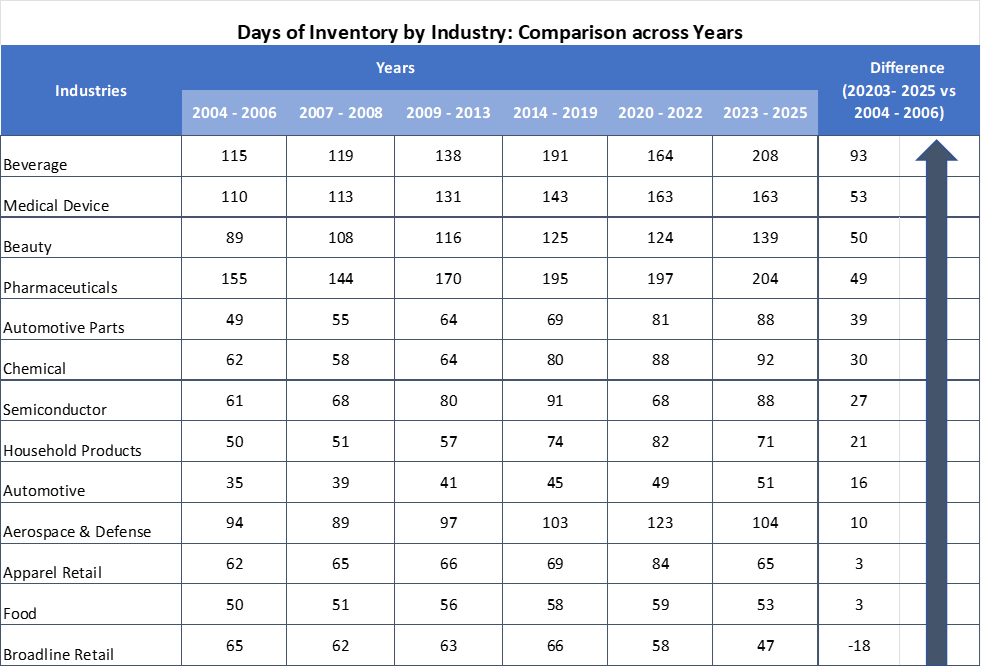
Let’s start with the basics: inventory is our most important buffer for distribution-centric companies to power growth. Growth has the highest impact on market capitalization. And, despite all of the investment in supply chain planning, inventory levels have grown disproportionately to revenue, as shown in Table 1. Let’s agree. We have a problem.
Table 1. Inventory Levels by Industry
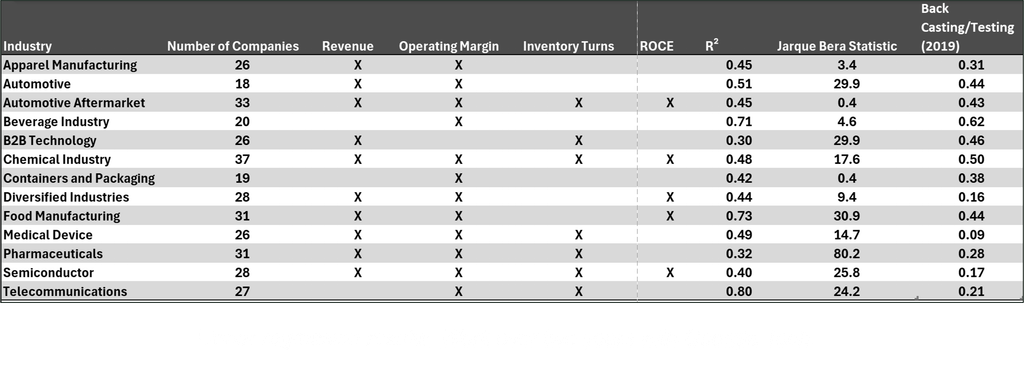
The supply chain needs to be the engine of growth. In the work I completed two years ago with Georgia Tech, as shown in Figure 1, we found that in a regression model of factors to predict market capitalization/employee of a public manufacturing company, inventory turns are a factor about 55% of the time. It matters, but so does the asset strategy.
Figure 1. Regression Analysis Factors to Predict Market Capitalization/Employee.
What I Would Teach the Class
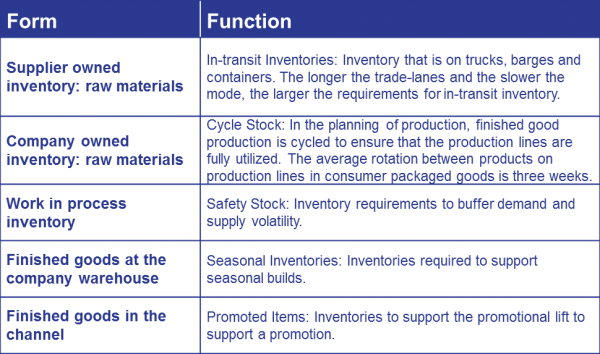
I would start by having the students take a company’s inventory plan and classify the functions of inventory as shown in Table 2.
After the analysis, I would ask, “Given demand and supply variability, where should the inventory be placed?” This determines the form of inventory to hold. The greater the variability, the further back in the supply chain the inventory should be placed as a raw material or semi-finished good. Building an agent to assign the form would be a great project.
I would then take the order and procurement data and evaluate demand and supply variability. Use machine learning to identify patterns and variability, then build the optimization models. This might be a good activity to help students understand the potential of context versus the knowledge graph.
Table 2. Form & Function of Inventory
You could then have the students build the buffers for raw materials and work-in-process. I would start with an understanding of the DDMRP logic (connected to market factors for supply variability and lead times).
Then consider helping students understand the impact of unabated complexity on forecastability and manufacturing cycle stock. Calculate the bullwhip and distinguish between waste and cost, and the impact on safety stock.
Then, using NoSQL, have students build a planning master data layer to understand supply variability, including manufacturing run times, conversion-rate variability, delivery variability, and aggregate lead times. Use your technology connections to help students build their own pilots. I think they will be shocked to see the impact of lengthening supply lines on variability.
Summary
So, Bram, I don’t think that the issue is the reliance on Microsoft Office Tools or BI. I think the issue lies in a holistic understanding of inventory management in this changing world. This is where I would center my discussion. Ask students how to determine buffers and analyze inventory health. And then think about the applicability of AI programs that some agents can build:
- Use streaming data from logistics systems on changes in the expected arrival of inventory from ocean shipments to update Available to Promise. Synchronize true inventory availability for customer expectations.
- Build a workflow based on forecastability to align FVA and error calculations to a manufacturing process stream. If an item is not forecastable, assign to a configure-to-order or a make-to-order workstream. Focus then on managing materials.
- Focus on agent-based workflow for new product launch and seasonal product sell-through based on point-of-sale data. Update replenishment values based on actual sell-through, while recognizing that orders are a poor proxy for demand.
- Analyze shipment variability and the impact on finished goods and material buffer sizing.
- Talk to some of the native AI technologies so students can have a conversation with engines on “What-if Analysis” for inventory strategies. Talking to the application through a context engine on a context graph helps improve readiness for their next job.
I could go on and on, but hopefully, this is a good place to start. Bram, good luck! I hope that this helps.
For additional insight, the reader might consider these prior articles: