
Remember, the frog in the pot of water? If the heat is slowly increased, the frog may not jump to prevent being boiled alive. In contrast, if the frog is put into boiling water, it will jump.
I think that the frog analogy fits today’s supply chains. Companies are absorbing volatility and complexity without redefining core processes.
Companies confuse historic practices as best practices. Many are even attempting to automate existing processes with agents and agentics, without stopping to ask, “Does this make sense?”
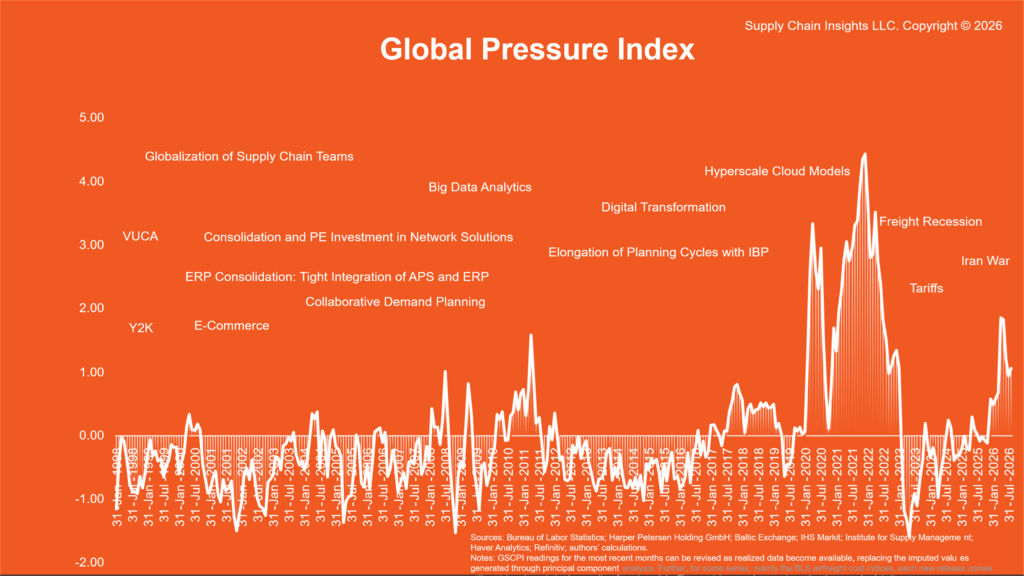
When it comes to volatility, I use the Global Pressure Index as a guage. Note three things:
- In the period of early 90s to 2020, low volatility was the norm. Companies spoke of volatility, but they actually enjoyed low variability. Processes based on tight integration proliferated, and process latency–the time to get data or insights–elongated and was just accepted.
- The current levels of volatility are a similar pattern to the financial crisis of 2007. The global multi-nationals underperform regional supply chains.
- We are slowly turning up the heat on the global supply chain. Traditional work processes are not sufficient.
Driving Change
To not be like the frog in the analogy, drive change through this five-step process:
- Redefine your relationship with data.
- Define governance.
- Upscale your team’s understanding of supply chain management.
- Build an AI Strategy.
- Rethink connection.
Redefine Your Relationship with Data
In defining supply chain outcomes, words matter. Get clear on definitions.
In the industry, I find a lot of handwaving and marketing hype, and few definitions. As you redefine your relationship with data, here are some for you to think about:
- Integration: Specific interfaces (APIs) to move data between systems in a meaningful format.
- Interoperability: Exchange of data and process semantics without custom interfaces, based on commonly-held standards, protocols, and formats.
- Orchestration: Coordinated process workflows across functions, people, systems, and decisions so they can work together toward a common outcome.
Today, the term orchestration is a new buzzword. The problem? I find many technology leaders mistaking the mechanics of data orchestration with a more holistic definition where processes, technology and organizational workflows need to be orchestrated together to drive improved outcomes. Which for me, requires the redefinition of work.
Data orchestration or transformation is a pre-requisite but not the entire story in the delivery of orchestration capabilities.
80% of the data surrounding the supply chain is not used. To use different data forms requires the buiding of a semantic layer. To accomplish this, build an understanding of these techniques:
- Industry Knowledge Graph: A structured representation of the knowledge, relationships, entities, and rules that define a particular industry. Think of it as a map of how an industry works, rather than simply a database of industry facts.
- Semantic Layer: The translation layer between raw enterprise data and the business meaning people—and increasingly AI—need to use the data.
- Ontology: Representation of a series of interconnected truths.
- Process Canonical: Workflows between parties. A process canonical is a standardized reference model for how a business process is defined and structured, providing a common language across systems, functions, and organizations.
- Operating Model: An operating model defines how an organization is designed to operate while a process canonical defines how a particular business process is standardized and represented.
- Unified Data Model: A unified data model describes how data is structured and related. While an operating model describes how the business is organized and works. For example, Distribution Requirements Planning (DRP) and Transportation Management Systems (TMS) do not have a unified data model.
As you redefine your relationship with data, challenge traditional organizational paradigms:
- Dirty Data. Most data is not dirty: it is different. In this new world, while data needs clear definitions, it does not have to be clean and pristine with similar formats to be used in supply chain processes.
- Process Redefinition.I find the number one data change management challenge is designing processes with disparate data. To drive process evolution over the last four decades, data had to have a similar format. This is no longer the case. Data no longer needs to fit into database rows and columns. In schema-on-read architectures, the data can be stored with the semantics. Do a data audit and group available data by volume and velocity (Y axis) against the data structures–structured, unstructured, streaming– on the X axis.
- Joins. Traditional joins–data transformation to connect one data element to one data element–formed our current process definitions. In the evolution of processes with the knowledge graph based on an ontological infrastructure, the joins can be one-to-one, one-to-many, and many-to-many. So if you have multiple hierachies or data structures that have inter-relationships, this can now be modeled.
- Engines. Using AI, the engines can be deeper and quicker using multiple data types. An engine no longer has to be a single input to a single output using transactional data.
Define Governance
When my daughter was four, I sat on bleachers and watched her attempt to learn how to play soccer. I laughed at the SCRUM—the play where the kids on her team had frequent, brief, disorderly struggles for the ball. The gameplay was comic relief.
I see a similar pattern when companies talk to me about using supply chain planning solutions to drive decisions. My observation is MAJOR SCRUM.
The larger the company, the greater the issue. In most of my clients, I see a lack of clarity on governance—who should make each decision for each planning period, and what defines a good decision—as an opportunity. The roles of the global, divisional, and regional teams need to be clear. Most of the time, they are not. Often, the plans miss the information on “who is responsible, who is the influencer, and which teams need to be informed when.”
Upscale the Team’s Understanding of Supply Chain
Technology capabilities are evolving quickly, which is exciting. However, as we think about how to use new forms of technology, I am witnessing a precipitous drop in the industry understanding of basic supply chain fundamentals:
- Time horizons, use of lead time, and consumption logic.
- Clear definition of a good plan.
- Alignment of functions on outcomes.
- Organizational alignment on metrics, what is possible, and what is feasible.
- Planning governance: Who should make a decision, what is the right frequency of a decision, and the processes for organizational input. (Alignment of responsibility, accountability, control
Build an AI Strategy
There are many technological advancements under the heading of Artificial Intelligence, with more evolving each day. I broadly characterize the emerging capabilities as advancements in ability to act (agents and agentics), delivery of insights (Large Language Models (LLM), Joint Execution/Value(JEV), better engines (Deep Learning, Reinforcement Learning, Neurosymbolic AI), and data transformation (Gen AI, machine learning, building a semantic layer).
My fear is that when most companies speak of AI, they mean agents. For me, Agents and Agentics on traditional supply chain architectures offer limited promise. How can we talk about agents when we are not clear on the required behaviors for both agents and humans?
Rethink Connect
The first time that I heard the term “the connected supply chain” was at an Anaplan conference in 2012. I liked it. For me, it was analogous to the definition of “interoperability,” which was a step forward from the overworked concepts of the “integrated supply chain.”
My testing for ten years with clients taught me that the tightly integrated supply chain–with tight connections to Enterprise Resource Planning (ERP)– throws the supply chain out of balance increasing the bullwhip impact and risk.
Connect can mean many things. Let me share a story.
From 2000 to 2002, I was a Gartner analyst. In 2002, on one of the regular Gartner analyst calls, the question of the day was, “What is the difference between a sales order and a purchase order?” The question sounds simple, but on the call, over 100 analysts struggled to answer. When you examine the mechanics, the Purchase Order and the Customer Order are surprisingly similar. At the end of the two-hour discussion, the group agreed there were few differences and that the architectures evolving in what was then called data exchanges (now termed supply chain operating networks) for purchase orders also applied to customer orders. Our discussion focused so much on the transactional mechanics that we sidestepped issues of ownership, compliance, and governance.
I now realize that the difference lies in the contractual processes and the role/process ownership of the trading parties at these two polar-opposite ends of the supply chain. At each end of the supply chain, lawyers and contracts exist. Most of these contracts go unused. Deductions, penalties, and compliance are relatively new topics, but managing order compliance feels like the Wild West. The reason? No system of record tracks compliance with negotiated contracts. Order-to-cash and procure-to-pay processes are disconnected from the unstructured data that defines required terms and conditions. Companies need to connect structured transactional data with unstructured contractual data in a meaningful way.
Despite improved connectivity, few orders cross corporate boundaries hands-free. Touchless order management is mired in compliance issues, price and credit workflows, and master data compliance problems. Customer service processes aren’t connected to these Ts and Cs to understand compliance, deviations, and guide fulfillment. Most supply chain conversations are blinded by a focus on transactional mechanics. Transactional flow efficacy is the industry paradigm.
Updates
If you are at CSCMP Edge, let’s connect. I will be speaking on Tuesday morning in the innovation track with Nicole Miara, Huber+Suhner, and Pravin Kamble, Senior Director Supply Chain and IT, Thermo Fisher Scientific.
This week, I announced a partnership with ISCEA The International Supply Chain Education Alliance (ISCEA) for access for AskLora.AI, my large language learning platform. The model now has ten years of financial benchmark data for all public manufacturing and distribution companies, a maturity model, a risk management assessment, and twelve years of research. Use the product to:
✅ Assess maturity: Instantly evaluate your supply chain maturity, governance, and inventory guardrails. Deploy the model in a center of excellence to understand relative process maturity.
✅Benchmark performance: Compare your metrics against data from hundreds of companies. Use the model to build orbit charts and understand industry potential.
✅Get actionable insights: Upload your strategy documents, powerpoints, and project plans and ask for feedback. Gain immediate, strategic clarity to optimize your operations.
✅Generate reports: Download a comprehensive, strategic benchmarking report in just minutes.
Apply the code ISCEA at checkout to unlock your exclusive fee reduction.
🔗 Explore Ask Lora today: https://asklora.ai