

I started Supply Chains to Admire research to set an objective, data-driven standard for supply chain excellence—one that measures what companies actually achieve, not what they claim, how much they spend on technology, or how other industry analysts view them. The goal is to let the data drive the performance discussion.
The research initially helped me establish a consistent standard for my writing, but I also wanted to give supply chain leaders insights that they could use to benchmark performance and set realistic goals. Writing this report is arduous. It takes three to four months. So, you might ask, why do I do it? There are four reasons.
1. There is no agreed-upon definition of supply chain excellence. Companies often described themselves as having best-in-class supply chains, but no consistent, objective standard existed to validate those claims. Cecere wanted to replace anecdotal evidence and reputation with measurable business outcomes.
2. Benchmarking needed to measure results over time. It takes 4-5 years for a company to beat a peer group. I wanted to give leaders a way to track progress. I find publishing orbit charts of progress against industry potential illustrative.
3. Companies needed to balance competing supply chain objectives. Rather than focusing exclusively on functional cost reduction, I wanted to build a balanced scorecard that could define value. Working with Georgia Tech, I developed a balanced scorecard built around four measures: Revenue growth, Operating margin, Inventory turns, and Return on Capital Employed (ROCE). The intent was to assess whether a company could improve its supply chain while delivering stronger financial performance relative to industry peers.
4. Supply chain leaders needed evidence to guide improvement. The research is intended to help executives set realistic goals, understand their relative performance, and recognize companies that consistently achieved superior results. It also challenged the assumption that successful individual projects necessarily translate into sustained enterprise-wide improvement. For insight, compare the results of the winners to the industry results.
What is the History?
2012: Supply Chain Insights founded: The formation of an independent research firm and began developing a deeper, data-driven approach to supply chain performance analysis.
2013–14: Methodology developed and published; Work on the benchmarking methodology began in 2013, with the first public Supply Chains to Admire recognition appearing in 2014. The toughest piece was establishing a credible industry peer group.
2016 onward: The research expanded into a systematic, multi-industry analysis of improvement, financial performance, and shareholder value.
The goal is to define supply chain excellence in measurable business terms. The question changes from:
– Who has the best supply chain reputation?
to:
– Which companies are improving faster than their peers, outperforming them on balanced financial and operational measures, and creating superior value?
In short,I created the methodology to make supply chain excellence measurable, comparable, and actionable—and to help leaders understand the connection between supply chain decisions and enterprise performance.
The research is free, open, and available for supply chain leaders. It is now the foundational research for the ASKLORA.ai maturity models.
Reflection
Recently, I have been interviewing Supply Chains to Admire Award Winners to learn how they beat their peer groups at the intersection of operating margin and inventory turns. The pattern is distinct, with seven characteristics in their secret sauce:
- Focused on Using Some Form of Innovation to Better Serve A Customer Need. The focus is on business process or product innovation with a strong outside-in focus on the customer. The portfolios are usually more narrow, and the organizations are aligned on customer delight.
- Strong Focus on Driving Innovation. Engineering and supply chain organizations work well together. The processes may not be pretty, but the teamwork is exceptional. You don’t find them chasing hype cycles with superfluous discussions about autonomous supply chains.
- The organization is in A Growth Mode. Companies in a growth mode usually outperform their competitors. Politics are low, and the focus is on driving meaningful growth.
- Wide Definition of Supply Chain with Strong Organizational Alignment. The definition of supply chain is broad — procurement, transportation, customer service, planning, and manufacturing working together. The leaders focus on cross-functional discussions.
- Scrappy. Processes in these organizations are adaptive. As markets change, the processes change with them: a stark contrast to the process excellence work of many large multinationals.
I equally find what Supply Chains to Admire is not. It is not a:
- Technology Solution. In these organizations, few people argue about technology. Technology is seen as a means to an end. The focus is on delivery for the customer. The company is not interested in discussions of technology for technology’s sake.
- Consulting Methodology. The leaders tend to do fewer big-bang transformational projects. When you sign in at their front desks, you tend to see the names of small boutique consultants, not the larger players. Boards aren’t dripping with strategy consultants.
- Focus on Doing Historic Practices Better. The teams have little time for conferences, pandering analysts, and talking about supply chain stages at events. The goal is to roll up your sleeves. Many may see the processes as immature, but there is no mistaking the focus, intent, and alignment driving customer success.
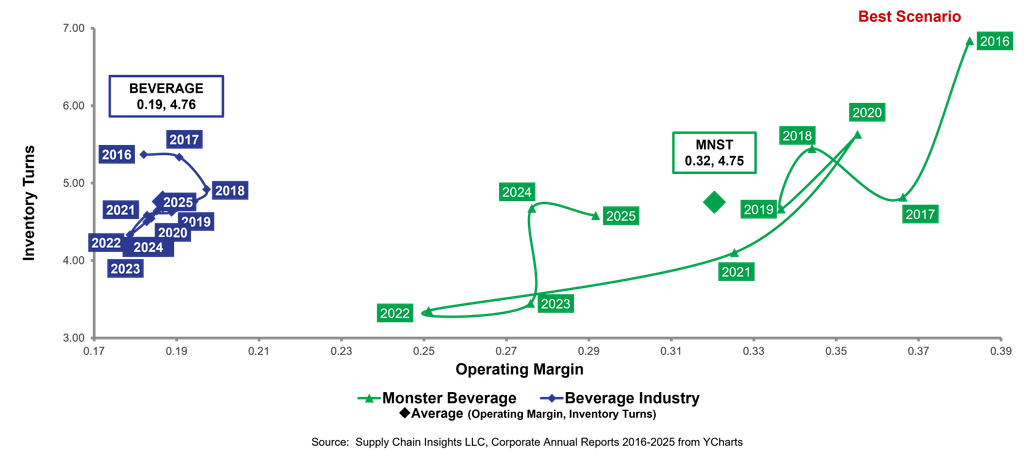
To help you understand the methodology, I share Monster Beverage’s performance (leader in the energy drink category) against its beverage peer group.
Figure 1. Beverage Industry Orbit Chart for 2016-2025
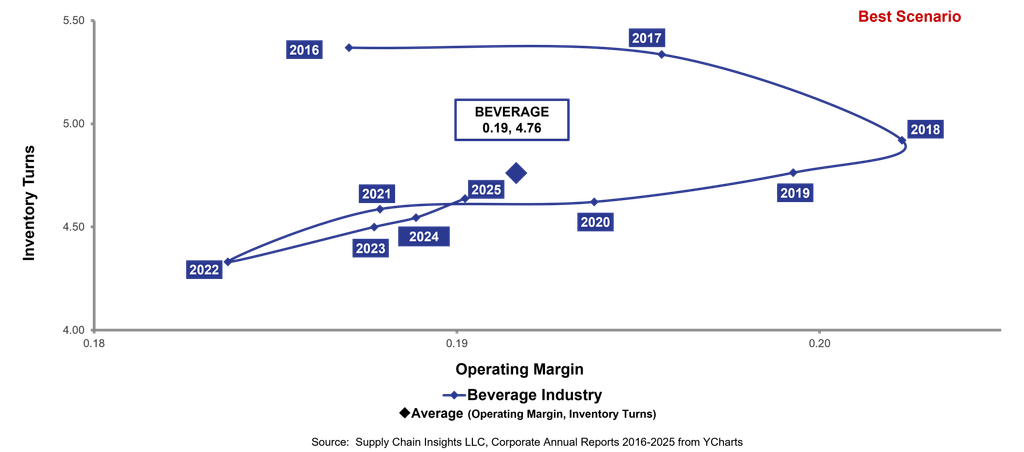
Figure 2. Monster Beverage (Winner) Orbit Chart Comparison to Peer Group
Celebrating Supply Chains to Admire Award Winners:
After twelve years of publishing the report, I am pleased to announce a conference to celebrate the winners and share insights.

ISCEA – International Supply Chain Education Alliance and Supply Chain Insights are hosting an ISCEA Awards & Networking Reception on February 9, 2027, in Las Vegas, Nevada, USA, to celebrate the award winners’ insights. A limited number of tickets are available for ISCEA members and the public who are interested in joining the ISCEA Awards. Ticket purchases: https://lnkd.in/g-YjgKdc
Update on Ask Lora:
What can we learn from using a large language model to provide research insights? The Supply Chains to Admire Methodology is embedded in the Large Language Model. Prior to the ISCEA Awards attend the Ask Lora session (2:00 PM to 4:00 PM) with Lora Cecere to find out. Sign up using this link: https://lnkd.in/g-YjgKdc
What is Ask Lora? This platform synchronizes 15 years of deep industry research into an interactive, chat-based LLM. Key research areas include testing outside-in concepts, better use of market data, and financial benchmarking in Supply Chains to Admire. The LLM enables:
✅ Maturity Assessment: Evaluate your supply chain maturity in organizational design, process definition, and technology satisfaction. Benchmark your data against Supply Chains to Admire and Gartner Top 25 Award Winners.
✅Benchmark performance: Compare your metrics against data over a ten-year period for over 5000 public companies. Build orbit charts to track progress against your peer group and understand industry potential.
✅Get actionable insights: Upload your plans and gain immediate, strategic clarity to optimize your operations.
✅Generate reports: Download a comprehensive, strategic benchmarking report in just minutes.
👤 About the Expert behind the Ask Lora:
Lora Cecere is the founder of Supply Chain Insights, author of Supply Chain Shaman, and a leading independent analyst with over 40 years of industry experience. Her unparalleled expertise spans,
⭐Technology Leader: Implementation, Product Management and Marketing Experience with Manugistics and Descartes Systems Group.
⭐ Analyst Roles: Former industry analyst at Gartner Group, AMR Research, and Altimeter Group.
⭐ Practitioner Leadership: Hands-on leadership roles at Procter & Gamble, Kraft/General Foods, Clorox, and Dreyer’s Grand Ice Cream.
Visit the platform to explore Ask Lora and the Dynamic Benchmarking Agent. https://asklora.ai
💡 How to Redeem Your Discount
Don’t miss out on this opportunity to pressure-test your supply chain performance with elite-level data. https://asklora.ai