

In the first quarter of 2026, the value of the companies offering Software-as-a-Service (SaaS) fell by 25-30%. The sell-off occurred as investors worried that Artificial Intelligence (AI) would replicate capabilities, undercutting the brand promise of packaged software.
The fall sent shockwaves through the supply chain community and affected the evaluations of public companies in the software sector, such as E2open, Kinaxis, Palantir, and ServiceNow, along with the private evaluations of companies like Anaplan, Celonis, Coupa, Gains Systems, Everstream Analytics, Fourkites, Lyric, Relex, o9 Solutions, OMP, Optilogic, ToolsGroup, and P44.
In this world, where AI is everywhere yet still emerging, investors and software buyers are confused. I am answering questions like, “Do I EVEN need to buy supply chain software again with the evolution of technologies like Claude and Gemini?” I think that it is a case where two things can be true. Yes, it is easier to build software, but it is harder to make it successful. Domain expertise is the constraint. Too few understand the requirements for a successful supply chain planning deployment.
Should I Build Supply Chain Planning Software Myself?
The largest competitors for most technology companies in the supply chain planning market are DO NOTHING or BUILD IT YOURSELF.
Build-it-yourself strategies are risky, no matter how smart the developer and the evolution of AI tools. AI makes this easier. My answer is to look past the initial code build to think through the delivery of value. I believe the greatest value comes from building the right relationship with the provider of the code. (And, remember, I have never seen a consulting partner deliver code successfully. Consulting and software are different business models.)
A build-itself model is only a valid option for a short-term, limited-use deployment. You may have a bright individual or team in your organization that wants to build a solution themselves. And, when you compare the cost of the build to the cost of packaged software, this may seem appealing. My caution is to think beyond the initial deployment to the technology’s evolution and use. Focus on the long-term view of usage and value. In this blog, I give you considerations for building a relationship.
With all the upheaval and mounting cost pressures within companies, many buyers are taking a wait-and-see attitude before making a purchase. However, there are many compelling reasons that a company cannot wait. If this is you, consider this guidance. Evaluate these criteria against a five-year time frame. Why five years? The market is very fluid.
Building a relationship requires work. My advice? Flip the script. Focus less on implementation and more on delivering value through usage and evolution. The traditional software deployment focuses 80% on the initial install and 20% on software usage through evolution. I believe that to drive value, you need to shift the focus with 80% of the effort on building the relationship.
Steer clear of third-party assessments that are often manipulated (Gartner reviews and Magic Quadrants) and do your own homework. The references used by technologists in a sales cycle are usually positive. Seek honest and unabridged assessments. The best way is networking. I usually do this by standing at the water cooler at the user conference and sparking conversations. Be a sponge.
Here, I share my reasoning.
Driving Improved Outcomes
What is SaaS? By definition, a SaaS platform has a cloud-hosted delivery, and operates on a subscription/recurring-revenue model, provides centralized updates to subscribers, uses a multi-tenant or cloud-native architecture, and is scalable. The evolution of the SaaS deployment model was a step change from the licensing model two decades ago.
Artificial Intelligence is now changing the model again. With the evolution of artificial intelligence and the introduction of AI-native platforms, SaaS technologies are being embedded into platforms and agentic solutions, and pricing models are shifting from a seat-based/user model to a value-per-outcome model.
As you search for a solution, throw away your rose colored glasses.
There is no perfect solution in the market today, and the offerings come in all shapes and varieties. As a result, it is critical to clarify the business requirements for defining success and focus on building a relationship with a software provider.
In this process, avoid vague and squishy terms and focus on a clear definition of measurable outcomes. A bad statement would be “the selection of an end-to-end supply chain planning solution to improve visibility.” The reason? The terms end-to-end planning and visibility mean many things to different people.
Instead, I find it useful to examine why companies use spreadsheets. If your organization has a supply chain planning solution yet remains extremely dependent on spreadsheets, press for an explanation of why. List the use cases. Understand the reasons.
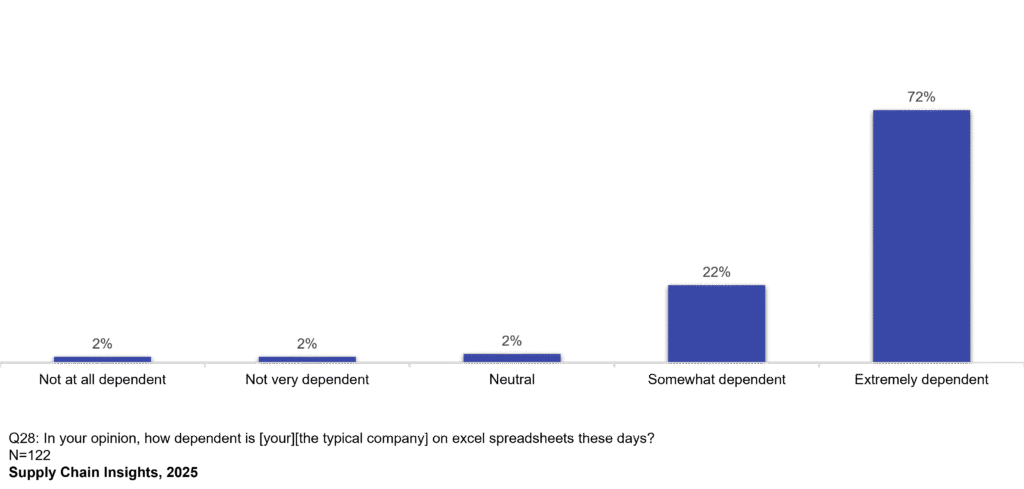
I find it fascinating that, on the one hand, business leaders want to AI everything, and, on the other, they don’t know why their teams, despite millions of dollars invested in planning solutions, still rely primarily on spreadsheets, with planning technologies primarily used as a system of record. Press to understand the root cause.
Driving Usage
The process of planning does not come naturally to an operations leader who rewards action. Many don’t even value planning.
Many mistake reactivity with responsiveness. A reactive supply chain constantly throws the supply chain out of balance creating waste whereas a responsive supply chain senses, evaluates alternatives, and then responds. In this world of rising uncertainty, they may question the value of planning.
Getting good at planning in these organizations is not easy; it may require driving a “tipping point” or pushing past the threshold where the change becomes self-sustaining. The goal is to drive adoption, which becomes like water suddenly freezing once conditions cross a boundary. In practice, you don’t force a tipping point directly—you shape the conditions so it becomes inevitable. Measure the waste created by a bad plan.
Tipping points aren’t just about amplification—they’re about alignment between value, network, and context. It’s not about convincing everyone—it’s about reaching a critical mass within the right network or segment. Once that threshold is crossed, spread accelerates naturally. The question for the implementor is, “How do you shape the work processes to need planning?”
One important reality: you can do all of this and still not hit a tipping point if the underlying idea doesn’t solve a real problem or the timing is off. Tipping points aren’t just about amplification—they’re about alignment between value, network, and context.
Redefining the Value of Software in the Emerging World of AI
The speed and accuracy of code development are accelerating with technologies such as Cursor, GitHub Copilot, Claude Code, and chat models like Claude and Gemini. The business user’s relationship with data is changing with the shift from relational databases, where data had to be clean and pristine under schema-on-write architectures, to using NoSQL/Python to work with unstructured data in schema-on-read architectures. The shift in the data layer enables the definition of schema-ready architectures that enable more insight into data sources, attributes, and usage information. For example, an item can now include attributes, provenance, grade, use-by date, packaging, etc.
As the industry is being redefined, the basics of how software is built, sold, and priced are changing simultaneously. Each reader of this blog is living through a period where the business user’s relationship with data and code development is being redefined. In parallel, the traditional model of data stripped of semantics and written into fixed rows and columns is driving innovation in the solution redefinition. The solutions to planning that we know today will look quite different in a year.
As a result, business users need to be open to the outcome to rethink processes and use cases as new solutions enter the market. While generative AI models are also a great help in generating Requests for Proposal (RFPs and RFIs), now is not the time to buy based on a feature-function analysis. Put the RFP/RFI approach on the back burner.
Instead, think hard about the relationship that you need and want to build with a technology provider. The relationship elements include implementation partner ecosystems, industry templates, user enhancements, industry share groups, benchmarking, training, expert coaching, and events. Think beyond the purchase to define what you need in the software’s evolution to deliver value.
Get Clear. What Do You Need in a Software Relationship?
No relationship is ever perfect. In your search for a software relationship, make a list of what your company needs. Build this into the governance model for decision-making. Consider the following elements:
- Geographic Presence. Understand the dependencies on data centers and third-party software. Evaluate the risk of war, grid failure, and security.
- Financial Viability. Select a company that will be around and viable throughout its lifecycle. If the company is a start-up, ask about planned liquidity events and focus on selecting a company with a low risk of a change in state during the consideration lifecycle. Remember that the only people who win in an acquisition or a buy-out are the investors. Market churn usually destroys and redefines the customer/provider relationships.
- Work with Data Scientists. In this emerging AI world, enabling data scientists within your organization to work directly with those in the provider’s organization becomes paramount. Determine the availability of resources for data scientist support. Give extra points for the presence of a Foundry or a Test & Learn Innovation Lab.
- Industry Templates. Does the company understand the needs and requirements of your industry? Look for companies like you. Ask to see the industry templates and review the product development roadmap, looking for innovations that fit your industry.
- Training. With M&A and employee turnover, packaged training is an essential. Find out what is readily available and the potential for customization. Give extra points if there is a certification process for third-party implementors.
- Scalability. Define the number of users, items, and locations, and the time requirements for batch processing. The solutions range in scalability around these dimensions. Test the solution in a third-party lab to assess performance. For example, there is a solution on the market with great production planning, but the scalability and the time it takes for a demand planner to get data are deadly; use this insight in the solution consideration.
- Assessment and Benchmarking. Online assessments and periodic tune-ups/evaluations are key. Gain an understanding of what is available.
- User-Based Enhancements. Gain an understanding of how user enhancements are initiated, evaluated, and implemented. Get clear on the user group’s governance.
- Push for Interoperability. Focus on the need for interoperability, and clearly understand the difference between integration and interoperability. When business leaders say that they want to drive integration, they usually mean interoperability. In your search, get clear. Integration is about linking systems together so they function as one. It usually involves building specific connections—such as APIs, middleware, or custom code—so that data flows between systems in a controlled manner. These connections are often tightly coupled, meaning that if one system changes, the integration might break or need updates. Interoperability, in contrast, is defined by a capability for different systems to communicate and use each other’s data without special, one-off connections. It relies on shared standards, formats, or protocols. The difference is a semantic reconciliation layer. Explore this difference in your discussions.
Conclusion
The limiting factor in supply chain planning deployment is usually domain expertise and clarity on the planning mission to drive value. Despite the rise of technology to make do-it-yourself modeling easier, side-step the do-it-yourself option and build a relationship with the technology provider. I look forward to seeing your comments.
See You There?
I am facilitating a Virtual Roundtable event this Friday with Don Hicks, Founder of Optilogic, to discuss the evolution of network design technologies and the use of quicker, easier-to-use technology approaches in the redefinition of work. This roundtable is limited to 25 business leaders. Sign up. It is sure to be fun.
If you would like to discuss these topics further, please reach out. I will be speaking at the ASCM chapter event in Rochester, New York, on May 21st on the power of AI in redefining supply chain outcomes. This presentation is offered for both in-person and virtual attendees.
I will also be speaking on the executive tracks at Kinexions 26 and Opticon 2026. I hope to see you in my travels.