
The supply chain is knotted. It is unruly. It is complex. It is growing more so.
Current supply chain planning deployments often degrade value. This is not by design, but by the lack of focus on value-based delivery.
Companies are unclear about what drives value and what to measure. Most are stuck in traditional paradigms as the world of new and promising technologies swirls around us.
Over the last six months, multiple technologists briefed me with a similar message: “Let’s improve reaction time.” With excitement, the voices on the phone share how they used agents and agentics to streamline an insight. The conversation grows painfully quiet when I ask, “What is a good outcome? How do you define a good plan?” I call this AI stupid. My goal is to AI smart. I want you to join my coalition to use technology better.
Reflection: Use Performance Data to Build a Guiding Coalition
I find many companies unclear about the role of planning. Many are surrounded by math geeks. Effective supply chain planning is more than a math problem to be solved; it is a systems dynamic opportunity to be harnessed.
If you accept this mission, the first stop on the supply chain leader’s journey is the Chief Financial Officer. The goal is to align the financial team with the mission of delivering a reliable supply to drive growth amid uncertainty.
The important discussion for the supply chain leader in the CFO’s office is to convince the financial team that the efficient supply chain—the attempt to run the supply chain at the lowest cost— is not the most effective approach in the face of rising uncertainty. Based on the analysis of demand and supply variability, on average, only 20% of product volume can be managed effectively with a focus on the lowest cost. (My analysis of 80 companies, where effectiveness is defined as consistent cost, quality, and customer service.) (Using supply chain modeling technologies like Lyric or Optilogic, do your own analysis of your demand and supply variability to determine what percentage of your flows can be managed effectively with a focus on the lowest cost. )
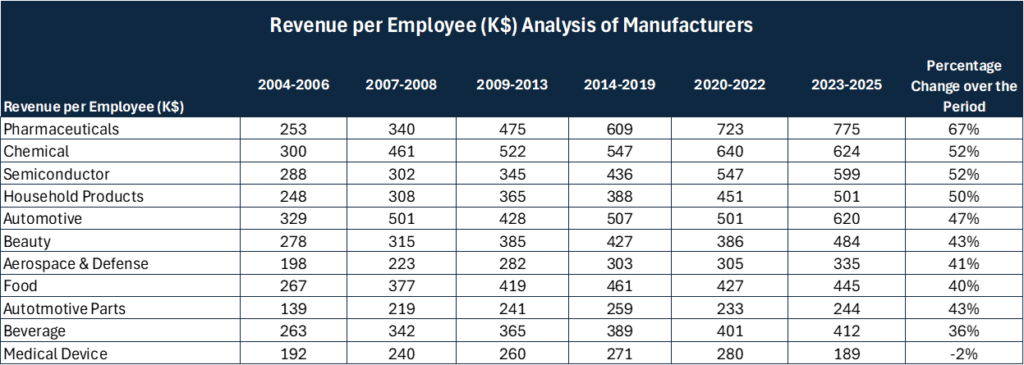
Historically, companies focused on labor efficiency. Advancements in technology made this possible. Traditional Advanced Planning Models (APS) focus on improving manufacturing efficiency and maximizing throughput through constraint-based theory. This thinking drove dramatic improvements prior to 2020. As shown in Table 1, this is no longer the case.
Table 1. Revenue/Employee of Manufacturing Companies
The second stop to build the guiding coalition is the Chief Operating Officer. The goal of this discussion is to align on the supply chain’s role in delivering value. This conversation is not trivial.
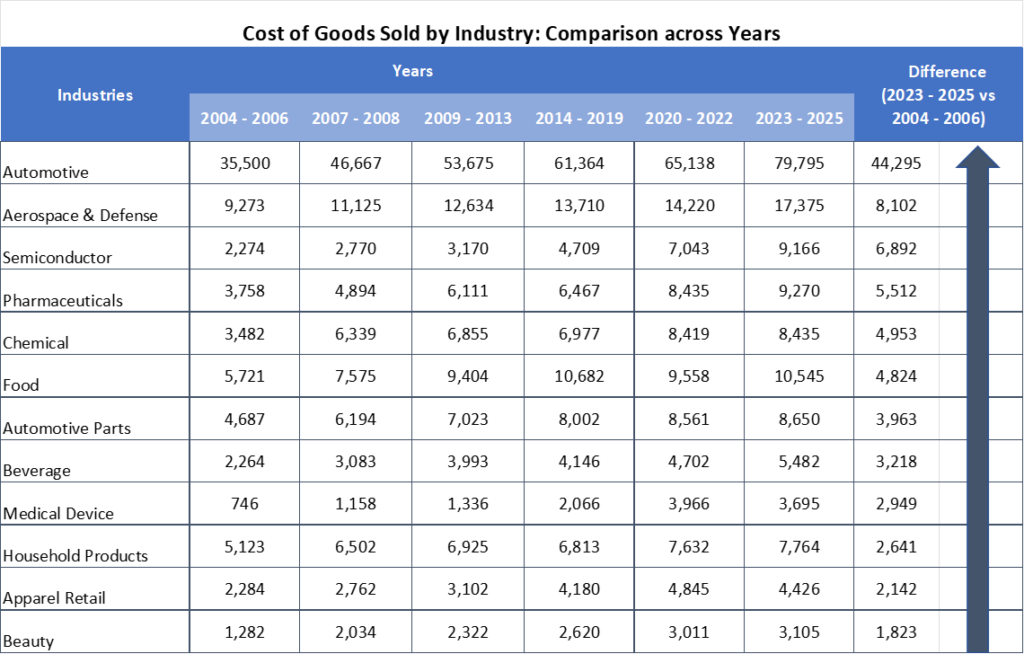
Many companies use the cost of goods as a proxy for supply chain excellence. This logic is flawed. Let me explain. The cost of goods measurement is the direct costs associated with producing the goods a company sells, excluding indirect expenses such as distribution and sales costs. In contrast, a company’s operating margin is the amount it earns on every dollar of sales after deducting variable costs but before accounting for interest or taxes. In contrast, operating margin is calculated as operating income divided by net sales.
The question for the COO is, “How do we best manage costs?” Traditional APS approaches do not allow companies to make trade-offs between make, source, and deliver. With rising demand variability and the lack of product forecastability, traditional planning processes push and amplify the bullwhip, increasing waste. The COGS (Cost of Goods) is rising due to several factors: misalignment between operations and commercial teams, a traditional focus on functional metrics, unabated complexity, and a lack of a clear strategy to deliver value. Forcing the discussion of what we are doing today is not working is not easy, but it is necessary. A shift from COGS to operating margin better aligns commercial and operations teams.
Table 2. Analysis of the Rising Cost of Goods for Manufacturing Industries
To deliver results, push the organization to move from a focus on transactional efficiency, past the theory of constraints, to embrace the world of flow and supply chain dynamics. Question the first principles of existing systems. Ask the COO not to accept the status quo, but to also side-step the hype.
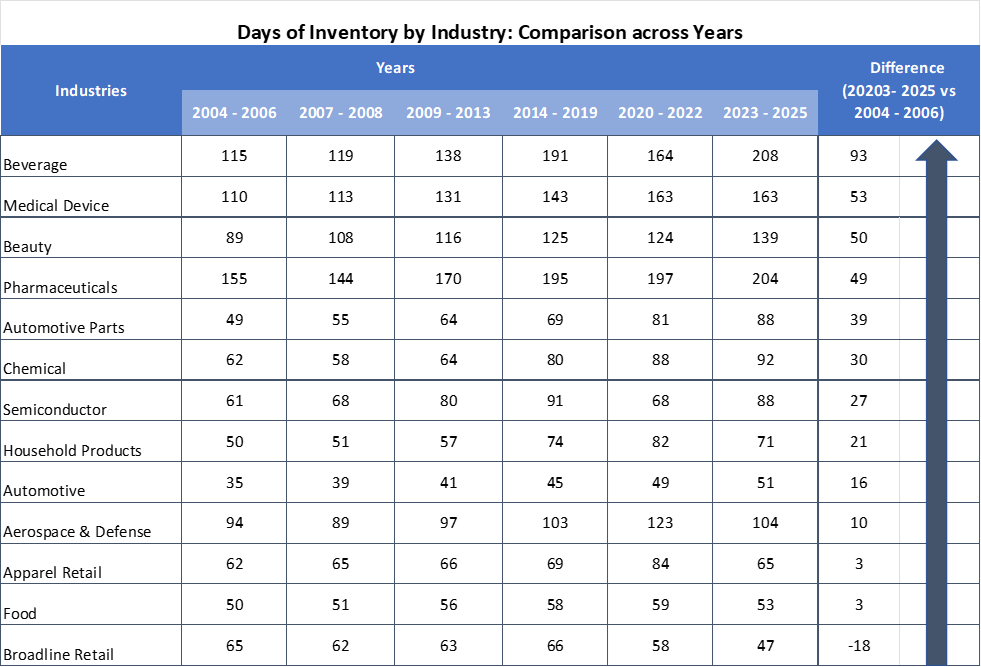
In the process, ask your executive team to have a more mature discussion on the role of inventory in the supply chain. Face the hard reality that inventory levels rose an average of 30% across manufacturing industries in the past two decades.
Most organizations focus myopically on managing safety stock in planning processes, when the increase in inventory is usually due to higher cycle stock resulting from a rise in product portfolio complexity, and to increases of in-transit inventory arising from outsourcing and sourcing/logistics choices. Every year when I do this chart, I laugh when I think about the discussion that I once had with a CFO who said, “If I had a penny for every dollar that I mistakenly spent on the management of inventory, I would be a rich man.” He would indeed.
Table 3. Analysis of Inventory by Industry
Ground the Discussion on Business Performance
In the process, push to redefine your organization’s relationship with data, build a semantic reconciliation layer that embraces all data forms to enable interoperability (not just integration) with market data. (For example, today, data used by the sales and marketing teams cannot be used effectively in supply chain decisions.) Push for organizational change to include data scientists in the supply chain center of excellence and to design and modify the supply chain response at the same cadence as Sales and Operations Planning (S&OP).
To understand the opportunity, study the progress of companies in each industry. Analyze the choices made and the results. (Spoiler Alert: The Supply Chains to Admire report for 2026 is a month away. I am heads down in analysis.)
Let me give you an example. The Household Non-Durables manufacturing sector struggles with growth. Each team and function sits in an isolated silo(s). Tens, sometimes hundreds, of consumer account-facing teams model demand and supply data for each account weekly and monthly. This data is not connected to mainstream supply chain planning data because there is no “ship-to” translation into “ship from” information. As a result, supply chain planners cannot use data that account teams see, which is 15-20 days earlier than their demand-planning view based on orders.
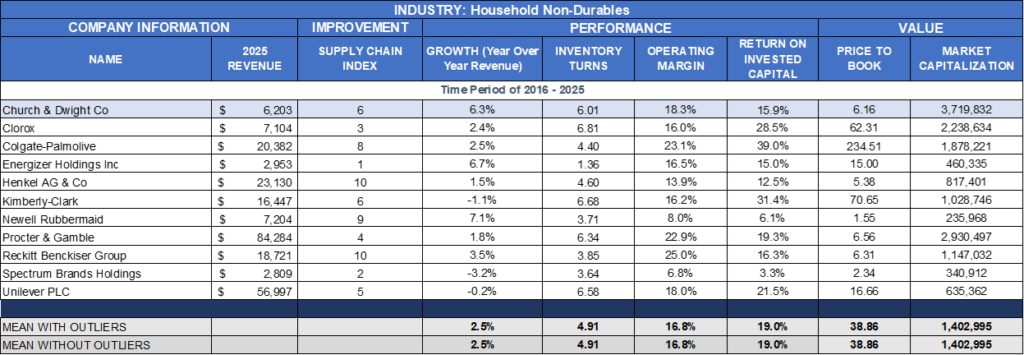
P&G is readily hailed as the market thought leader, but as shown in Figure 4, while the company has outperformed on operating margin and inventory turns, it has spent a lot of money to not grow. I define top supply chain performance as the ability to drive improvement, outperform their peer group on key metrics (growth, operating margin, inventory turns, capital investment), and deliver value.
Using this definition, the top performer in the Household Non-Durable industry is Church & Dwight. Why has Church & Dwight, and less than a tenth the size of P&G, outperformed its peers? The answer is largely leadership. The Company has shifted from a marketing-driven to a market-driven model, with a focus on rationalizing portfolios, redesigning demand processes, building strong design and modification capabilities, and driving functional alignment through metrics.
Why is Unilever underperforming? Inventory turns and operating margins are high, but growth lags the industry. The reason? Each region operates largely autonomously, and the organization lacks discipline in managing its product portfolios. The alignment of operations and commercial teams is an opportunity.
Similarly, Henkel and Reckitt are stalled in their attempts to drive improvement, and Colgate, with a myopic focus on cost, struggles to manage inventory. The key to driving market capitalization per employee is balance.
Table 4. Ten-Year View of Household Non-Durables
Which returns me to my core statement of how do companies drive reliable growth in an uncertain world? The answer, I am afraid, is not more of the same. The answer, I am afraid, is not buying into hype.
It requires a clear mission and alignment with a balanced scorecard. It also requires sidestepping the wonk-based discussions that permeate the supply chain world.
Fire the Wonks
Driving results requires a strong foundation in making better decisions based on a clear strategy. It requires side-stepping the many hype cycles that surround us today.
When I asked ChatGPT for a definition of a ” wonk”, I received the following definition:
A “wonk” is an informal term for someone who is deeply interested in and/or is knowledgeable about a specific subject, especially in a very detailed or technical way.
Most commonly, you’ll hear the term it in politics:
- A policy wonk is someone who studies laws, policies, and government programs in great detail.
- These people often focus on the fine print, data, and mechanics, rather than broad ideas or speeches.
Today, the supply chain WONKS come in many flavors. Stay rooted in business fundamentals, and side-step the wonks. Meet the supply chain WONKS:
- The Real-time Wonk. There is a wide variety of real-time wonks: the real-time S&OP wonk, the real-time planning wonk, and the real-time decisioning wonk. Planning should never be real-time. It needs to enable data at the speed of business with insights that have zero market latency. Planning options need to be incorporated into the operational and executional processes. Most real-time wonks confuse time horizons and focus on execution, wanting insights now to react. However, reactivity is not responsiveness. Over-reaction introduces nervousness into the complex system, reducing effectiveness.
- The Autonomous Spouting Wonk. Many don’t understand why we cannot put planning processes on autopilot. My retort? How do you define a good plan? And, if there is no response, I ask, if we are not clear on outcomes, how can we be autonomous?
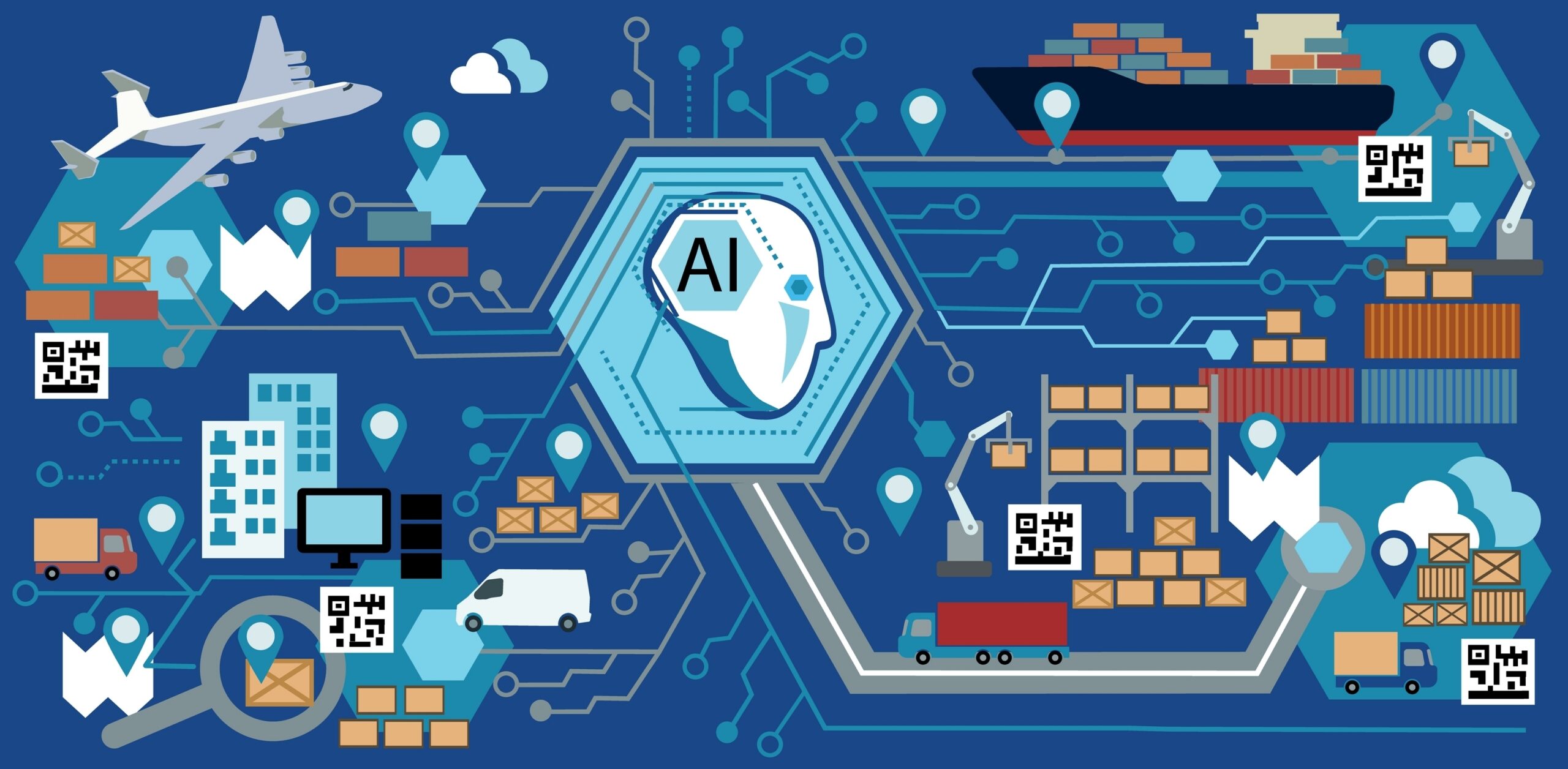
- The AI is Everywhere, but Nowhere Wonk. After a lot of hand-waving, ask the speaker to define AI and draw a visual of how to use AI to improve business outcomes. Ground the discussion.
- Supply Chain is a Math Problem Wonk. Driving supply chain outcomes is more than better math. Focus on building an organization that can use math, but is aligned to outcomes. Build systems thinking.
- The Religious Wonks. You can count the different sects —DDMRP, flowcasting, lean — the problem? These are all tools in the supply chain toolbelt, versus the panacea.
Wrap-up
Driving supply chain excellence is hard work. Building a guiding coalition requires a clear definition of the mission and alignment with metrics.
If the mission is driving reliable growth in an uncertain world, focus on first-principle thinking, redefine your relationship with data, and fire the wonks. Then you can start having the important discussions of how to redefine supply chain outcomes in this new world of emerging Artificial Intelligence.
If you would like to discuss these topics further, please reach out. I will be speaking at the ASCM chapter event in Rochester, New York, on May 21st on the power of AI in redefining supply chain outcomes. This presentation is offered for both in-person and virtual attendees.
I will also be speaking on the executive tracks at Kinexions 26 and Opticon 2026. I hope to see you in my travels.