 This week, after ten years, I am test-driving cars. I have not owned a car for a decade. City living has come to an end and it is time for me to get some wheels. Buying a car is overwhelming. I just want one that works. I find the process of negotiation, and comparison shopping tiring. My goal is safety and comfortability. It is hard to sort through the options.
As we prepare for the Supply Chain Insights Global Summit, the Supply Chain Insights team is combing through the research data collected over the past six years. We sit on 9,000 quantitative responses and we want to better understand the drivers of supply chain excellence. Supply chain planning satisfaction is a driver of excellence.
Companies that are better at supply chain planning are better able to manage operating margins and inventory turns. However, the odds of business user satisfaction are low. In our research, we find that there is only one satisfied business user out of two. It is the same as the flip of a coin.
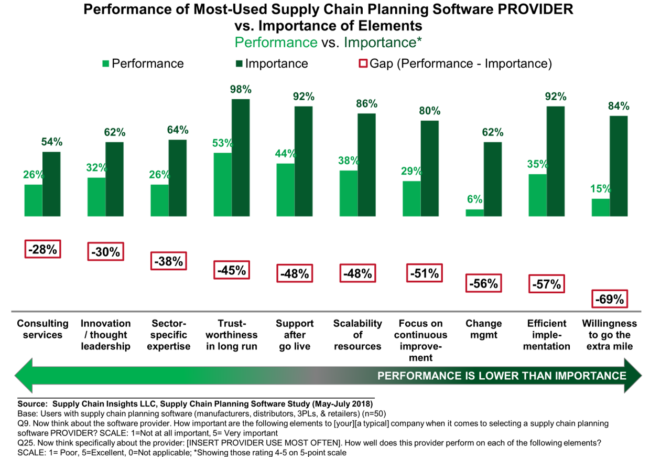
As I look at the data, the analogy of test-driving a car comes to mind. The gaps, as shown in Figure 1, are high. The largest is the “willingness for the software company to go the extra mile.” Most business users that I talk to feel that the software vendor always has their hand in their pocket asking for more money–maintenance, tune-ups, conferences, upgrades.
Figure 1. Supply Chain Planning Performance Elements
I feel for the users. As you look at the gaps, I hope that you do as well.
The model of car ownership is changing. Lyft/Uber provide shared rides. Zipcar and other rental car services provide car sharing. In the future, car ownership will decline. My question in this blog post is “should the supply chain planning software industry rethink it’s model as well?” Especially in light of these gaps? Here are three initial thoughts:
- Maintenance. Maintenance costs of license software are 18-22%. In the heyday of planning software when average deal sizes were larger, maintenance fees were higher. There is the opportunity to rethink maintenance.
- Planning As a Service? Should the focus be on outcomes? I spoke to Baxter Software this week. Their focus is service parts planning and they have progressively grown their business model to provide planning as a service (the deal includes the software along with the planning service). Since many companies struggle to retain talent, this might be a viable option.
- Value-Based Planning? With the wider adoption of Software as a Service and Cloud-based Solutions, business value monitoring is more feasible. Should we center on value delivery? Should this become a new model?
As I close this post, take another look at Figure 1. Think hard about the gap of “Going the Extra Mile for the Customer.” If you are a software vendor, I hope that this gives you pause.
Have a great week. I hope to see you at the Supply Chain Insights Global Summit! The event is on September 4-7, 2018 in Philadelphia, PA.