Preparing to Run Supply Chains at the End of the Second Global Economy
Global supply chains are built on three assumptions: rational government policy, availability of transportation resources, and low variability. The pandemic taught us many lessons that we are quickly forgetting.
Compliance, sanctions, and tariffs loom. Supply chain leaders have little history to use as a guide to prepare. Before the pandemic, supply chain leaders experienced relatively free trade across borders in 2017. The Tariff Act of 1930–commonly known as the Smoot–Hawley Tariff–signed by President Herbert Hoover on June 17, 1930, raised US tariffs on over 20,000 imported goods. The tariffs under the act, excluding duty-free imports, were the second highest in United States history, exceeded by only the Tariff of 1828. Economists and economic historians have a consensus view that the passage of the Smoot–Hawley Tariff worsened the effects of the Great Depression. Take-away? Current supply chain practices starting are not designed to operate in a high tariff/compliance environment.
Where to Start
Removing friction from trade fuels the global economy. A tariff is a tax paid on foreign goods as they cross borders. Think of it as a sales tax. The tax burden falls to either the consumers or the producers of goods.
What can we learn? I think that this is an opportunity for companies to become more responsible trading partners. The investments to adapt to higher tariff levels are similar to what we need to track SCOPE 3 emissions, Deforestation, and Fair Labor compliance, and the pending compliance with the emerging legislation in the EU for Digital Passports.
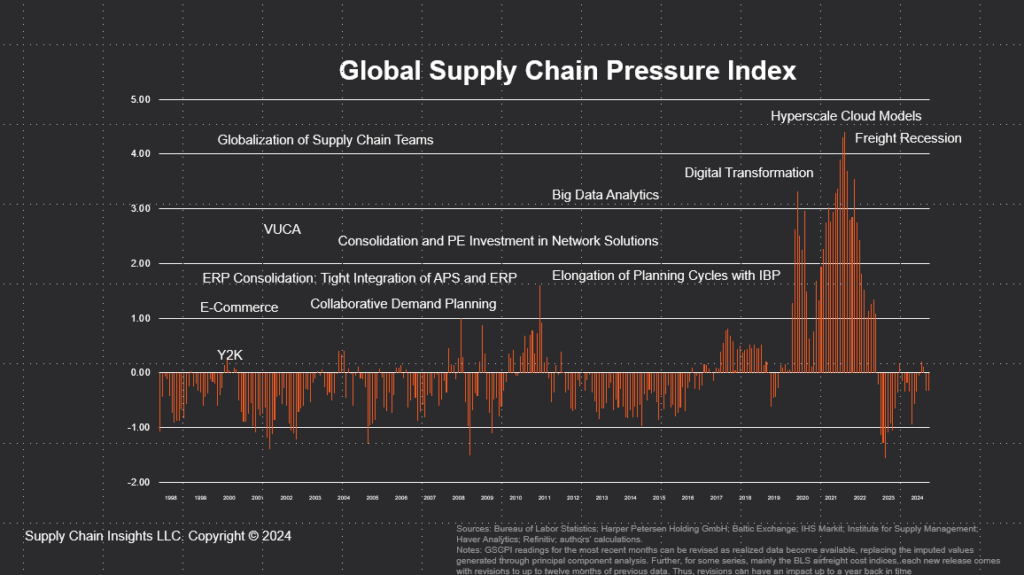
Using the Global Supply Chain Pressure Index to view volatility, we can see patterns.
–Technology Evolution Outpaced Adoption. Supply chain leaders were slow to adopt advances in Big Data Analytics. In parallel, PE/venture capitalists purchased/consolidated network solutions, slashing R&D and delaying investment, reducing industry capabilities. Digital transformation initiatives looked great on PowerPoint(s) but drove little value. In many ways, we squandered opportunity before the pandemic to build strength during a low volatility period. No one in the industry has managed a supply chain with the level of tariffs threatened. The rules are changing. Is this the end of the second global economy? No one knows. However, prepare for the many political clashes/wars and increasing compliance. If you, like most, are running your supply chain based on ERP and Excel spreadsheet data, you are not prepared. What to do?
–We Are Not Prepared. Despite the fact that many supply chain consultants waxed eloquently about VUCA (Volatility, Uncertainty, Complexity, and Ambiguity), most supply chain practices evolved during a time of low volatility. Most processes are enterprise-centric, and trading partner networks are largely managed by email and spreadsheets.
–The Myopic Focus on Cost Reduces Effectiveness. In 2001, China joined the World Trade Organization, increasing access to China as both a channel and a supply source. As companies expanded globally, regional practices were adopted without redefinition. The focus was on cost mitigation and deploying labor arbitrage and tax efficiency strategies.
–Planning Cycles Slower Despite Faster Channel Requirements. In response, companies tightly integrated planning systems into transactional architectures, improving transactional accuracy but decreasing operational flexibility/agility. The evolution of Integrated Business Planning processes (IBP) elongated planning cycles at a time when e-commerce and regional markets demanded shortener order cycles.
Building Capabilities
Where to start? How to be a better trading partner? Here are seven tactics to consider:
Ensure Compliance. Tariffs slow trade flow across borders, increasing the burden of compliance documentation. Expect greater variability in lead times and an increase in in-transit inventory. Take two actions. Build a supply chain planning master data layer to understand lead time variability and a system of record for certificate compliance information.
Inventory Management. Tariffs dynamically change the value of inventory, necessitating investment in deeper inventory management solutions. Few are ready to rationalize the differences in the price of inventory on receipt.
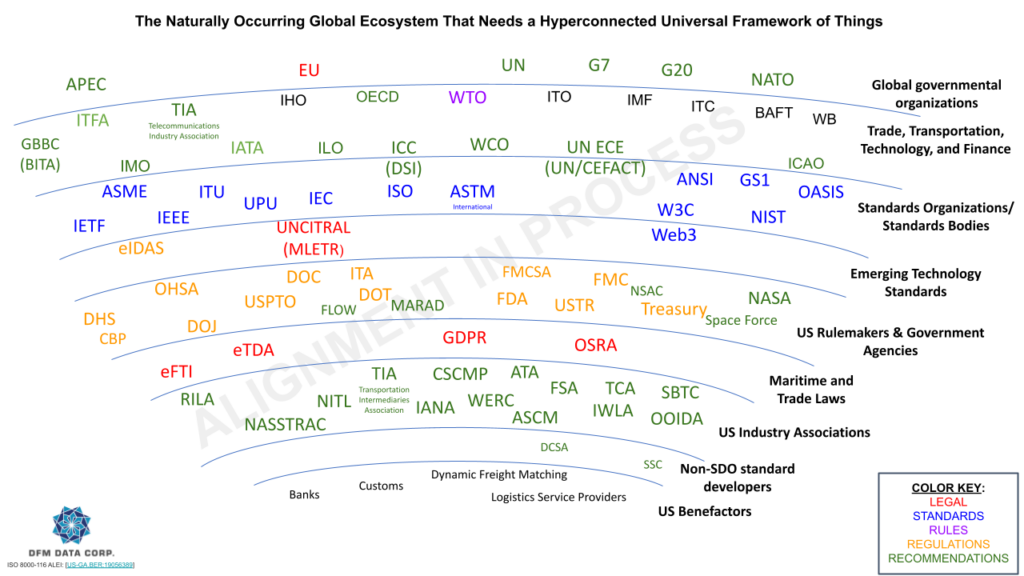
Adopt Standards and Authoritative Identifiers. Adopt the GS1 GTIN and the ISO 8000 standards, but don’t drown in trying to adopt ONE standard. Standards bodies are largely self-serving bodies with religious tendencies. Use large and small language models to rationalize between standards. Build ontological rules engines to orchestrate standards mapping into compliance documentation. Here, to illustrate the point, I share the overview of the standards landscape built by Michael Darden of DFM Data.
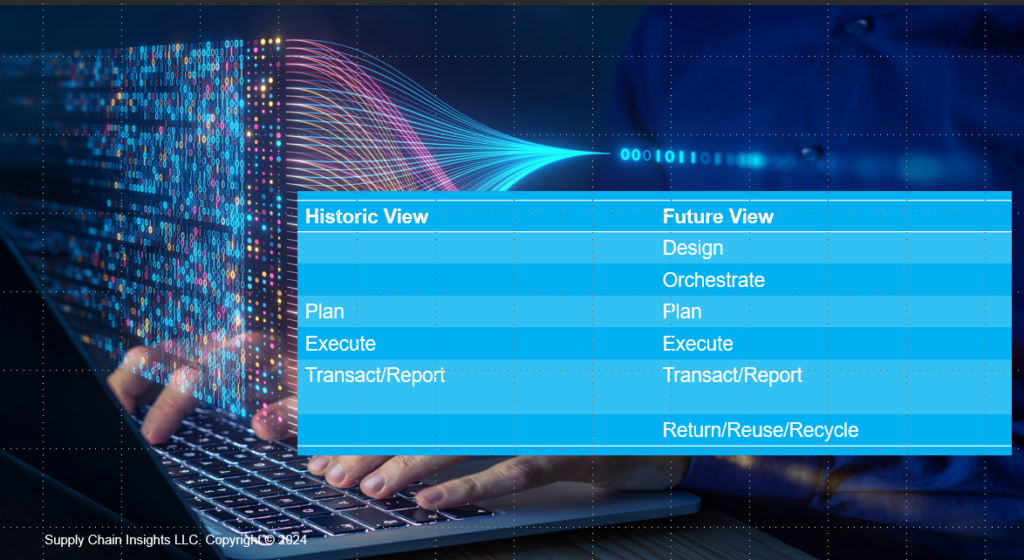
Prepare for Growth to Slow. The average time for the supply chain to adapt to market shifts is 15 months. This did not improve during the pandemic, and most companies are busy investing in AI-based engines using enterprise data. Consider the investment in outside-in planning processes using market data and orchestrating source, make, and deliver based on a holistic design process. Supply chains perform better when they are pedaling uphill. They are slower to adopt when markets slow. Build an orchestration layer and invest in digital twin for design.
During the past election, the focus was on the price of eggs, milk, and bread. Few appreciate the current health of the US economy. Below is a quote from Ernie Tedeschi. I highly recommend his blog.
“The US economic recovery from the pandemic has been extraordinary. In the four years since 2019 Q4, the last quarter before COVID-19 hit, the inflation-adjusted size of the US economy (real gross domestic product or “GDP”) has grown by a cumulative 8.2%. That performance so far is much stronger than America’s Great Recession recovery: four years into that business cycle (2007 Q4 to 2011 Q4), US real GDP was only 1.8% larger than its pre-recession level. The Briefing Book, Ernie Tedeschi, April 01, 2024 “
Expect Supply Shortages. Know faster and respond better—work on being a more capable trading partner. Share data and build relationships. Build capabilities for alternate sourcing and bill of materials and drive bidirectional orchestration of source, transform, and deliver capabilities based on market shifts.
Align for Success. Build cross-functional leadership. Start by auditing your current capabilities. Do you have technologies deployed that could help? What is the state of readiness of your third-party logistics and contract manufacturers? For example, I recently interviewed someone in procurement who is working on SCOPE 3 emissions and tariff readiness. She advocated investment in a risk management solution for mapping, supplier surveys, and an extensive use of the DUNNS numbers. Procurement was operating in isolation from supply chain. The procurement director had no understanding that the company had a robust track and trace system deployed in the channel that could be used without buying an additional, less-capable technology. DUNNS numbers are relatively worthless in track and trace, and mapping is too static to ensure compliance.
Wrap-up
We are facing headwinds. Don’t expect business as usual. Revisit the lessons of the pandemic. Data synchronization and process orchestration market-to-market (channel to supplier) matters. Enterprise-centric data using faster planning engines based on Artificial Intelligence (AI) is not the path to success. Question current process paradigms, measure outcomes, and make a difference.
I hope this helps. I look forward to seeing your comments.
Learn With Us
Every two weeks, I will be doing a podcast with Peter Bolstorff previously at ASCM and now at Inspire.ai. Sign up to follow the Straight Talk YouTube Channel or our podcast channel on Spotify to listen. Next week’s session is on the Fundamental Score to measure value that is being developed through work with Georgia Tech.
A simple quiz to assess an organization’s AI readiness.
The pace of change is fast and furious. Every day, technology advances faster than we can digest. A great challenge to have.
Determining whether a supply chain is “AI-ready” is less about technology and more about the gray matter between the ears of supply chain leaders. Leadership, alignment, and clarity of goals matter.
Too few companies are clear on the definition of supply chain excellence. Measuring and rewarding functional metrics reduces the firm’s value. Putting agentics on top of today’s processes can make bad practices run faster, reducing value.
The toughest job for the supply chain leader is challenging existing supply chain paradigms that were defined by the limitations of decades of supply chain technologies. As the curtain lifts on the potential of new forms of technology, process redefinition is our opportunity, but only if we are clear on what drives value. (Here, I link to the Supply Chains to Admire reports to help you define value. The next report will be published on June 23rd, along with my Dynamic Benchmarking Product, to help you define value in the face of your AI readiness. More information about the launch is at the bottom of this blog.)
This study of Franklin Sports shines a light on the work that needs to be done at the sales account level to challenge a retail forecast, and also highlights the importance of a new technique for a forecast engine — reinforcement learning.
Artificial intelligence comes in many forms — large language models, generative AI, machine learning, unstructured text mining, deep learning, neural networks, reinforcement learning, agents, and agentics. While the industry is wigging out about agentics, I think reinforcement learning is a great step forward in the journey of Artificial Intelligence.
When it comes to combining tech, 1+1+1 should equal more than 1. The impact should be exponential. Unfortunately, today, the answer is 0.
What do I mean? Let me explain.
I find that the supply chain technology market moves slowly along traditional technology lines. Conferences are usually focused on the use of technology, not on redefining work. This bothers me. I want it to bother you as well.
An orbit chart is a powerful tool for understanding the “health” of a supply chain and its potential for improvement. The supply chain is a complex, non-linear system with limited trade-offs. The relationship between trade-offs varies by industry, region, and size. The orbit chart is a diagnostic we use in the Supply Chains to Admire work. Here I explain the use case.
Today, companies require industry-specific supply chain solutions. The performance of 82% of the industries–I term this industry potential–is going backward while companies are trying to
Don’t let a well-intending, but ill-informed consultant or technologist set an expectation that you cannot meet. No when wins when there is a check written that cannot be cashed. In this case, the consultant will move to the next account leaving you holding the bag. Fight back with a data-driven argument. Help the organization think about inventory more holistically.