The Supply Chain Insights Global Summit is a week away. We are currently tabulating the results to publish the report, “Top 15 Supply Chains to Admire.” In this report, we track the progress on balance sheet performance of companies by peer group and chart the relative improvement for the period of 2006-2013. This work has taken us two years to finish.
As I look at the results—and reflect back on my ten years of experience as an analyst with these companies—I find the differences between a leader and laggard boil down to five things: supply chain leadership, talent management, active design of the supply chain, strong horizontal processes, and being good at supply chain planning. While consultants and technology providers may preach that you need the latest and greatest technologies, I often see companies implementing the wrong technology, doing it badly, and sending them backwards. Supply chain leaders that make the biggest difference build supply chain potential and make small, incremental progress over time.
A Closer Look at Supply Chain Talent
For most, supply chain talent management is challenging. In the recent report that we completed, Supply Chain Talent – A Broken Link in the Supply Chain, we shared data from a recent study that only one in three companies today thinks that they are managing supply chain talent effectively. When I look at the performance data, I think that it matters.
Figure 1.

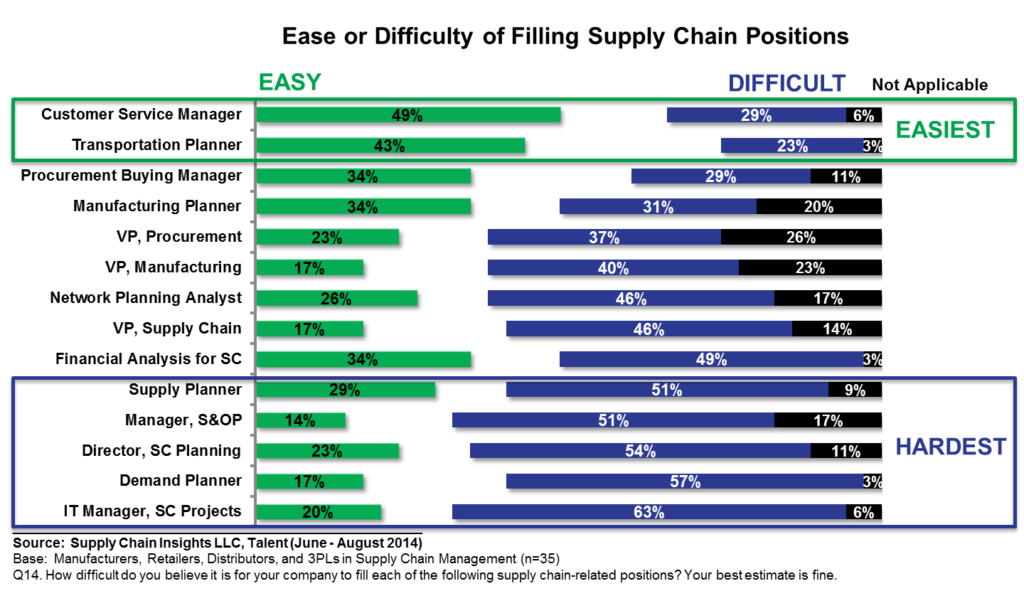
Talent management is not trivial, and supply planning is at the nexus of the talent problem. Today there is a shortage of mid-management supply chain talent; and as shown in Figure 1, some of the toughest positions to fill are in the area of supply chain planning. Supply chain planning requires a good understanding of the business, strong influence skills and deep analytic capabilities. These are hard to build, and the loss of a great planner can hurt.
Job satisfaction for supply chain planners is low. As a result, companies are churning planners—they are moving from one company to another. Due to the unique skill mix, it is difficult to recruit supply chain planners. Which makes me wonder, if we gave our supply chain planners more good old-fashioned love, would we have fewer open positions? And, if the position was more desirable, would the job have higher satisfaction causing others within the company to want to do the job more readily? I think so. Here I share my point of view.
What I See in the Data
From time to time at Supply Chain Insights, we do quantitative assessments of individual companies to understand the dynamics within the supply chain organization. These are private studies that we do for clients, and we keep the results of these studies confidential. However, time after time, we see a consistent theme in the data. Supply chain planners do not feel appreciated. The job is tough and the obstacles are many. Here are the seven issues that we see most frequently:
- Changing Priorities. It is hard for a planner to keep up with ever-changing priorities. Planning takes time and the use of optimization requires a clear objective function. With conflicting and ever-changing priorities, it is hard to do.
- Rewarding the Urgent. No Time for the Important. Most organizations reward the fire fighters. Planning requires a focus on the important and allowing planners time to plan. Culturally, this is a tough shift.
- Giving Planners Time to Plan. Good planning takes time. When an employee is always fighting fires, they do not have the time to plan.
- Making Their Positions Meaningful. At the end of the day, when we turn turn out the lights in our offices, we all want to think that we make a difference. Supply chain planners want their work to be used. They want to make a difference. Too few companies actually use their plans to make better decisions. The degree of this gap has grown greater in my time as an analyst. The good have gotten very good, and the average companies have gotten worse.
- Giving Planners Technologies That Are Easy to Use. The right supply chain planning tools have the right data model that is set up to adequately model the environment, and the planners are supported by easy-to-use business intelligence tools. As you can see in our reports on technology satisfaction, Voice of the Supply Chain, and Maximizing the ROI in Supply Chain Planning, both are an issue right now.
- Creating the Right Work Environment. Politics, and the lack of understanding of the basics of supply chain, are issues for supply chain planners. The planners see the gaps in the organization first, and they need leadership help drive alignment.
- Clarity of Career Paths. In the early days of creating a supply chain planning group, the positions were entry-level and there was high turnover. In the companies that do it well, there are established career paths that reward planning.
What I Hear in Discussions.
When groups are doing well, you don’t hear stories like these:
- “Yesterday, I presented the demand plan to my boss. He asked me to go back to my desk and create a better plan. When I asked him to define a “better plan,” he said that it would be one that showed the company growing with less demand error. When I asked him how to do this, he said just work on the plan and make it better. I shook my head. I cannot change the basics of the business.”
- “Good news travels fast in our company, and bad news is seldom communicated. So, when we run a demand plan on market data and see that products are not selling, our jobs become very uncomfortable.”
- “My boss criticized our work today on the demand plan stating that the demand error was too high. He mentioned to one of my colleagues that he wanted to recruit a new demand planning team to reduce the error. He just does not understand that the demand error is characterized by market conditions and what you are selling in the market. He thinks that he can just get a new team and that the demand error will magically go away.”
- “My general manager believes in having a high bias. He thinks that if you forecast high that you are going to sell more, then you will sell more. When I tried to explain the issues with over-forecasting on waste and inventory obsolescence, he was dismissive. We have to keep two sets of ‘internal books’. One set has the marketing and sales bias and the second has what we think that we are really going to sell.”
- “We are always on the hot seat. Whatever goes wrong, it is attributed to issues with the demand plan. I often feel that we are the scapegoat.”
Unfortunately, we hear these stories more than we’d like. So, on this sleepless morning, as I sit in Stockholm trying to recover from jet lag, I want to ask you a question. Have you given your supply chain planner some love today? If not, why not stop by their office this morning and make the first step. I think that it matters.
We will be discussing the issues and opportunities with supply chain talent in greater detail at our upcoming Supply Chain Insights Global Summit. We hope to see you there. If not, try to join us by ustream. Supply chain talent and the role of supply chain planning are topics that I think need to be elevated.