
Yesterday, I spoke at the University of Tennessee Supply Chain Leaders Forum on innovation. The presentation focused on nine themes. One of the nine was blockchain. I asked the audience for a show of hands to understand how many of the supply chain leaders in the room were testing blockchain. I saw no raised hands.
Later that afternoon, I hosted a webinar featuring blockchain case studies. The Supply Chain Insights webinar series is designed as an educational forum. We use our research as a backdrop, and host supply chain leader panels to have a discussion on the research topic. Yesterday, Bristlecone and IBM presented case studies. The case studies focused on cold chain safety/alerting for out-of-condition limits for milk transport in India and the use of blockchain for fresh produce monitoring. The webinar was well-attended. Over 180 people joined, and the question panel was the busiest I have ever experienced hosting a webinar. Lots of interest.
Why the disconnect of interest between the two groups? Blockchain is new. It is not well-understood. In the traditional world of supply chain management in the United States, the focus is on the Plateau of Productivity as shown in Figure 1. The current efforts are on improving functional metrics and traditional processes. While leaders talk “value chains,” the focus is on the “efficient enterprise” which underdelivers on creating value for the firm.
Figure 1. The Supply Chain Management Hype Cycle
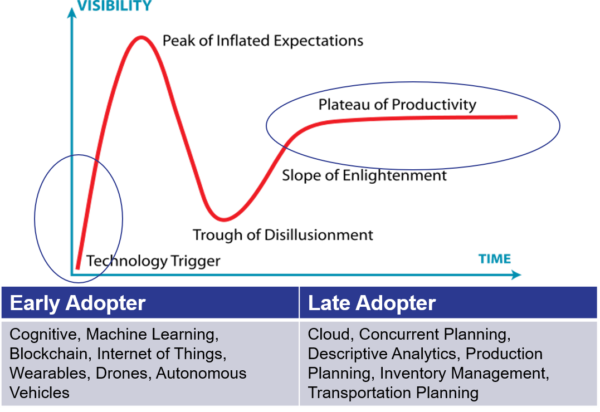
Conservative teams, programmed by large system integrators and technology providers, focus on the evolution of traditional supply chain technology approaches. The projects are on the plateau of productivity. As a result, there is very little time to focus on innovation. The focus is not on building value chains. Instead, it is on creating the efficient enterprise.
Rethinking Supply Chain Technologies
For the company, there is a huge opportunity cost. The singular focus on IT standardization and ERP migration hijacked supply chain innovation. ERP is not the foundation or the future of B2B processes. It is the system of record for enterprise transactions. Blockchain is a promising technology to redesign B2B processes, but we are at the beginning of the hype cycle, and we must manage the hype through the adoption. If we overpromise, we will kill innovation. Likewise, if we do not adequately test and learn, the technology will not evolve.
The questions on the webinar yesterday, centered on three themes. Here I share some insights:
- What is blockchain? I encourage all readers of the blog to learn for themselves. Read the short book, Blockchain for Dummies and visit the many blockchain demo sites on the web.
- How do I use blockchain? Start with use cases that are one-to-many (your company to your partners). Focus on something that is important to the company, but has clear governance. Examples include quality specifications, cold chain, return data, etc. Don’t start with cryptocurrency. Reference our past blogs for examples. Make the initial efforts small and clearly defined. Take small steps. Avoid big implementations.
- Define immutable. Blockchain is an immutable ledger. On the webinar, Juan Ruiz from IBM used an analogy that I loved. He shared the story from his boss. She describes immutable as completing a crossword puzzle with an ink pen versus a pencil. When you use a pencil on a crossword puzzle, you can erase the entries. However, in the use of the pen, the first entries stay and are then crossed through. This is a great analogy to understand “immutable” as it pertains to blockchain.
- What is the impact of blockchain on collaboration? This question is at the heart of the biggest barrier I see in the deployment of blockchain technologies. In the deployment of blockchain, the nodes (or designated parties) agree on the data. In today’s supply chain we do not share data well. We talk “collaboration” but supply chain teams cannot walk the talk. There is more of a focus on “wielding big sticks” than “carrots.” Yesterday, a presenter at the conference spoke of value and the use case presented was elongating Days of Payables by 120 days. I squirmed in my seat. This type of mentality is win/lose thinking. In contrast, true collaboration hinges on building win/win value propositions. For me , the greatest barrier for blockchain adoption is not with the technology, but with the definition of effective multi-tier processes.
For those interested in learning more on the evolution of B2B processes, please consider joining our Network of Networks share group. The next meeting is on December 4th in Indianapolis. It is an open group, focused on improving interoperability in B2B processes. At this next session, we will focus on current state of B2B, improving interoperability between existing networks (Elemica, E2open, GTNexus and SAP Ariba), and blockchain case studies. This open group is learning together. We limit attendance to 35 participants. We have 30 registered. Drop me an email at lora.cecere@supplychaininsights.com if you would like to attend.