 It is Saturday. This was a tough travel week on the East Coast by any measure. I’m rearranging my schedule as stranded friends cancel personal plans. As I write, a ferocious wind whips around my apartment windows reminding me that the weather always has the upper hand.
My goal in this blog post is to answer a series of questions I got from the audience when I spoke at a couple of conferences this week. The primary question was, “With so many things changing, what remains the same?”
Leading in the Face of Change
I am 63. I have been an industry analyst for sixteen years. I have never seen the rate of change which is occurring now. It is both unprecedented and disruptive. The supply chain leader is incredibly busy and made even busier by having to navigate systems that don’t work well. Unfortunately, this gives them little time to keep up. Many feel overwhelmed. To help, let me share the questions I got this week.
On Wednesday morning, when I finished speaking at the Foundation for Strategic Sourcing in Fort Lauderdale, an executive from J&J pulled me aside and said, “Our strengths, are now our vulnerabilities.” He continued, “Great mass marketing used be our differentiator, but now the barriers to entry have changed. Through digital marketing, small brands are cropping up all over, and it is sentiment analysis and digital content driving purchases. How do we compete?”
A supply chain leader from GE at another conference said, “Yesterday, we called it big data. Now it is just data. Similarly, we used to use the term e-commerce, now it is commerce. It is the same with digital marketing. The concepts now core to marketing practices. How do we keep up and manage the hype cycles that are happening so fast? How do we make the shift?”
My answer? Take a deep breath and carve out of a part of your team to build digital capabilities. This team, by design, is a small, scrappy one focused on a goal. Focus on a diversity of thought, background, and experience. Embrace the maverick spirit. Locate them in an innovation center, not a function. Challenge them to build new capabilities working with innovative technology leaders. The innovation you need today will not come from large consultants or technology companies. Why? I find most of them focus on improving the status quo and selling large system projects. New thinking will not come from functional leadership within the organization. Their focus is on continuous improvement of current processes.
So what to do? Make digital supply chain transformation a priority. Innovate at the edge and bring it into the core. I define the digital supply chain as “rethinking the atoms and electrons of the supply chain to improve value.” This takes many forms. It is not sufficient to just digitize data. Instead, companies need to build it into digital process redefinition like digital path-to-purchase, digital procurement, digital agriculture, digital manufacturing or digital service. In each of these process definitions, the “What?” changed along with the “How?”

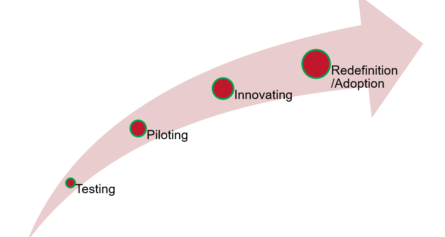
In this journey, expect natural tension from the functional stakeholders. They will want to hold on to their historic processes like Linus holds his blanket. Build stage-gate processes for digital innovation to pass through, and have the functional leaders drive governance of “go” or “no-go” at each gate of testing, piloting, reinventing, innovating, and redefinition. Sidestep the potholes. I am working with one company that made an error of handing over digital innovation to a strategic consulting group under the guise of improving “master data.” Buyer beware. No one can do the hard work for you. As you evolve to use “schema on read” capabilities and adopt machine learning, the master data issues that you have now go away. Likewise, this is not something you can expect from partnering with SAP, Oracle or Infor. (When I wrote the article on SAP: Three Reasons Why It Is a Risk to Your Business, My concern? I thought I was too harsh. However, the more I work in the space, the more I think that I should have been harsher. Companies placing their bets on working with SAP on digital innovation will quickly fall behind.) You will also find that the gap in marketing between IBM’s message and the reality of their solutions is bigger than you would like.
Figure 1. Phases of Digital Innovation
What Remains the Same?
While much is changing, the basic tenants of supply chain leadership are the same. Focus your efforts on solving meaningful business challenges while concentrating on three pillars:
Talent Development
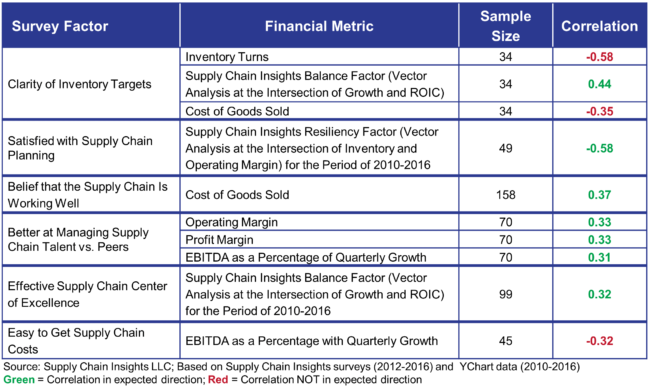
There is no substitute for talent development. In 2017, when we tested over 150 factors across 450 companies to understand correlations from our surveys, we found that companies who are better at managing talent will improve costs. And, when companies are better at supply chain planning (which is largely determined by talent development) their supply chains are more resilient and better balanced between cost and inventory targets.
Figure 2. Correlations between Quantitative Survey Data and Balance Sheet Analysis
Strategy to Network Design
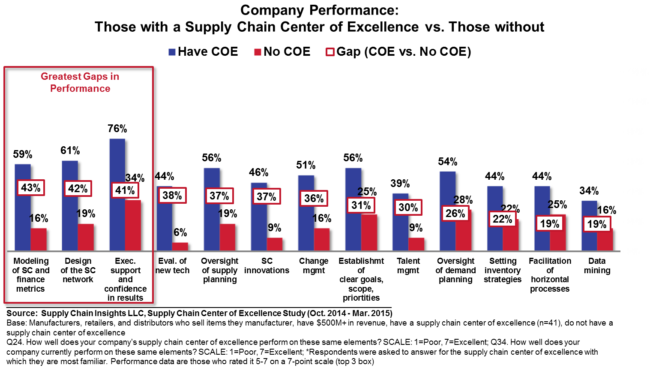
The best supply chains are designed against business goals with conscious trade-offs. Leaders make choices on strategy and these decisions are tied to network design parameters. The network design setpoints are then incorporated into supply chain planning assumptions. A strong center of excellence tied to network design is essential.
Figure 3. Importance of a Center of Excellence and Network Design
Drive Organizational Alignment
The organization does not naturally align. It requires leadership. Alignment matters. We now sit on a database of 9,000 respondents. Over six years, we have repeated questions in multiple surveys to get critical mass. We see that when companies have better alignment there is a belief their supply chain is working well. Cut down the friction. When manufacturing reports to a supply chain function, there is better alignment and a stronger belief the supply chain is working well.
Figure 4. Characteristics of Companies Believe Who Their Supply Chains Are Working Well

Use Common Sense
My last advice is to avoid hype cycles and stay grounded. Go forward by going forward. The world is changing under your feet so this is going to take some work.
I hope that this helps.
 We hope to see you at the Supply Chain Insights Global Summit on September 4-7, 2018 in Philadelphia, PA. We are building the program, and I am excited about the content. It is designed to enable business innovators to speak to digital innovators.
For more reading on the topic, check out the series of Linkedin Articles recently published. (I write on this blog, on LinkedIn, and on Forbes.)
Supply Chain Planning: Teaching an Old Gal New Tricks
Getting Off the Starting Blocks for An Agile Sprint
Managing Change in Digital Disruption
The Rough and Tumble Ride of Digital Innovation