

Lora's Latest Post

Losing Focus on Serving the Global Multinational

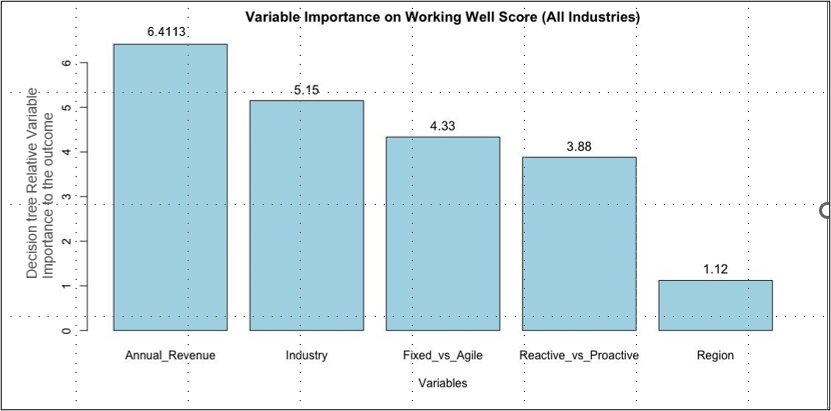
Supply chain leaders readily agree that industry differences exist in planning. Similarly, debate rages on the differences between regions. Industry differences trump regional definitions, but there is little recognition of the supply chain planning requirements by company size in the discussions. When it comes to defining solution success, mapping the requirements based on company size is more important than industry or region.

Today’s planning solutions serve small regional teams well, but the answer for the global multinational manufacturer requires bespoke wiring of solutions from multiple technology solutions. There is no good answer.

Figure 1. Analysis of Quantitative Surveys From the Last Decade
Getting To An Answer

The first step is to recognize the gap. In my interviews with global multinationals, I hear the need for an architecture that scales for hundreds and thousands of users. There is a need for discovery and what-if analysis, enabling insights not held hostage by laborious, time-consuming processes to run multiple batch jobs. Companies have not been successful in building planning solutions themselves. At the same time, academics focus on building better mousetraps (improving models and engines) in existing taxonomies versus redesigning work to ensure the security of the system of record and proactivity in systems of insights.

Figure 2. Rethinking Planning
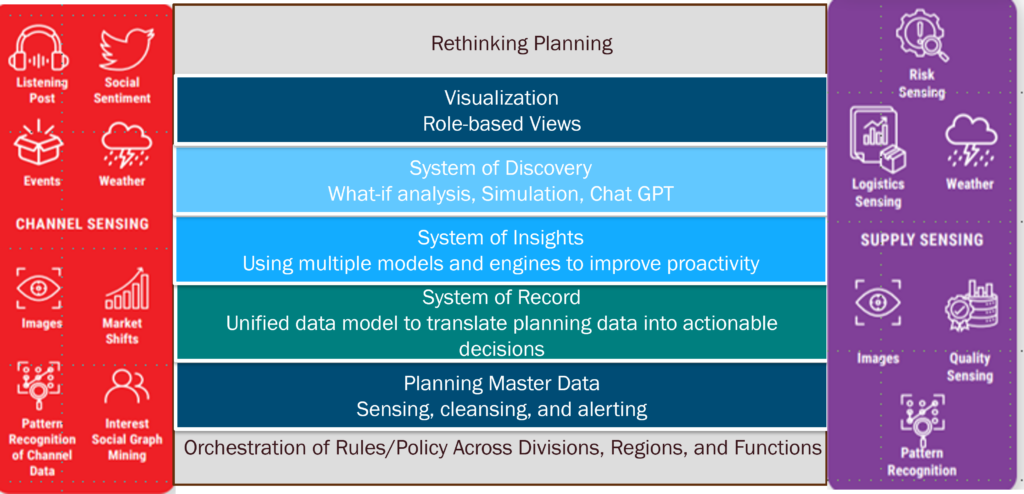
As we think about the promise of new forms of data analytics, the talk of “AI” without definition drives me crazy. There are so many techniques under the “AI” umbrella. The tragedy, I find, is when technologists slap the term “AI” on their marketing without sharing the specifics of how specific tactics drive outcomes. AI for AI sakes drives nothing other than the hype cycle. Here are some application possibilities:

Architectural ElementTechnique
Planning Master DataPattern Recognition and Machine Learning
Channel SensingLarge language models, Sentiment mining, Machine learning, and Graphical flow modeling
Supply SensingLarge language models, Retrieval Augmented Generation (RAG), Vector DB, Machine Learning, Pattern Recognition
Rules and PolicyRules-based Ontological Frameworks
System of RecordNoSQL No/Low Code, Unified Data Model
System of InsightsAgent-based Optimization, Probabilistic Demand Translation, Cognitive Learning Models
Systems of DiscoveryDigital Twin Simulation and Optimization
VisualizationWorkflow Automation and Role-based Views

Wrap-up

I look forward to hearing your thoughts. Why do you think we missed the mark in serving large, global multinational corporations?

And how do we stop the false AI rhetoric that has the industry spinning its wheels instead of addressing possibilities?


Search the Archives
Search
Share this Post
Email
Twitter
LinkedIn
Facebook
Pinterest
WhatsApp
Featured Image
Recent Posts

Is your Supply Chain AI Ready?

A simple quiz to assess an organization’s AI readiness.

The pace of change is fast and furious. Every day, technology advances faster than we can digest. A great challenge to have.

Determining whether a supply chain is “AI-ready” is less about technology and more about the gray matter between the ears of supply chain leaders. Leadership, alignment, and clarity of goals matter.

Too few companies are clear on the definition of supply chain excellence. Measuring and rewarding functional metrics reduces the firm’s value. Putting agentics on top of today’s processes can make bad practices run faster, reducing value.

The toughest job for the supply chain leader is challenging existing supply chain paradigms that were defined by the limitations of decades of supply chain technologies. As the curtain lifts on the potential of new forms of technology, process redefinition is our opportunity, but only if we are clear on what drives value. (Here, I link to the Supply Chains to Admire reports to help you define value. The next report will be published on June 23rd, along with my Dynamic Benchmarking Product, to help you define value in the face of your AI readiness. More information about the launch is at the bottom of this blog.)

Read More »

Case Study: A Scrappy Demand Management Approach

This study of Franklin Sports shines a light on the work that needs to be done at the sales account level to challenge a retail forecast, and also highlights the importance of a new technique for a forecast engine — reinforcement learning.

Artificial intelligence comes in many forms — large language models, generative AI, machine learning, unstructured text mining, deep learning, neural networks, reinforcement learning, agents, and agentics. While the industry is wigging out about agentics, I think reinforcement learning is a great step forward in the journey of Artificial Intelligence.

Read More »

Can We Side-Step the AI Spin Cycle?

When it comes to combining tech, 1+1+1 should equal more than 1. The impact should be exponential. Unfortunately, today, the answer is 0.

What do I mean? Let me explain.

I find that the supply chain technology market moves slowly along traditional technology lines. Conferences are usually focused on the use of technology, not on redefining work. This bothers me. I want it to bother you as well.

Here I share some insights to drive change.

Read More »

Supply Chain Health Check: The Power of an Orbit Chart

An orbit chart is a powerful tool for understanding the “health” of a supply chain and its potential for improvement. The supply chain is a complex, non-linear system with limited trade-offs. The relationship between trade-offs varies by industry, region, and size. The orbit chart is a diagnostic we use in the Supply Chains to Admire work. Here I explain the use case.

Read More »

Are You Writing a Check You Cannot Cash?

Don’t let a well-intending, but ill-informed consultant or technologist set an expectation that you cannot meet. No when wins when there is a check written that cannot be cashed. In this case, the consultant will move to the next account leaving you holding the bag. Fight back with a data-driven argument. Help the organization think about inventory more holistically.

Read More »