Lora's Latest Post

Digital Transformation: Where Was the Beef?

Where is the Beef? is now a colloquialism. The phrase started as a line in an advertisement in 1984 for Wendy’s hamburgers.

I remember sitting at SAP Insider listening to a compelling speech on digital transformation in the spring of 2017. As I listened, I scratched my head, and asked myself, “What does it mean to have a successful digital transformation?” What does digital mean in this context? And, how do we drive value?”

You know me. I am a geek. Definitions matter. I despise the use of hype-based rhetoric by technologists.

I then set off on a mission to gain more insights. The article I published was, “Are you active in the Digital Transformation Drinking Game?” My conference in 2018, showcased case studies of digital transformation. My favorite was the transformation of manufacturing by Agco, a manufacturer of heavy equipment. This one suprised me. It was brilliant. But, I found few to equal.

Where’s the beef?” is a catchphrase common in the United States and Canada, introduced as a slogan for the fast food chain Wendy’s in 1984. Since then it has become an all-purpose phrase questioning the substance of an idea, event, or product.[1]
Wikipedia

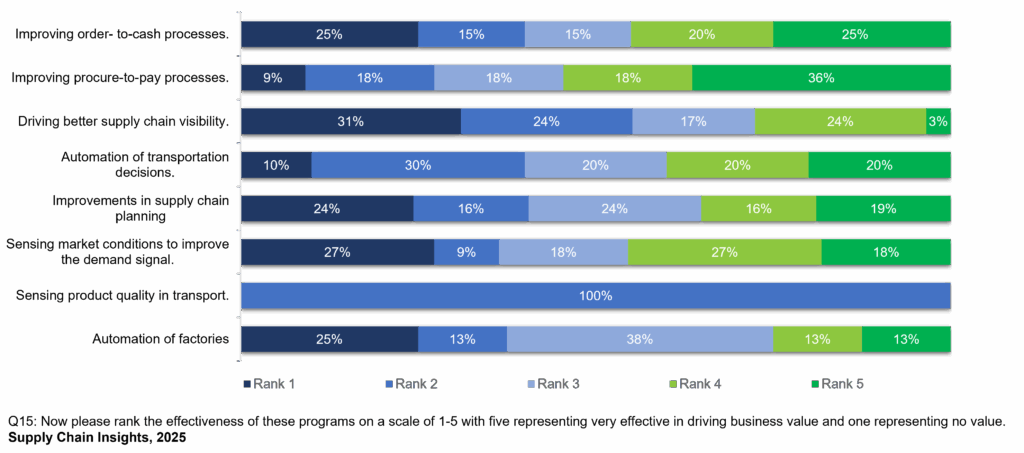
Since then, digital transformation is everywhere but nowhere. Lots of hand waving, and rhetoric. So, in my recent analytics survey, I wanted to find out in greater detail where companies feel that they got value. In short, manufacturers over 5B in annual turnover drove improvement in transactional efficiency in procure-to-pay and order-to-cash eleminating paper processes, but few drove value in supply chain planning or visibility.

Goal

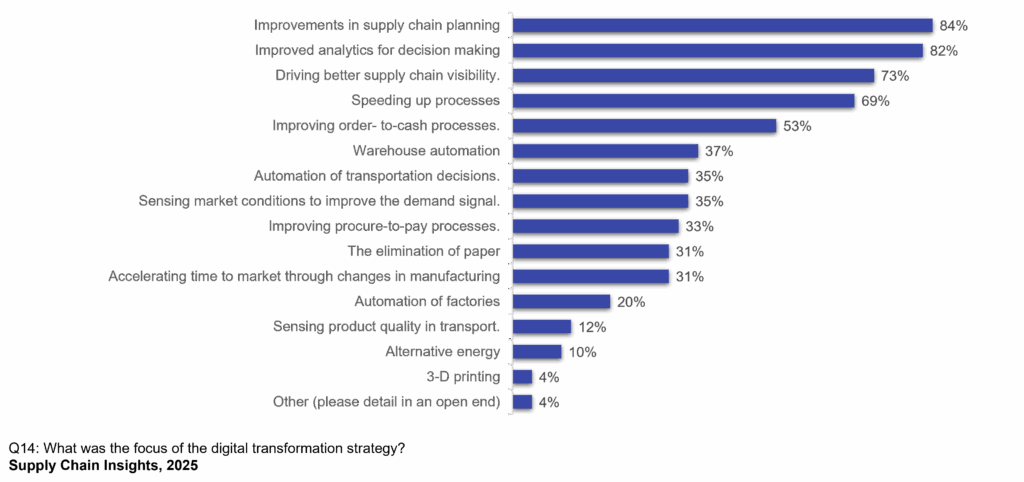
The primary goal of digital transformation was to improve planning and decision making. The announcements by SAP on SAP APO and the movement to SAP IBP, triggered many companies to evaluate alternatives driving an increase in spending in supply chain planning. Within the organization, 55% of the programs were driven by the CIO, and more than 45% of the programs are more than four years old.

The digital transformation model built by Deloitte with ASCM added to the hype. In my opinion, It was just bad. (Feedback shared multiple times with both Deloitte and ASCM.)

Figure 1. Goals of Digital Transformation
The Results

When you look at the results, companies were more successful in improving transactional efficiency than improving planning and supply chain visibility. The redefinition of transportation and the use of transportation streaming data remains an opportunity that few believe is currently driving effectiveness. (The issue is that we have to redefine Transportation Planning to gain true value. This is subject for another blog.)

Figure 2. Self-reported Effectiveness
My Take

The results do not surprise me. During the period, I conducted many qualitative interviews. I found some consistent themes:

  • IT Standardization Is a Death Knell for Planning. Sounds good. One throat to choke. A common vendor. However, planning is industry specific, and needs to be driven by business requirements. IT standardization as a mandate for supply chain planning seldom results in an effective deployment. And, deployment by a large consultancy is fraught with a high potential for failure.
  • Many Companies Used Digital Transformation as a Foil to Spend More on ERP. With the rise in maintenance costs and the reduction in budgets, many CIOs used digital transformation as an excuse to spend more on unfinished projects.
  • Few Companies Understand Supply Chain Planning. As I speak and work with clients, I am surprised at how few companies (this is includes most consulting firms) understand the basics of supply chain planning. The lack of clarity on requirements is the first of many stumbles when the functionality and work requirements are not clear.
  • Delivery Methods Lacking. With the rise in spending, the deployment methods of the supply chain planning technologists were not equal to the challenge. Most assumed the client was clear on the requirements. Most were not.

This is my take. I would love to hear from you.
Search the Archives
Search
Share this Post
Email
Twitter
LinkedIn
Facebook
Pinterest
WhatsApp
Featured Image
Recent Posts

Lead Time: A Broken Gossamer

If you are struggling with supply chain planning, dancing in the light of shiny objects, and scratching your head, please read on. My goal is to help you.

Please do not AI Stupid. What do I mean? AI Stupid is putting agents and agentics on top of existing architectures believing that making them faster and hands free add value. To me, this is fools play.

I love AI. I am excited about new technologies. To this end, I want to shine a light on how new technologies can help address the black holes and inconsistencies in today’s supply chain, which largely stem from the limitations of the first generation of supply chain planning and execution technologies. In this blog, I give you three places to start.

Read More »

Do You Need a Supply Chain Coach?

Supply chain is where the rubber hits the road. For a public company, over 40% of market capitalization is tied to the trade-offs between growth, operating margin, inventory management, and Return on Capital Employed.

The road for supply chain improvement is fraught with issues. Here we share some and offer some advice.

Read More »

Is your Supply Chain AI Ready?

A simple quiz to assess an organization’s AI readiness.

The pace of change is fast and furious. Every day, technology advances faster than we can digest. A great challenge to have.

Determining whether a supply chain is “AI-ready” is less about technology and more about the gray matter between the ears of supply chain leaders. Leadership, alignment, and clarity of goals matter.

Too few companies are clear on the definition of supply chain excellence. Measuring and rewarding functional metrics reduces the firm’s value. Putting agentics on top of today’s processes can make bad practices run faster, reducing value.

The toughest job for the supply chain leader is challenging existing supply chain paradigms that were defined by the limitations of decades of supply chain technologies. As the curtain lifts on the potential of new forms of technology, process redefinition is our opportunity, but only if we are clear on what drives value. (Here, I link to the Supply Chains to Admire reports to help you define value. The next report will be published on June 23rd, along with my Dynamic Benchmarking Product, to help you define value in the face of your AI readiness. More information about the launch is at the bottom of this blog.)

Read More »

Case Study: A Scrappy Demand Management Approach

This study of Franklin Sports shines a light on the work that needs to be done at the sales account level to challenge a retail forecast, and also highlights the importance of a new technique for a forecast engine — reinforcement learning.

Artificial intelligence comes in many forms — large language models, generative AI, machine learning, unstructured text mining, deep learning, neural networks, reinforcement learning, agents, and agentics. While the industry is wigging out about agentics, I think reinforcement learning is a great step forward in the journey of Artificial Intelligence.

Read More »

Can We Side-Step the AI Spin Cycle?

When it comes to combining tech, 1+1+1 should equal more than 1. The impact should be exponential. Unfortunately, today, the answer is 0.

What do I mean? Let me explain.

I find that the supply chain technology market moves slowly along traditional technology lines. Conferences are usually focused on the use of technology, not on redefining work. This bothers me. I want it to bother you as well.

Here I share some insights to drive change.

Read More »

Supply Chain Health Check: The Power of an Orbit Chart

An orbit chart is a powerful tool for understanding the “health” of a supply chain and its potential for improvement. The supply chain is a complex, non-linear system with limited trade-offs. The relationship between trade-offs varies by industry, region, and size. The orbit chart is a diagnostic we use in the Supply Chains to Admire work. Here I explain the use case.

Read More »