When I was a young girl, we received one television channel.
Rabbit ears on top of the TV helped us get more channels.
We loved the new world of black-and-white TV. The transition to the color TV experience, when I was in college, was fantastic. The evolution of viewing options — Netflix, Amazon streaming, cable TV — stretched beyond our limited imaginations. In my lifetime, we have redefined home entertainment.

Reflection
I entered the world of manufacturing during the era of black-and-white TV.
At that time, sales and operations planning was a manual process. We forecasted based on historical sales and met monthly as a team to develop a potential line schedule. Not a lot has changed. Despite the implementation of advanced planning systems (APS) and enterprise resource planning (ERP), the process remains largely manual.
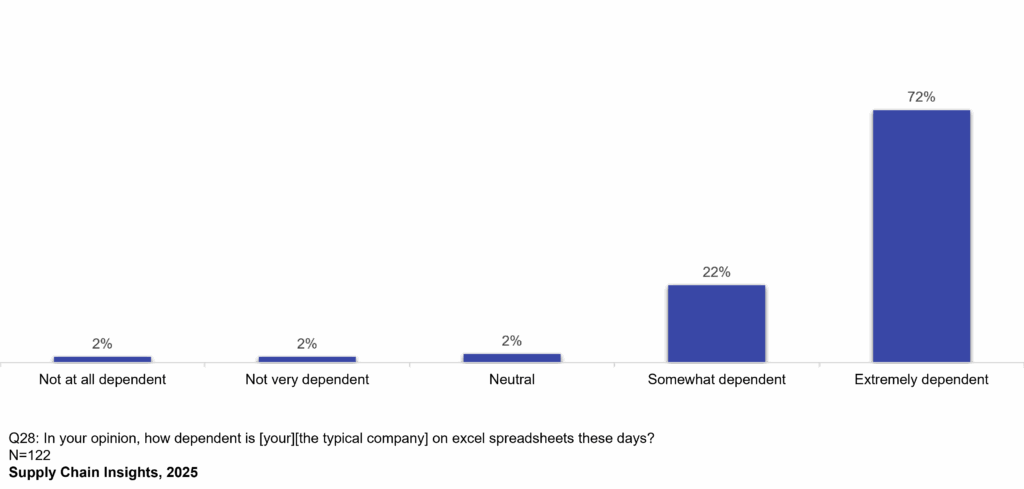
The most significant improvement came from the introduction of the Excel Spreadsheet. (Funny, but sad. Right?) Today, 92% of organizations operate some supply chain planning system; yet, as shown in Figure 1, 94% are highly or somewhat dependent on spreadsheets. Sadly, for most organizations, advanced planning became a system of record.
How do I form these opinions? I have completed 17 qualitative and 12 quantitative studies on S&OP and written 10 research summaries, first for Gartner, then for AMR Research, and finally at Supply Chain Insights. Many of the insights are summarized in the Shaman’s Journal series.
Figure 1. Organizational Dependency on Spreadsheets
S&OP should align the organization while providing insights on how to maximize the business strategy within the tactical planning horizon (outside of supply lead time). The best processes balance the “S” with the “OP.” Unfortunately, many processes today are hijacked by corporate politics. They are not balanced. Functional metrics and bonus incentives derail most processes.
So, what if we stretch our minds and redefine Sales and Operations Planning (S&OP) beyond the current state? Let me use a weather metaphor as an example.
Stretch Your Imagination
I imagine a world for S&OP where agentic AI develops multiple spaghetti-planning models for the coming months based on playbooks. The planner, as an orchestrator, shares the modeling parameters (through writing prompts) with the system before the planning period, after which the system develops multiple plans based on knowns and unknowns. The spaghetti models enable easy visualization of the unknowns.
I first encountered the concept of using planning books (multiple what-if analyses based on assumptions) when I was working with Eli Lilly in 2004. At the time, the process was manual. I wrote about it as an AMR Research analyst, and inquiries spiked. The demand was high, but there were no good technology options for my clients.
The process focused on likely business outcomes. At the time, Eli Lilly was competing heavily against Nova Nordisk in the launch of new diabetic treatments. The combination of platform delivery options (pill, injection, etc), dosage, and regional requirements drove uncertainty. Regulation precluded postponement.
Traditional APS approaches are designed for a world where items are forecastable and uncertainty is low. Recently, as I have been working with native AI platforms, the concepts of planning books and spaghetti models have merged in my brain as a potential option for S&OP.
What are Spaghetti models? It is a technique used in weather forecasting to display multiple possible paths for a storm, most often used during hurricane season. Each line in a model represents a different forecast run based on varying data inputs, creating a tangled “spaghetti-like” appearance. The primary function of a spaghetti model is to convey the range of possible storm paths, emphasizing uncertainty rather than a single model. This approach provides a visual representation of the possible trajectories for a weather system, offering insights to improve preparedness.
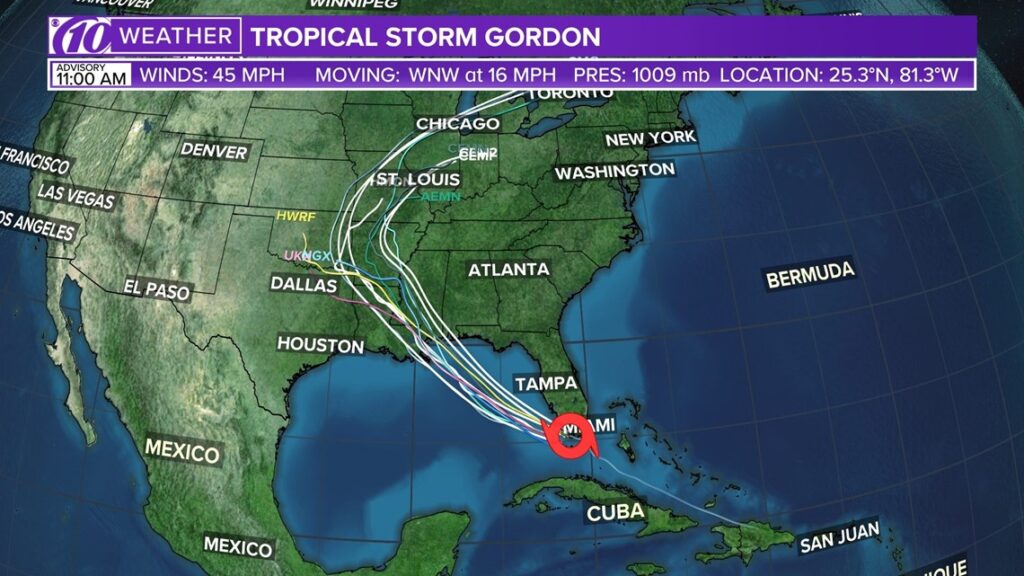
If we use spaghetti models to forecast uncertainty in S&OP, the supply chain planning system is connected to market data. (A planning master data system is continuously fed information on plant schedule adherence, quality of conformance, conversion rates, change-overs, inbound transit times by lane, prices, and labor/equipment availability.) The system’s output within the tactical horizon would be a set of spaghetti models to help business leaders gauge and visualize uncertainty.
To drive a plan to a system of record, each plan carries a probability. The range of probabilities across all plans forms the effective frontier for operating in the upcoming period. As new data becomes available, the plans are consumed — from tactical to operational planning — based on market data. S&OP stakeholders can visualize plan consumption daily and post questions and concerns for the model.
Key to this new process is agreement by all stakeholders on “what good looks like.” This includes customer segmentation prioritization, a balanced scorecard (functional metrics are replaced by reliability goals, enabling the functions to support improvement of the balanced scorecard), and the management of complexity. For most, this will be the most challenging task.
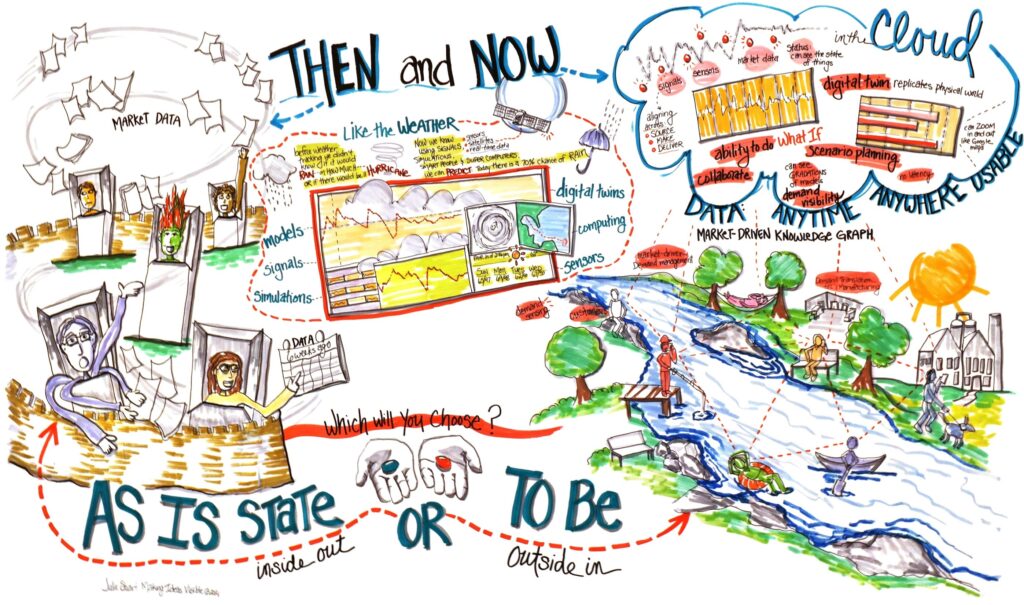
Meetings are virtual. Goals are aligned. No one feels pressured to buy into THE plan. The multiple plans help teams visualize uncertainty. Each model has a probability, and the analysis of all the probabilities defines the effective frontier of outcomes. This frontier of outcomes helps to translate demand into planned orders and aggregate buying plans for commodities and direct materials/transportation requirements.
These models and probabilities are available for all to view. (Not only the plan, but the impact of the plan with the enablement of self-service modeling for what-if analysis.) As the calendar progresses, a small team guides plan consumption and, when there is a choice, answers modeling questions. (An S&OP execution team.
Wrap-up
What I see in demos from tech providers aiming to drive value through agents is automation of today’s processes. A better forecasting engine. Probabilistic modeling. A deeper inventory optimization approach. The better use of streaming data for sensing. Yadda yadda.
So, many experts are applying new technologies to improve current processes. Yawn.
I don’t see anyone attempting to redefine S&OP in the same way Netflix redefined entertainment. I feel that we are caught in the AI stupid lane, fiddling with rabbit ears on the black-and-white TV as the world of technology evolves around us.
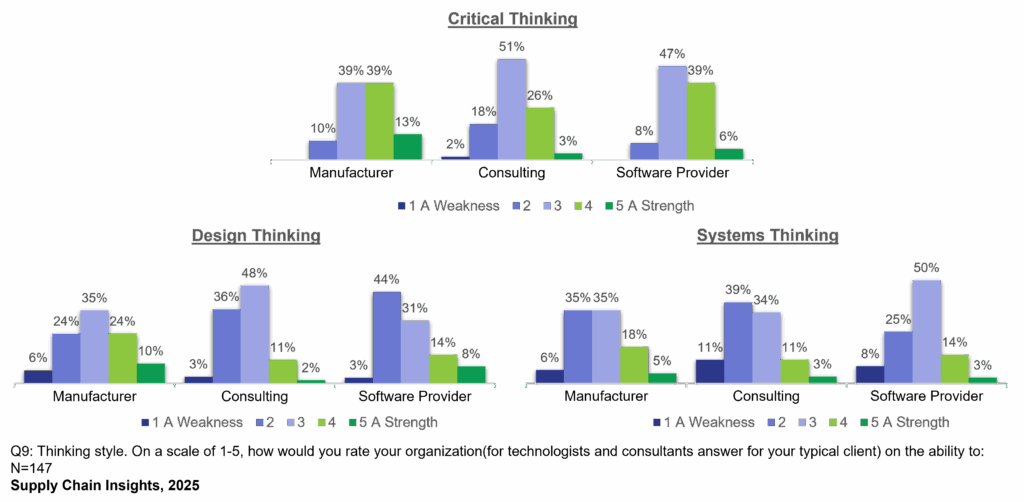
As we seize opportunities and potentially drive innovation, I am thinking a lot about thinking styles and the alignment of critical, design, and systems thinking to capitalize on the potential of new approaches to drive process automation. The reason? We are stuck as an industry.
Note in Figure 3 that manufacturers rate themselves higher on thinking styles than consultants and technologists do. Teaching critical, design, and systems thinking is an opportunity for both internal training programs and academia.
The supply chain is a complex, non-linear system with rising uncertainty. Current processes model the relationship between knowns and knowns, but miss modeling unknowns.
Improving planning processes requires critical and systems thinking. Making new approaches usable requires design thinking.
Figure 3. Analysis of Thinking Styles
OK. Here I share a vision. I am sure that there will be a lot of naysayers, and that is ok. I have thick skin. My goal in this blog is not to provide AN ANSWER. My goal is to stimulate conversation and for us not to AI Stupid. As uncertainty increases, we need to look past traditional definitions of APS.
I look forward to hearing your vision. Please join the dialogue. Let’s break traditional norms because today’s S&OP processes don’t work so well.
Meanwhile, I am busy working on the analytics of the artificial intelligence study that I just pulled from the field. If you helped me and answered my survey, I send a hearty thanks!
Happy holidays to all my readers.