
Lora's Latest Post

Time to Take Out the Pen

When you get asked the same question over and over again it is time to take out the pen and write a blog post. Here it goes…
Last week, when I was sharing the recent results of the Supply Chain Insights Sales and Operations Planning study with survey respondents and attendees to our public training, one question kept coming up. It was “How do the change management issues differ by level of S&OP maturity?” Here I answer this question.
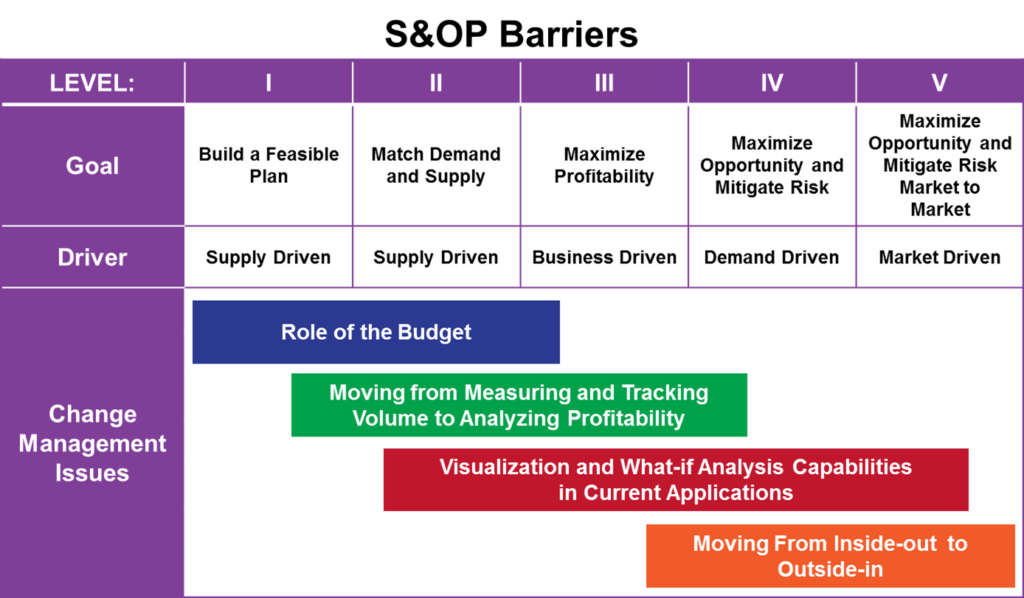
Figure 1.

There are usually four distinct change management stages as shown in figure 1. When companies are early in their infancy in managing an S&OP process, the biggest barrier is typically the role of finance and the integration of the S&OP process to the financial budget. For many organizations, this is a tough obstacle. I have seen financial guys kicked off of the S&OP team. It takes time and education for companies to align. The budget is developed as a planning tool at the first of the fiscal year. It is a guide, but should never be used to constrain the S&OP plan. Instead, the goal becomes maximizing opportunity while mitigating risk. In this process, budget assumptions are aligned to market actuals.
The second barrier is moving from a focus on matching demand and supply (managing volume) to maximizing profitability. The change management issue is that the technologies do not do this well. And, calculating profitability in today’s complicated business environments is not so easy. Only 23% of companies feel that they have systems and processes that enable the translation of volume to profitability analysis. At this stage of the process, which is often called Integrated Business Planning (IBP), companies will usually build something on their own to augment the traditional functionality of Advanced Planning Systems (APS).
As they get more fluent in profitability analysis there will be a thirst for visualization and “what-if ” analysis. Only 11% of companies self-assess as having the ability to complete “what-if” analysis well. Most systems are just too inflexible.
Probably the greatest challenge of all lies in the transformation from inside-out to outside-in to become market driven. This usually requires the reimplementation of technologies and processes and the building of demand and supply networks to connect with market data. I find this stage the most exciting and enjoy helping companies to rethink their processes through the training.
Let me know your thoughts. Did I miss anything?

Search the Archives
Search
Share this Post
Email
Twitter
LinkedIn
Facebook
Pinterest
WhatsApp
Featured Image
Recent Posts

Navigating Supply Chain Economic Downturns

In 2007, the average company took six months to sense market shifts and adapt its supply chain. My estimate, based on work with clients, is that if a downturn happened today, the average company would take 20-30% more time to adjust than in 2007. Here I give insights on preparedness.

Read More »

Warning: Sidestep the Narrative of the Misguided Goldiggers

Ten years ago, I started writing a book titled Stories of the Misguided Gold Diggers. The book was a collection of stories from two decades of stories of technology leaders perpetuating the myth of integrated end-to-end supply chain planning.

I dusted off the manuscript on Saturday. I think that we have a new chapter. Companies focused on putting Artificial Intelligence (AI) on top of existing architectures are putting AI Stupid on steroids.

Read More »

The Myth of End-to-End Planning

Supply chain planning, supply management, supply chain execution, network design, and transportation/logistics management operate in silos. Not much has changed over four decades. The connections flow back through transactional systems: order-to-cash and procure-to-pay. There is a myth that companies can buy an end-to-end supply chain management solution. This is largely a myth. Here we explain.

Read More »

Lead Time: A Broken Gossamer

If you are struggling with supply chain planning, dancing in the light of shiny objects, and scratching your head, please read on. My goal is to help you.

Please do not AI Stupid. What do I mean? AI Stupid is putting agents and agentics on top of existing architectures believing that making them faster and hands free add value. To me, this is fools play.

I love AI. I am excited about new technologies. To this end, I want to shine a light on how new technologies can help address the black holes and inconsistencies in today’s supply chain, which largely stem from the limitations of the first generation of supply chain planning and execution technologies. In this blog, I give you three places to start.

Read More »

Do You Need a Supply Chain Coach?

Supply chain is where the rubber hits the road. For a public company, over 40% of market capitalization is tied to the trade-offs between growth, operating margin, inventory management, and Return on Capital Employed.

The road for supply chain improvement is fraught with issues. Here we share some and offer some advice.

Read More »

Is your Supply Chain AI Ready?

A simple quiz to assess an organization’s AI readiness.

The pace of change is fast and furious. Every day, technology advances faster than we can digest. A great challenge to have.

Determining whether a supply chain is “AI-ready” is less about technology and more about the gray matter between the ears of supply chain leaders. Leadership, alignment, and clarity of goals matter.

Too few companies are clear on the definition of supply chain excellence. Measuring and rewarding functional metrics reduces the firm’s value. Putting agentics on top of today’s processes can make bad practices run faster, reducing value.

The toughest job for the supply chain leader is challenging existing supply chain paradigms that were defined by the limitations of decades of supply chain technologies. As the curtain lifts on the potential of new forms of technology, process redefinition is our opportunity, but only if we are clear on what drives value. (Here, I link to the Supply Chains to Admire reports to help you define value. The next report will be published on June 23rd, along with my Dynamic Benchmarking Product, to help you define value in the face of your AI readiness. More information about the launch is at the bottom of this blog.)

Read More »