
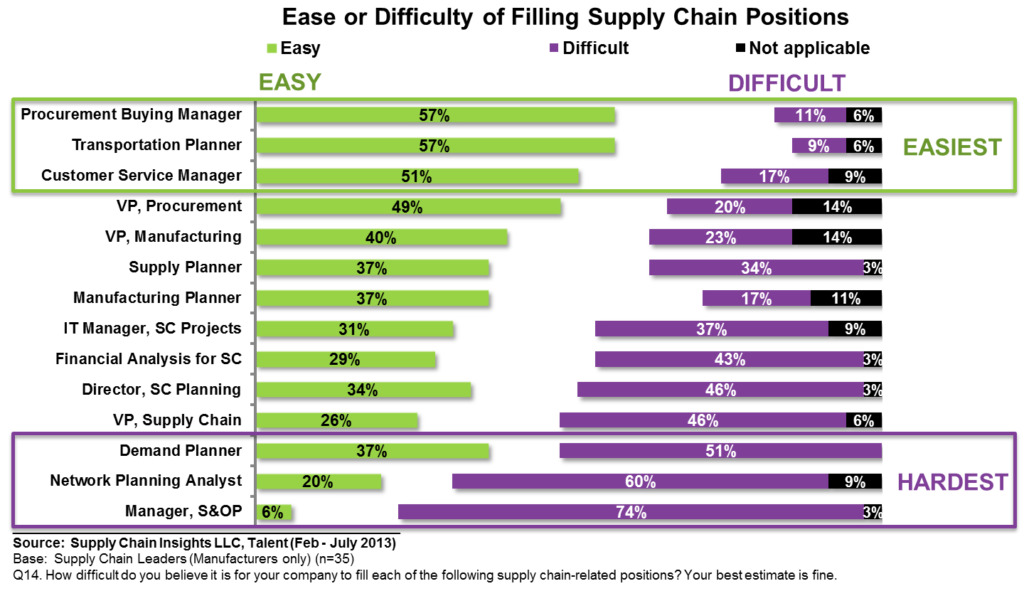
Today, I finished up a report on supply chain talent. After doing the analysis of the results, I even more firmly believe that supply chain talent is the missing link in the supply chain. In figure 1, I outline the company’s biggest gaps. It is the sourcing and development of mid-management talent. YOWZA! It is large.
Figure 1.

Isn’t this ironic? Most of the current company’s efforts are focused on new-hire recruitment or mentoring for high-performance development for executive level positions. There are few companies that understand and have addressed the mid-management talent issue. OUCH!
Figure 2.

As a result, mid-management supply chain talent is getting short shrift. If you cannot make our Thursday webinar or the Supply Chain Insights Global Summit, here are a couple of facts to consider:
Opportunity to improve. Overall, companies rate their capabilities to manage supply chain talent worse than their peers. In the study, when companies were asked to self-assess their capabilities to manage supply chain talent, 17% self-rated that they perform better than their peer group while 34% reported that they do worse than their peers. And, we all know that self-assessment scores tend to overstate capabilities. <It is a bit like me reporting my weight on my driver’s license.> I think that it is worse than reported…
High turnover. Average turnover of supply chain managers is 15%. It is increasing. In the study, 46% of companies attempt to hire from within the company, and 17% fill roles primarily through recruiting talent from other companies. External recruiting is becoming less and less successful.
Shortage of talent. The average company in the study has four positions open for five months. Companies are is feeling the pain of open positions. The most difficult positions to fill are in the areas of planning that require both a technical mastery of technology and an organizational understanding of the business drivers.
Stiff competition for college graduates. Today, there is a 6:1 demand to supply ratio for new college graduates in supply chain management. Competition is intense and there is a lot of effort to attract the best and brightest from college recruiting; however, the larger issue is with the retention of mid-management talent.
Working on the Right Stuff? In short, we need to broaden our scope. The current focus is on recruiting college graduates and high-performing talent with little attention being given to middle-management talent development. Only 23% of companies responding to the study have a planned cross-functional training program for existing employees. This study points out the need for skill development in the areas of training and career progression to give employees cross-functional breadth.
Want to know more? On Thursday this week, I will be joined by three of my favorite people—Joe Krkoska, Dow AgroSciences; Nick Little, Michigan State; and Marcia Conner, Sensify (a specialist in adult learning)—for a webinar on Supply Chain Talent. In this session, we will be sharing insights from our recent study. We will continue this discussion at the upcoming Supply Chain Insights Global Summit in Scottsdale, AZ on September 11th and 12th.
I would love to hear your thoughts. Does the study mirror what you are seeing in your organization?

My Answer to Joe. The Future of APS
Traditional Advanced Planning Systems (APS) are unlikely to become true enterprise platforms because organizations remain functionally siloed, metrics are misaligned, and current APS architectures were designed for an environment that has fundamentally changed. Here I share how I think that APS systems can adapt to drive more value.