

Today I’ll present the Supply Chains To Admire 2015 Analysis at the Supply Chain Insights Global Summit in Scottsdale, AZ. The theme is “Imagine the Supply Chain of 2025.” It is our third year of hosting the conference. We will also announce the winners of the Supply Chains to Admire methodology for 2015.
Today, supply chain excellence is easier to say than define. To drive success in the journey leaders need to know where they are going. Currently it is not clear. It needs to be. We want to help. It is for this reason that we analyze the patterns of the Supply Chain Metrics That Matter using orbit charts over the period of 2006-2014. The work is designed to analyze supply chain leader success on a portfolio of metrics.
Sharing of the Supply Chains to Admire Work
In our analysis of the 2015 Supply Chains to Admire work, we analyzed 320 companies in 23 industries on growth, operating margin, inventory turns and Return on Invested Capital (ROIC) for the time period of 2006-2014. Nine out of ten are stuck, unable to make improvements in these Supply Chain Metrics That Matter. In this analysis we evaluate relative performance and improvement of a company on the supply chain metrics of growth, operating margin, inventory turns and ROIC within its peer group. The 26 companies outperforming their peer group are listed in Figure 1.
Figure 1.
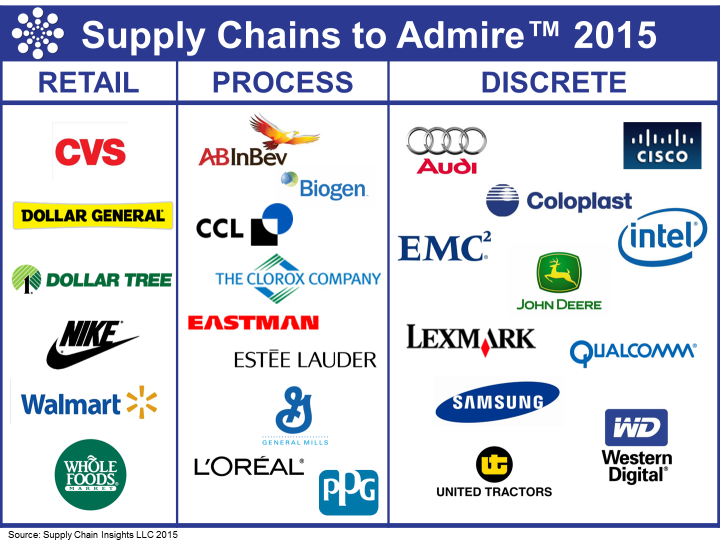
Forty percent of these companies made the list for two consecutive years. Today we will celebrate this accomplishment with three of them: General Mills, Intel, and Eastman Chemical. The presentations and dialogue with the audience will be videotaped and shared openly next week.
What Have I Learned?
This is the second year I have poured over what always seems like an endless pile of spreadsheets and orbit charts. In my presentation I will share three insights:
- Focus on Industry-Specific Analysis. The evaluation of a company within a peer group is essential since each industry has a unique potential with very different rhythms and cycles. Putting all companies in a spreadsheet and shaking it up and declaring a winner is fool’s play.
- Sustaining Performance Above One’s Peer Group Is Difficult. Many leaders are losing ground due to complexity. While the adoption of traditional processes and technologies can take companies to a certain level, they plateau. The performance levels are hard to sustain.
- Complexity Throws the Supply Chain Out of Balance. As power shifts to the consumer, and growth slows, companies are adding products and services attempting to stimulate demand. The added complexity throws the supply chain out of balance and erodes performance.
Later this morning I will stand on stage and share the results. I am proud to introduce a methodology which can be applied across industries in benchmarking analysis. As you read the analysis in our new report, I would love to hear your feedback. It is our goal to build the de facto standard to judge supply chain excellence. Help us to mature and evolve the methodology.
About the Author:
 Lora Cecere is the Founder of Supply Chain Insights. She is trying to redefine the industry analyst model to make it friendlier and more useful for supply chain leaders. Lora wrote the books Supply Chain Metrics That Matter and Bricks Matter, and is currently working on her third book, Leadership Matters. As a frequent contributor of supply chain content to the industry, Lora writes by-line monthly columns for SCM Quarterly, Consumer Goods Technology, Supply Chain Movement and Supply Chain Brain. She also actively blogs on her Supply Chain Insights website, for Linkedin, and for Forbes. When not writing or running her company, Lora is training for a triathlon, taking classes for her DBA degree in research at Temple or knitting and quilting for her new granddaughter. In between writing and training, Lora is actively doing tendu (s) and Dégagé (s) to dome her feet for pointe work at the ballet barre. She thinks that we are never too old to learn or to push an organization harder to improve performance.