In 1993, I implemented supply chain planning systems for a company named Manugistics. My focus was demand and supply planning, and my talented friend, Ellen, implemented logistics planning (TMS).
Our goal was to implement end-to-end planning for our client. We tried, but failed. After sitting on our beds and poring over manuals while eating takeout for hours, we couldn’t figure it out. So, we asked the larger Manugistics organization for help and discovered that, at that time, the only possible connection between tactical supply planning and transportation planning was order management. So, we mapped TMS to order management and order management to forecasting/distribution planning.
On the same day, we attempted to map planned orders in tactical planning to transportation requirements and freight constraints back into S&OP; the company issued a press release on end-to-end planning. We laughed.
We gave up trying to do more than map supply chain planning into ERP and then back out to TMS. Today, when I see Ellen at a conference, we still laugh. Thirty-five years later, not much has changed.
Manugistics assets were sold to JDA in 2006, which, through a series of revs, became a part of Blue Yonder. Blue Yonder’s tagline is Frictionless Outcomes. The Company claims to deliver end-to-end supply chain management. The reality is there is no such thing as end-to-end supply chain management.
My goal is not to pick on Blue Yonder, but to give you an example. Browse through any of the supply chain planning or supply management solution websites, and you will see the term end-to-end supply chain management in multiple places. The problem is that end-to-end supply chain management does not exist.
We should be using the new capabilities within AI frameworks to define:
- What decisions should be made?
- Who should make the decision?
- At what frequency should the decision be made?
- What defines a good decision?
In general, we are not. Instead, we are hanging agents and agentics on old-fashioned architectures like icicles on a holiday tree.
Straight Talk
I am known for straight talk.
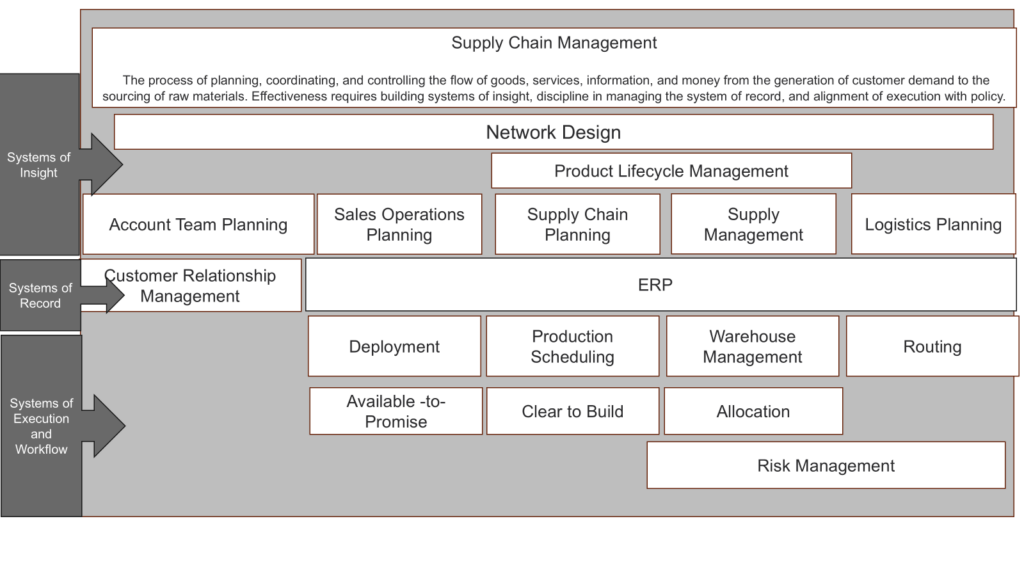
Supply chain planning, supply management, supply chain execution, network design, and transportation/logistics management operate in silos. Not much has changed since Ellen and I worked together in 1992. The connections flow back through transactional systems: order-to-cash and procure-to-pay. Planning connects through an ERP bill of material to drive MRP (or DDMRP), but there is still no process flow to map planned orders from tactical supply planning (S&OP) to supply management (another name for procurement) for aggregate buying functionality or transportation planning. In short, the Systems of Insights for Supply Chain Management are disjointed. The language is packed with nuance, and the term “AI” is slathered everywhere. The technology promises sound good, but the reality is disconnected flows.
Newer solutions are emerging at the fringes of today’s technologies, but they do not fit into traditional taxonomies. There is no proven method to connect supply chain visibility flows — think vendors like Four Kites, Project 44, and Shippeo —into supply chain planning processes. This is the case despite valuable insights. Risk management technologies search for anomalies and provide early alerting, but there is no common data model, consistent definition of events, or workflows.
Traditional software players focus primarily on retail and make-to-stock flows. The discrete industries are underserved. The flows between Product Lifecycle Management and supply chain planning are underdeveloped. Software solutions like Pelico are automating clear-to-build for make-to-order and configure-to-order manufacturers, while Lean DNA tracks supplier conformance for discrete manufacturers.
How can we align if process flows cannot map the systems of insights and workflows across functions? Each system has a different definition of location, item, events, order, and purchase orders.
Supply management and supply chain planning operate in separate silos. Logistics and distribution planning have very little in common. There is no common data model.
Steps to Take
The first step is to have technologists and consultants speak in clear English. (If not English, insert the language of your native tongue). Force the technologists to identify themselves on the taxonomy map in Figure 1 and map the flows between their technologies to the systems of insights, systems of record, systems of execution, and the resulting workflows.
The second step to take is to get clear on the use of AI. Throw away the hype. Clearly understand each technologist’s value proposition. Get clear on the “So What” and “Who Cares.”
As a team, build an image that helps to define terms and interconnections. Don’t confuse the systems of insight with the systems of record and the systems of execution. Try to keep the flows clean. My crude drawing from lunch with a client is shown in Figure 1.
Figure 1: Definition of Solutions Under Supply Chain Management
After identifying flows and establishing a common vision, build a unified data model across the solution stack and define the canonical, rules-based ontological frameworks and a planning master data layer. In your selection of technologies, focus on minimal latency, but cast off terms like real-time execution.
This will help the team align and speak a common language.
Then, and only then, start the discussion on redefining work and improving capabilities through AI. Identify your requirements and build value. Then call me. I want to write your case study.
I hope this helps. I look forward to your thoughts.