You have brains in your head, and feet in your shoes. You can steer yourself any direction you choose. You’re on your own and know what you know. And, you are the only one that will decide where to go.
Dr. Seuss
In this blog we are going to focus on the word part.
By definition it is one of the pieces, sections, qualities, etc., that make or form something.
Merriam-Webster Dictionary
I love Dr. Seuss. When my daughter was six, I would beg her to let me read her another whimsical Dr. Seuss story before she went to bed. It was fun. The words from Seuss would flow from the pages as I held a promising young girl full of life and energy. We laughed at the illustrations. The sing-song words rang through the night air as we turned out the light and said good-night.
Tonight, as I return from a client, I thought that I would start with Seuss to lighten up a bad story. It is a story of parts. It is a tale of pieces that do not assemble to build the whole. It is 2014. Leaders tell me the real story of monies spent and pennies saved. The consultants and technology vendors tell the stories of small dollars invested and large value gained. The advertisements in the airports boast of great gains. There is a disconnect. I do not see value when I am visiting clients. So I ask myself, “Why?” These leaders are well-equipped. They have brains in their heads and feet in their shoes. They can steer themselves any direction they choose. Why are we not making more progress?
Let’s start with history. We have been at this for at least thirty years. This is not a new topic. ERP was designed to deliver transactional efficiency. It accomplished this goal. It was not designed to be a planning architecture.
At the beginning of the last decade, the promise of the tightly-integrated enterprise was born. Companies invested in tight integration of ERP with supply chain planning (APS). It was a mistake. ERP vendors rushed to provide planning solutions that were less robust than best-of-breed providers. Consultants touted that 80% was good enough. Today, ERP investments have consumed IT budgets. The monies have flowed to the consultants. Today, only 8% of companies are satisfied with their “what-if” capabilities and only 22% of companies can get to cost data in making planning decisions.
Figure 1.
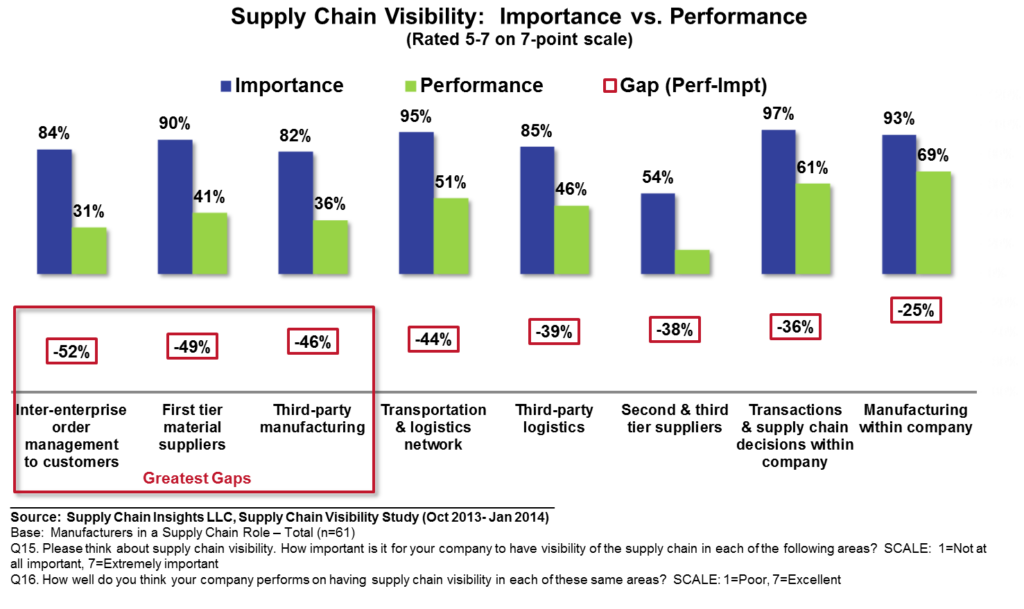
We are stuck. We have not been able to build the planning architectures that effectively let manufacturers plan from the customer’s customer to the supplier’s supplier. As shown in figure 1, the gaps in the value chain network are large. In this blog, let me share some insights based on work with clients and augmented with data from two recent studies that we have just completed at Supply Chain Insights. (We will also be sharing more insight on this topic on our webinar next week.)
The Problem
The goal was to automate the process of planning from the customer’s customer to the supplier’s supplier. However, today, we have pieces that do not fit together to make a whole. Sadly, our architectures are a compilation of piece parts. Most companies have defined enterprise architectures that are inside-out, but lack the ability to take them outside-in. The focus is on the enterprise not the value network.
With the investment in transactional systems for order-to-cash and procure-to-plan, many have lost focus on planning. As a result, they are not effectively able to connect to customers and suppliers. We have talked about it for a long time, but we are not making much progress.
The Dilemma. How We Got Here.
-Outsourcing Is Growing. It Is Here to Stay. It Is Growing More Important. In the study of 63 manufacturers, the average company has outsourced 49% of logistics and 30% of manufacturing. Physically, the supply chain is becoming a network. Logically it is not. Companies are more dependent on each other and there is less excess capacity. It is more brittle and less flexible. Upstream companies have systemically pushed costs and waste backwards on suppliers. While EDI is used to share transactional data, and progress has been made in this area, the software of choice to share plans is an excel spreadsheets. Yes, we have brains in our heads and feet in our shoes, but we communicate most of the important information about the supply chain in an Excel spreadsheet? Does this make sense? I do not think so. I spoke to one client last week that gets 13,000 spreadsheets from one customer that has 72 manufacturing plants with changes two to three times a day. After these discussions, I am amazed that we have made as much progress as we have.

-Nine out of Ten Companies are Stuck at the Intersection of Operating Margin and Inventory Turns. We have automated the enterprise, and 90% of companies have a supply chain organization, and have implemented supply chain planning. Most have multiple systems, but lack a clear understanding of planning architectures. New forms of analytics and cloud-based solutions are emerging, but companies are not clear how to use them. There are a number of science projects. Current investments are enterprise focused. They do not focus on automating the value network.
I am convinced that the greatest opportunity to unstick the supply chain lies in the value network. We have got to break the cycle of pushing costs and waste backwards in the supply chain and paying a higher price for materials. Modern procurement practices have lengthened payables by 30 days and made it almost impossible to have a true relationship.
-ERP Was to Be the Solution. We have naively gone down this path. ERP vendors were to build the architectures to extend the enterprise to their trading partners. It has not happened. As shown in Figure 2, connectivity of planning information with trading partners for third-party logistics, transportation and material suppliers is important to companies, and supply chain leaders have lost confidence that this gap can be closed by an ERP vendor. The investment in supply chain planning is growing by 55% in 2014, yet 56% of supply chain leaders report that it is focused on the work with their strategic vendors which are most often the ERP provider. The selection of IT solutions is typically a joint decision where IT is involved 80% of the time and the line of business leaders are involved 85% of the time. This just does not make sense to me.
-Supply Chain Business Networks Are New and Promising; Yet Only Represent 7% of the Flow. Today, there are a number of cloud-based supply chain planning solutions and new forms of business networks that offer both applications and communities to facilitate these planning flows; however, the awareness of these by line-of-business supply chain leaders is low and the ability to get funding for these projects is tough because most of the corporate funding is locked into ERP programs.
Where Do We Go from Here? What Do We Do About It?
Supply chain leaders have brains in their heads and feet in their shoes. Only they can direct what they do. They need to act. Ownership of the extended value chain is more important to drive differentiation and improve Corporate Social Responsibility initiatives. What steps to take?
1) Get clear on a planning road map. Put the parts together to make the whole. Build a multi-year road map.
2) Recognize the reality. Stabilize ERP investments. Recognize them for what they are. You need them as a planning system of record and to automate transactions. The gap in current state to automate the value network is real.
3) Take ownership for the signal that you are sending your suppliers.
4) Partner with emerging cloud-based solutions and business network technologies to connect the extended value chain.
Today, there is no perfect solution. However, the path that we are going down is not closing the gap. It reminds me of the old saying of “no matter how far you have gone down the wrong road, that when you realize that it is the wrong road, turn back.”
I would love to hear your thoughts. What do you think?
For additional writing on ERP and supply chain planning check out the blog posts:
End of the Fairy Tale, Part I