Yesterday, I finished a post on supply chain planning maturity. A client had asked me, “How do I know if we have a mature supply chain planning organization?” As we talked, and I drew the table, the first question was followed by, “How do I help my executive team understand the importance of planning and their role in the process?” Planning leadership is a problem for most organizations. My focus here is to answer this second question.

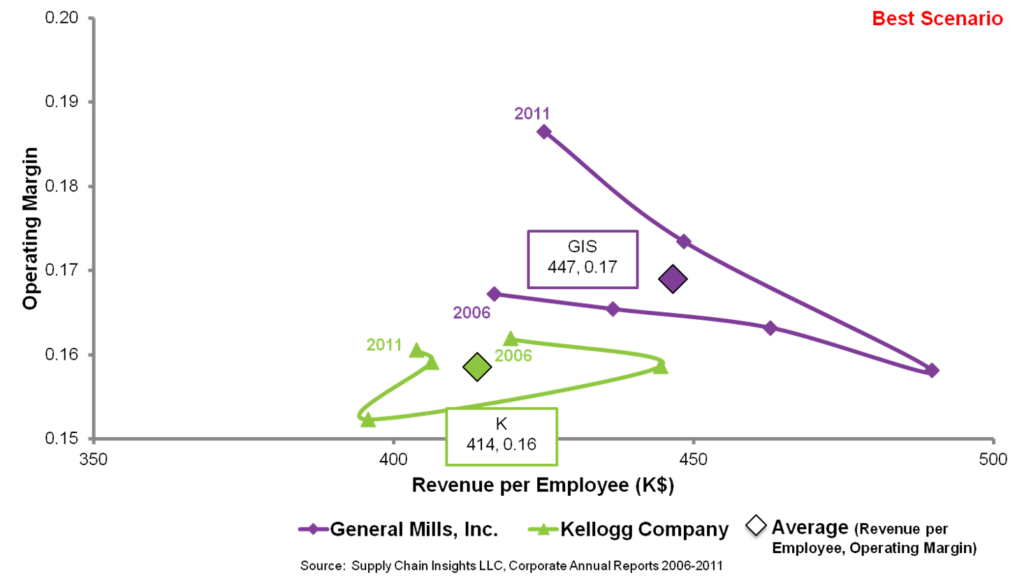
There is no substitute for leadership. Take the General Mills and Kellogg example in figure 1. In the cereal industry, General Mills and Kellogg are fierce competitors. With the shift of power to the retailer, both have had to add headcount to manage the increased demands for sales to staff account-specific teams to better manage against retailer expectations. As a result, both organizations saw a decline in revenue/employee.
General Mills is much better at planning than Kellogg. It is one of the primary reasons, as shown in figure 1, that General Mills has been able to have a margin advantage over Kellogg for the past four years. Through this period, under the leadership of John Church, they have focused on cross-functional decision making and the maturity of planning processes.
Excellence in supply chain planning is a cultural shift. Most organizations are better at reacting than planning. Reacting is rewarded and planning is not. Firefighting and hero behavior is easier to recognize than good planning.
To be good at planning, the organization needs to know where they are going. Alignment is essential. As shown in figure 2, organizations struggle. Functions, when they operate in isolation against functional targets, will not be aligned and supply chain planning can make this worse if there is not clear leadership.
In research study after study, we see that the greatest challenge to achieving supply chain excellence is the understanding of the supply chain by the leadership team. Most companies operate well within functions, but struggle to build strong horizontal processes. They lack cohesion. For most, as shown in figure 2, the gaps between organizational functions are large. Closing the gaps happens when there are aligned metrics, clarity of vision and aligned planning processes. There has to be an enlightened leader that understands that the supply chain is a complex system with increasing complexity. It must be managed as a system.
Understanding Planning.
The journey starts with a clear understanding of the fundamentals of planning. This does not come easily, and requires training. The executive team needs to be clear on the differences between strategic, tactical, operational, and executional planning and the connections between planning systems and the transactional systems of record. Many are not.

For clarity, the definitions are:
-Strategic Planning: The frequency is either monthly or quarterly and the focus is on long-term planning. It combines decisions across sell, deliver, make and source processes to drive value based outcomes. This includes optimization and discrete event simulation. The length of the duration will vary by industry, but is usually at least one year and often three to five. It allows companies to evaluate the design of the network. More advanced supply chain leaders model the role of complexity (product and customer), the impact of risk, and opportunity of innovation as well as product shipping and manufacturing locations, and inventory policies.
Leaders know that they have more than one supply chain and that they need to align the organization around the vision for each. They also are clear that the supply chain is defined outside-in based on the channel requirements and the underlying rhythms and cycles of fulfillment, manufacturing and procurement. The average supply chain leader has five distinct supply chains.

-Tactical Planning: This process is usually monthly. Strategic and tactical planning processes are cross-functional and the foundational elements for end-to-end process thinking.
It is important for the executive team to be aligned in the strategic and tactical planning processes to enable seamless planning by functions. Technology applications in this space include demand planning, tactical supply planning, procurement planning, multi-tier inventory optimization and Sales and Operations Planning (S&OP).
The executive focus should be on the output of strategic planning into the tactical process of S&OP. When this happens, based on recent research, the company achieves 50% greater agility and 30% better organizational alignment (reference the improved organizational alignment in figure 3 versus figure 2).
-Operational Planning: Planning done in this short-term duration (often in what is termed the “slush period”) happens where planning assumptions are being “consumed” by open orders, shipments and planning commitments. Applications that operate in this horizon are manufacturing or production planning, demand sensing, Vendor Managed Inventory (VMI), Supplier Managed Inventory (SMI), and Transportation Management Systems (TMS).
-Executional Planning: This planning occurs within the order duration and is characterized by Available-to-Promise (ATP) functionality, warehouse management labor planning, and the routing/scheduling of trucks and shipments.
Executive intervention into the operational and executional planning processes should be focused at improving reliability. When executives intervene in these functional processes there is the danger that these well-intended efforts will throw the organization out of balance.
Other Considerations
Career Progression. Leaders let planners get good at their jobs. One of the major hurdles that organizations face is organizational turnover in the planning function. Many organizations make the mistake of having the job as an entry-level position with lots of turnover. In many organizations there is no career planning track that encourages the building of planning skills. Leaders build strong planning organizations with defined career progression and mentoring.
Metrics Alignment. By definition, supply chain planning is based on the use of optimization engines to improve value, but organizations are often not clear on the objective function. When multiple supply chain planning systems are aligned functionally, but the outcomes are not aligned, they can fight themselves.
These leaders are clear that the supply chain is a complex system with increasingly complex systems. As a result, they never look at metrics in isolation of each other, and try to build the overall potential of the system focusing on alignment and balance. These leaders clearly understand that this focus needs to be on value-based outcomes, not inputs, and that measurement needs to based on a portfolio analysis. In assessing the health of the supply chain they look at the elements of growth, profitability, supply chain cycles (working capital, cash-to-cash and inventory turns), customer service, and complexity together as a system.
Technology Evolution. Leaders invest in new planning systems as part of an effort to drive business process innovation. They have a clear understanding of the differences between the terms integration, synchronization, harmonization and translation of data. The focus of this new investment is outside-in not inside-out. They understand that the last decade of Advanced Planning Systems (APS) tightly coupled to Enterprise Resource Planning (ERP) is now a legacy concept. The supply chains created were too inflexible and brittle. As a result, they are championing the collection and use of channel data, and the building of outside-in processes based on customer consumption. They are championing the building of sensing/learning supply chains based on new forms of analytics. They will frequently champion cross-functional teams on Big Data, new forms of analytics, Mobility, and Social/e-commerce convergence. The focus is outside-in, cross-functional thinking.
I hope that this helps. Gotta run. Cab is waiting and my flight from Johannesburg to the states leaves soon. It is my hope that you have enjoyed this series of posts and that you can join in the discussion. Let me know if I missed anything….
I would also encourage you to sign up for our newsletter, and for our webinar on Sales & Operations planning that is happening on Thursday, June 13th at 1:00 p.m. We will be sharing insights from a recent study of 95 supply chain leaders. We will be joined in the discussion by leaders from Enterasys and Avaya to vet the results. Hoping to see you there!