
Lora's Latest Post

Three New Insights on Supply Chain Talent

On Tuesday this week I will present the findings from the recent Supply Chain Insights study at the Penn State Forum. As I worked on my presentation,  three themes emerged.
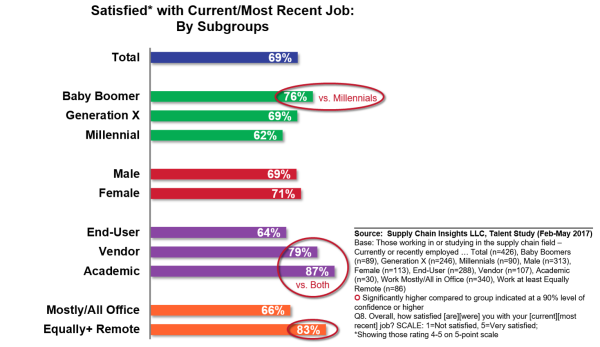
1) Opportunity. The most satisfied respondents on the survey were technologists and academics by profession, Baby-Boomers by age group, and those with the ability to work from home.  The least satisfied are those in manufacturing work teams.
A central theme in the study was the perceived lack of opportunity in supply chain management for Generation X and Millennials in manufacturing.
Figure 1. Relative Satisfaction
relative satisfaction
One of the issues is the lack of thinking and process innovation on next-generation supply chain processes. With the passing of the generational baton, Millennial workers struggle to get access to opportunity to make a difference. Traditional supply chain thinking is a deterrent. What does traditional supply chain thinking look like? It comes in many forms. Respondents report concern on the usability of traditional supply chain systems. They want supply chain systems that mirror their mobile phones and tablets in their personal life. They also want clear career paths with cross-functional and upward mobility. Many in the study feel stuck in insignificant positions with limited career mobility.
Figure 2. Top Supply Chain Challenges
Talent2017_Q23_ChallengesForCompanies
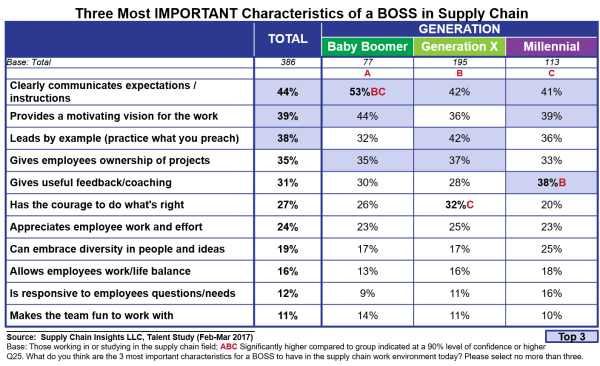
2) Leadership Matters. In the study, desired leadership takes many forms. While clear communication is important to all, Generation X employees want leaders who do the right thing, while coaching is more important to Millennials. In recruiting and hiring there is an overwhelming desire to work for a company that focuses on human resource development. Coaching, communication, internships, training, and clear career paths are important characteristics. While Baby-Boomers were comfortable working in an emerging field with an unclear career path, this is not sufficient for Millennial employees.
Figure 3. Most Important Characteristics of a Boss by Generation
Talent2017_Q25_BossCharImpt_byGeneration
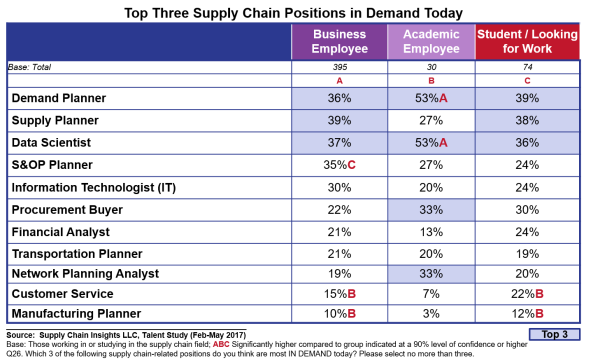
3) Talent Shortages. Today’s manufacturing organizations struggle to find talent at the intersection of analytics and planning. While most academics feel that the greatest talent gaps are in the area of demand planning and data science, the greatest shortage is in the area of supply planning. With more and more outsourced manufacturing, companies are struggling to build a comprehensive understanding of manufacturing and supply for today’s leader. The use of internships and cross-functional projects help, but this gap will continue to grow with the retirement of baby-boomer leaders.
Figure 4. Job Gaps
job gaps
In summary, if you are trying to attract supply chain talent, focus on three elements:
1) Clear Career Paths, Internships and Development Programs. Realize that the needs and requirements for Millennials are far greater in these areas than Baby-Boomers realize. To maximize job satisfaction, make sure that development activities embrace opportunity and process innovation.
2) Flexible Work Programs. With the issues of work/life balance and community, employees are more satisfied when they are able to work from home and better balance priorities. Create a work environment to enable this type of flexibility.
3) Coaching Programs. Openly discuss and gain clarity of business expectations for clear communication and coaching. These vary by company, but a focus on principle-based leadership in these areas pays big dividends.
These are my thoughts on a Sunday evening. I look forward to hearing from you.



Search the Archives
Search
Share this Post
Email
Twitter
LinkedIn
Facebook
Pinterest
WhatsApp
Featured Image
Recent Posts

The Myth of End-to-End Planning

Supply chain planning, supply management, supply chain execution, network design, and transportation/logistics management operate in silos. Not much has changed over four decades. The connections flow back through transactional systems: order-to-cash and procure-to-pay. There is a myth that companies can buy an end-to-end supply chain management solution. This is largely a myth. Here we explain.

Read More »

Lead Time: A Broken Gossamer

If you are struggling with supply chain planning, dancing in the light of shiny objects, and scratching your head, please read on. My goal is to help you.

Please do not AI Stupid. What do I mean? AI Stupid is putting agents and agentics on top of existing architectures believing that making them faster and hands free add value. To me, this is fools play.

I love AI. I am excited about new technologies. To this end, I want to shine a light on how new technologies can help address the black holes and inconsistencies in today’s supply chain, which largely stem from the limitations of the first generation of supply chain planning and execution technologies. In this blog, I give you three places to start.

Read More »

Do You Need a Supply Chain Coach?

Supply chain is where the rubber hits the road. For a public company, over 40% of market capitalization is tied to the trade-offs between growth, operating margin, inventory management, and Return on Capital Employed.

The road for supply chain improvement is fraught with issues. Here we share some and offer some advice.

Read More »

Is your Supply Chain AI Ready?

A simple quiz to assess an organization’s AI readiness.

The pace of change is fast and furious. Every day, technology advances faster than we can digest. A great challenge to have.

Determining whether a supply chain is “AI-ready” is less about technology and more about the gray matter between the ears of supply chain leaders. Leadership, alignment, and clarity of goals matter.

Too few companies are clear on the definition of supply chain excellence. Measuring and rewarding functional metrics reduces the firm’s value. Putting agentics on top of today’s processes can make bad practices run faster, reducing value.

The toughest job for the supply chain leader is challenging existing supply chain paradigms that were defined by the limitations of decades of supply chain technologies. As the curtain lifts on the potential of new forms of technology, process redefinition is our opportunity, but only if we are clear on what drives value. (Here, I link to the Supply Chains to Admire reports to help you define value. The next report will be published on June 23rd, along with my Dynamic Benchmarking Product, to help you define value in the face of your AI readiness. More information about the launch is at the bottom of this blog.)

Read More »

Case Study: A Scrappy Demand Management Approach

This study of Franklin Sports shines a light on the work that needs to be done at the sales account level to challenge a retail forecast, and also highlights the importance of a new technique for a forecast engine — reinforcement learning.

Artificial intelligence comes in many forms — large language models, generative AI, machine learning, unstructured text mining, deep learning, neural networks, reinforcement learning, agents, and agentics. While the industry is wigging out about agentics, I think reinforcement learning is a great step forward in the journey of Artificial Intelligence.

Read More »

Can We Side-Step the AI Spin Cycle?

When it comes to combining tech, 1+1+1 should equal more than 1. The impact should be exponential. Unfortunately, today, the answer is 0.

What do I mean? Let me explain.

I find that the supply chain technology market moves slowly along traditional technology lines. Conferences are usually focused on the use of technology, not on redefining work. This bothers me. I want it to bother you as well.

Here I share some insights to drive change.

Read More »