The supply chain technology market is in transition. Over the last three decades, the market weathered consolidations, mergers and technology shifts. Many of the clients I work with are nervous about SAP APO’s transition and the evolution of SAP’s supply chain planning solutions. They are looking for alternatives.
 As I work with these teams, one thing is clear. Companies are at very different places, based on the company’s cultural DNA to try new solutions. While there is a lot of hype about digital transformation, and I feel that the confluence of the new technologies offers great promise, the testing of planning alternatives is only for innovators. As I talk through the market options, I find we have solutions for two groups of buyers now–innovators and late majority/laggards. However, there are limited solutions for the companies in the middle of the adoption curve–early adopters and early majority.
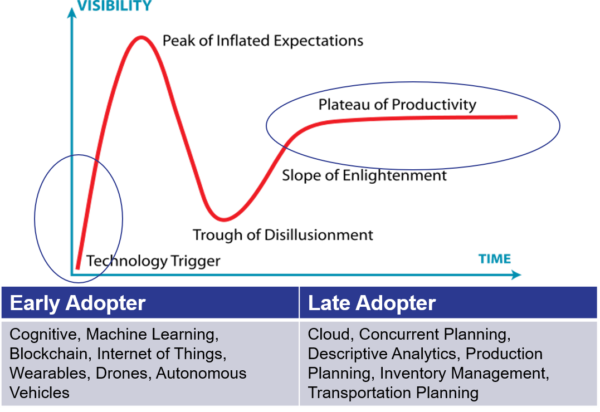
To tell the story, I am going to use the Gartner hype cycle model to explain the dilemma. (The hype cycle was my favorite Gartner model when I was a Gartner analyst in 2001-2003.) The hype cycle model asserts that technology adoption moves through five distinct phases: the trigger, the peak of inflated expectations, the trough of disillusionment, the slope of enlightenment, and the plateau of productivity. Most of the newer technologies–cognitive computing, machine learning, autonomous vehicles, cryptocurrency, the use of drones for sensing, additive manufacturing, wearables, and blockchain are early in evolution. We are at the beginning of the hype cycle. As a result, they are only a good fit for early adopters. In contrast, there is focused refinement of supply chain technologies on the plateau of productivity. There are few technologies in between, and I do not expect the technologies on the plateau of productivity to drive innovation.
Figure 1. Current State of the Supply Chain Management Hype Cycle
In contrast, when we look at the evolution of technologies for 2030, we see a very different view. Over the next 13 years, the innovators will test-and-learn with the technology innovators. Most of this effort will be with best-of-breed solutions, and I predict we will see an increase in the use of open source data techniques–Hadoop, Spark, Kafka– with more focus on schema on read.
The rate of change on the hype cycle is faster than in prior years. However, I am hoping the hype is better managed (setting of realistic expectations) than as happened previously in history. When we overhype the industry, there are more failures and disappointments.
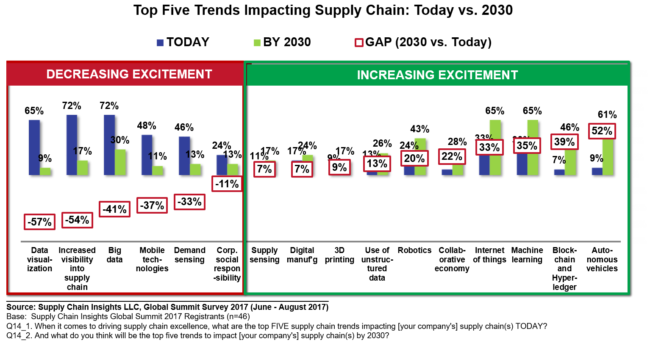
Figure 2. Shifts in Technology for Supply Chain 2030
Yes, I know. Two very different views of the same market. Most of the industry is working on the plateau of productivity. The promise of technology innovation hangs large for these teams, but they do not know what to do. The pressure is on.
I have never seen a faster pace of change. So what should an early adopter do when they want to move forward conservatively?
1). Learn. Actively send employees to conferences, encourage teams to attend webinars, and invite technology innovators to your facility for lunch and learn innovation activities.
2) Actively Follow the Work of Innovators. Identify members of your team to work in industry share-groups to learn more about the testing of new technologies.
3) Don’t Limit the Scope to Traditional Technologies. Innovation is happening at the edge. If you limit your options to traditional technology solution vendors, you will miss most of the opportunities.
Now is the time to develop the knowledge level of employees and focus on building capabilities. Start with clearly identifying the capabilities that you want to build and then organize discovery teams. I hope this helps. I look forward to getting your feedback.

Navigating Supply Chain Economic Downturns
In 2007, the average company took six months to sense market shifts and adapt its supply chain. My estimate, based on work with clients, is that if a downturn happened today, the average company would take 20-30% more time to adjust than in 2007. Here I give insights on preparedness.