 At the 2013 Supply Chain Insights Global Summit, Rick Sather, now VP of Supply Chain for Jack Link’s (Link Snacks, Inc.), stated “There should be an app for that,” and then quickly retorted, holding up his phone and saying, “but, we all know that there isn’t.”
In enterprise architectures portals proliferate, but they are not the answer. When it comes to inter-enterprise visibility a portal is like a sticky note in a windstorm. How so? The information is sticky for a period of time, but then is gone. There is no system of record for data over time, and the use of a portal gives the posting company a false sense of effectively communicating.
There are other options, but each has limitations. We can connect through EDI, but a document has latency and limitations for unstructured data. There is messaging available from ERP to suppliers, but it is inside-out and one-to-one with limitations for communication to a network.
Today 7% of order and purchase order flows move through business networks. (For access to the study on business networks reference this report.) However, inter-enterprise communication moves largely by email. Last night I was sitting with a friend that got transportation updates every hour from the GPS on the truck he had tendered earlier that day on his cell phone. (This was despite the fact it was moving in a business network.)
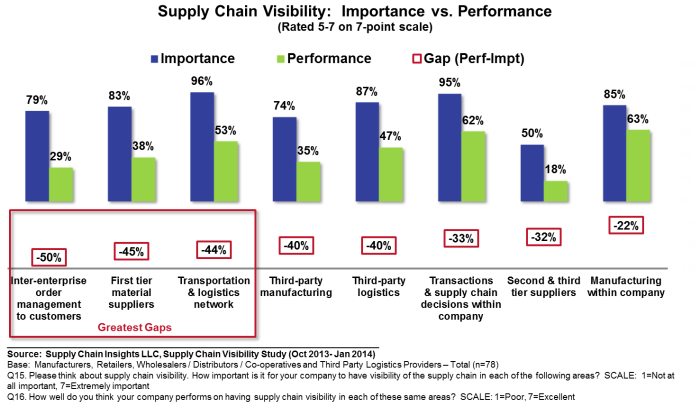
Increasingly companies are evaluating business network solutions to close the gap on inter-enterprise visibility; but as they work on the problem, they find that they need to somehow interconnect business networks. The gaps are large. The solutions to close the gaps are not so easy.
Figure 1. Gaps in Supply Chain Visibility
For one customer who I was working with, it was E2open for High-Tech procurement, GT Nexus for ocean freight, CH Robinson for over-the-road transportation, SupplyOn and Exostar for communication with A&D customers, and Elemica for communication with rubber and plastic suppliers. There just isn’t an answer. As a result, a customer told me, “I am mad that it is not easier.”
“It should be easier,” I said. “I have been thinking about the combination of non-relational database technologies coupled with cognitive learning to provide a new approach. I am wondering what would happen if we got technology leaders in the same room and brainstormed a solution?”
Smiling and nodding in agreement, he said, “It is frustrating,” He continued, “Why is SAP not doing more with Ariba? Why is there no solution for interoperability between networks?”
I said, ” I understand.” I then countered, “Why don’t we use this spring’s Shaman’s Circle to facilitate a new discussion between leading manufacturers and technologists and see if we could create a new way of thinking about the problem? Why don’t we have a special facilitated work session to discuss a Network of Networks with leading technologists.?” He smiled, and on the back of a napkin over lunch we formalized an agenda to facilitate a spark discussion between technologists and manufacturers to meet on April 19th in Amelia Island, Florida to explore a new approach.
I accepted his challenge. The event will be invitation only for 15 manufacturers and 15 technologists. No company can send more than two attendees and the session will cover a day and a half. (No technologist can send a sales person.) Let me know if you would like an invitation.
What do you think? What do you think is the answer?
About Lora:
 Lora Cecere is the Founder of Supply Chain Insights. She is trying to redefine the industry analyst model to make it friendlier and more useful for supply chain leaders. Lora has written the books Supply Chain Metrics That Matter and Bricks Matter, and is currently working on her third book, Leadership Matters. She also actively blogs on her Supply Chain Insights website, at the Supply Chain Shaman blog, and for Forbes. When not writing or running her company, Lora is training for a triathlon, taking classes for her DBA degree in research, knitting and quilting for her new granddaughter, and doing tendu (s) and Dégagé (s) to dome her feet for pointe work at the ballet barre. Lora thinks that we are never too old to learn or to push for excellence.


My Answer to Joe. The Future of APS
Traditional Advanced Planning Systems (APS) are unlikely to become true enterprise platforms because organizations remain functionally siloed, metrics are misaligned, and current APS architectures were designed for an environment that has fundamentally changed. Here I share how I think that APS systems can adapt to drive more value.