
 In 1960, when I was in the first grade, healthcare spending was 5% of the US economy. Today, it is 17.9%. By 2025, the projection is 19.9%. Yowza! This is trillions of dollars. To put it into dollars and cents, health care spending rose 4.3% to $3.3 trillion in 2016, or a cost of $10,348 per person.
Being a supply chain gal, I think that supply chain leaders can help. My worry is that they are not. In this blog post, I want to drive a call for action.
In the chart in Figure 1, let’s look more closely at the healthcare value chain. To understand the chart, let me explain the format. The first value is the average for the period of 2010-2016 while the second number shows the average change comparing 2016 to 2010. For example, for the period of 2010-2016, pharmaceutical company margins averaged 22% (the highest of any industry). Comparing 2010 to 2016, operating margin improved by 4%. In contrast, the average margin for a hospital is 10% for the period of 2010-2016, but the 2016 margin is down 13% when compared to 2010.
Suppliers to the healthcare value chain enjoy high margins and continue to drive higher profits. However, no pharmaceutical or medical device company has stepped up to redesign the healthcare value chain to improve outcomes and reduce overall costs. In comparison, in consumer products, P&G, Coca-Cola, Wal-Mart, and Wegmans have championed many industry value-chain initiatives.
Figure 1. Healthcare Value Chain Analysis

In national news, we are discussing “Who pays what.” Instead, I think we need to aggressively attack the cost of healthcare. We have a system that is not affordable.
Today, the focus is on “efficient sickness”–checking in and out of hospitals. Instead, I think we need to focus on wellness. This would be a huge transformation.
So, perhaps a baby step is to start with the better management of inventory. Today, it is just too hard to find things in a hospital. In recent research, we find that senior leadership spends 17 hours tracking materials while the non-senior team spends 23 hours of a 40-hour work week tracking materials. As shown in Figure 2, this is significant and a cost drain. It is 30X more manual effort than a counterpart in manufacturing-based supply chains.
Figure 2. Manual Tracking of Supplies in a Hospital
I remember the days when I first ran a warehouse for a manufacturing company. It was before warehouse management. In those days, it was impossible to track inventory in the warehouse. I shutter thinking about all of the time that I spent trying to find inventory.
In the last de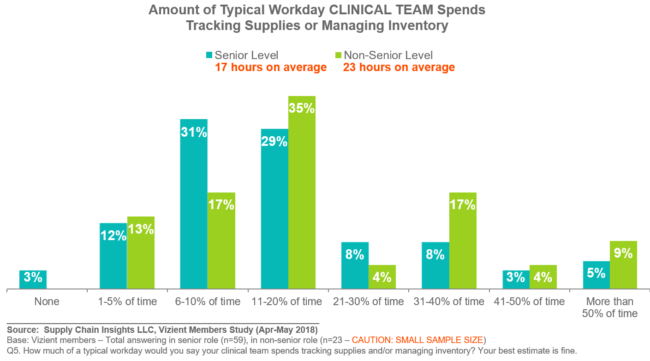 cade, e-commerce warehouse capabilities, and the picking of the each, drove great advancements that could help a hospital. A good perpetual inventory signal is essential to supply chain excellence.
We could start with effective scanning. I visited a hospital last month and only about 2/3 of the items scanned on receipt, and a pre-requisite is a perpetual inventory signal. A hospital is a warehouse that needs automation. The hospital network should deploy cloud-based warehouse management quickly to help the organization.
In consumer goods, Wal-Mart and other large retailers drove bar code scan compliance using fines and penalties to drive improvement. In healthcare, there is no powerbroker, and the richest manufacturers are not trying to address the larger issues within healthcare to improve the cost structure.
Maybe the new initiative driven by Berkshire Hathaway CEO Warren Buffett, J.P. Morgan CEO Jamie Dimon, and Amazon CEO Jeff Bezos can help. They recently named the CEO and they certainly have a daunting task ahead.
Solving this problem will take a village. It is one that I hope all supply chain leaders in healthcare will support.
Let me know your thoughts.
Sources:
CNN, https://money.cnn.com/2018/01/30/news/economy/health-care-costs-eating-the-economy/index.html
https://www.cnbc.com/2018/06/07/buffett-dimon-and-bezos-to-name-health-care-ceo-within-two-weeks.html


My Answer to Joe. The Future of APS
Traditional Advanced Planning Systems (APS) are unlikely to become true enterprise platforms because organizations remain functionally siloed, metrics are misaligned, and current APS architectures were designed for an environment that has fundamentally changed. Here I share how I think that APS systems can adapt to drive more value.