Definitions:
Provocateur. A person who or thing which provokes; a challenger, instigator, inciter, irritator; (in later use) specifically = “provocateur.”
Incrementalism. Movement by degrees. Known by gradualism.
I am tired.

For the past month, I have been working alongside companies implementing digital strategies. In my experience, during the first session energy is high. As time goes on these high energies dissipate. Fear engulfs companies. Teams cannot help themselves. They guard the status quo.
Change is hard. Despite good intentions, the programs get engulfed in waves of change management. Putting a sharp stick in the eye of the industry is hard work.
Challenges of a Digital Transformation
In a digital transformation, the challenges are many. It starts with the lack of a clear definition. In most companies, I find there is an organizational imperative, but no consensus on the goal, or agreement on the definition of supply chain excellence. Sometimes, even the definition of a supply chain is not clear. As a result, functional excellence anchors action.
Today, we find ourselves in a hype cycle. Instead of pushing innovation forward, I see companies using the term “digital” as a path for IT spending. It becomes a means to finish projects. The focus is on digitization—automating today’s processes—versus rethinking process excellence based on the art of the possible.
The term digital is cool and hip. My fear? We are quickly falling into the trough of disillusionment because we are not thinking more broadly.
What Is a Digital Transformation?
I define digital as rethinking the atoms and electrons of the supply chain. It is the ability to think differently and drive new outcomes. As I speak of this vision, most executives scratch their heads. In their minds, the term digital means digitization. Why does it matter? What is the difference? Digitization is taking existing processes and improving digital capabilities. Literally putting today’s processes on steroids. Why is this an issue? Today’s processes are not improving outcomes.
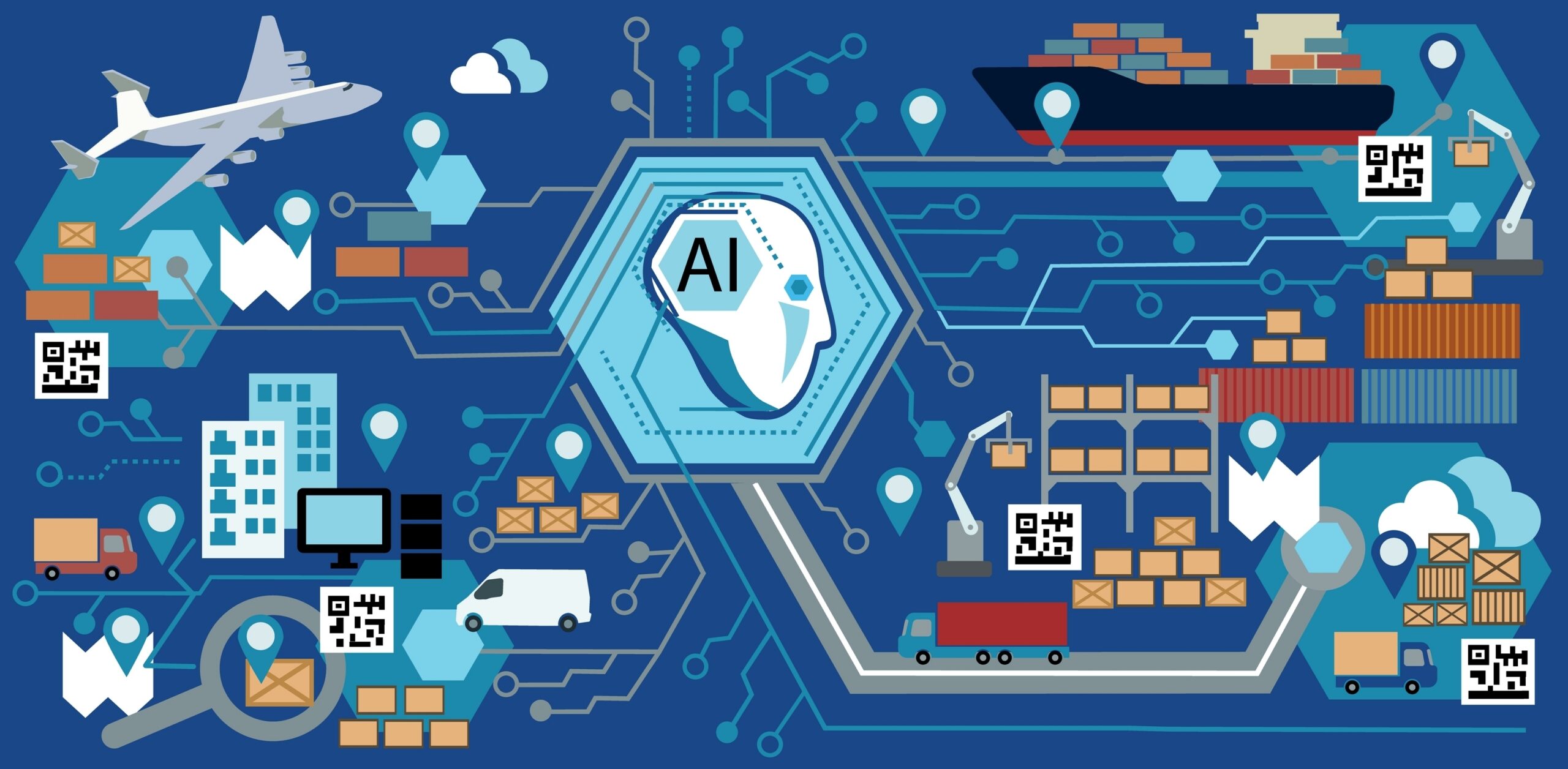
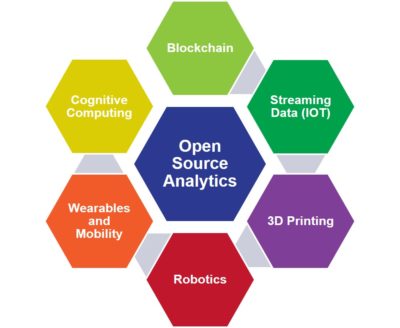
In contrast, the digital supply chain transformation solves problems and defines opportunities based on the confluence of technologies shown in Figure 1.
Figure 1. The Confluence of New Technologies
Step Back. Question the Basics.
When we study 600 public companies by peer group at the intersection of inventory turns and operating margin, only 5% drive improvement. Unable to go forward, companies speak of “basics” and the need for “best practices.” However, as I talk, and question if traditional practices can break the chains that bind us, most go, “Huh?” Going forward requires questioning the basics. Traditional processes cannot be sacrosanct.
That is me, the serial provocateur, a person that keeps challenging. I keep pushing for better outcomes.
Let’s start the discussion with a focus on philosophy. Supply chain planning’s goal is to improve decisions. There are many forms of decision support: price optimization, revenue management, transportation planning, spend management, and network design. The problem is that each form of decision-support solution optimizes the outcome within a function. The design principle is that history is a good predictor of the future. However, most of the data is not a normal distribution. In today’s supply chain, these traditional assumptions are usually false; yet, we try to use old-fashioned tools to drive better decisions without testing the output of the systems. In five companies that I have worked with in the past quarter, each degraded the forecast (using Forecast Value-Add methodology) by 10-18%. The issue? They believed that the system was driving improvement.
Houston, We Have a Problem.
Remember this phrase from the US Apollo 13 mission? In this mission, the astronauts were communicating a problem. In supply chain, we have a problem. We cannot move forward unless we admit we have a problem and agree that today’s processes don’t work.
I am Irish. Every man in my family has struggled with addiction. Gambling, drinking, and drugs. The first step of addiction recovery is admitting the problem. The supply chain needs to get on the road to recovery.
I believe the supply chain market has been co-opted by technologists and consultants. Event companies perpetuate the myths of best practices. Technologists love their solutions. They want to talk. The sales teams at software companies make great salaries selling software. In the process they sell hope.
The industry has too many events. The events funded by sponsorships not a quest for the truth. In the last decade, each party—consultants, technologists and event companies—have made a lot of money. However, buyer beware. The motives are not pure. The problem? We are not improving balance sheets.
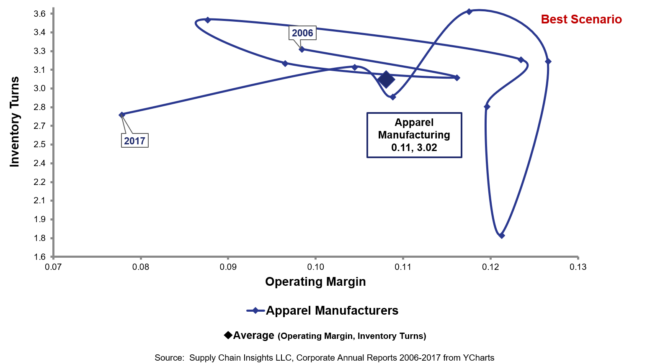
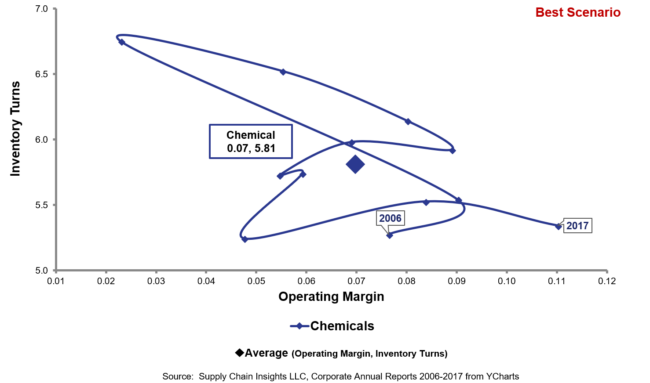
To make the argument, let’s look at industry orbit charts in aggregate for the period of 2006-2017 for the apparel and chemical companies. An orbit chart is a plotting of data at the intersection of two metrics. In this case, the metrics are operating margin and inventory turns. Operating margin is a measurement of profitability and inventory turns is a measurement of how fast inventory turns based on sales.
Both of these industries evolved through a major economic shift. For apparel, it was the transition to cheaper labor in the Asian market (in the apparel industry 30-40% of the cost of goods is labor). In the chemical industry, the boon was the falling price of oil. Today, the price of a barrel of oil is $64.82. In February 2016, it was $29.69. In February 2014, the price was $103.40. If this orbit chart depicting margin is held against the cost of a barrel of oil, the patterns are very similar. Chemical margins are following oil prices. Apparel margins are following the shifts in the labor market. In neither industry, despite the spend of 1.7% of revenue on IT, are we improving inventories. The margins of the apparel industry have declined from 10% to 8% over the period of 2006-2017. Inventory turns have also declined from 3.3 to 2.8. This is not progress.
Figure 1. Apparel Orbit Chart for the Period of 2006-2017: Intersection of Operating Margin and Inventory Turns
Similarly, in the chemical industry, margins have gone from 7.5 to 11.5%. The gains mirror the cost of oil. However, inventory turns have gone from 7 to 5.2. This also is not progress.
Figure 2. Chemical Industry Orbit Chart for the Period of 2006-2017: Intersection of Operating Margin and Inventory Turns
Houston, we have a problem. Traditional supply chain processes are not equal to the challenge of supply volatility. Our decision support tools today are not able to help drive better decisions for the complex, nonlinear system we call supply chain. We are optimizing volume, not value. We are driving functional excellence and incrementally. (To see the analysis of more industries, check out the SlideShare presentation.)
Moving Forward
To move forward, we need to start with a goal in mind. Inventories are ballooning and customer service is getting worse. This is surprising to most and is a wake-up call as we enter the third decade of supply chain management.
Begin the journey of digital transformation focused on solving a problem. Carefully examine the philosophy of historic solutions, and ask yourself some questions:
- Functional Excellence. Do you believe that functional excellence can drive supply chain excellence? If so, invest in the status quo. In the 1990s, technology limitations only allowed for the optimization of a function. Today, this is no longer a barrier. If your goal is functional excellence, invest in traditional systems. If not, consider alternatives.
- Time Is not optimized. In the supply chain, latency as increased. This has happened due to both complexity and globalization. Data latency is an issue and an opportunity. We optimize things—inventory or assets—but not time.
- Integration versus Synchronization. This is not an integration problem. Instead, it is a synchronization opportunity. We need a synchronized supply chain, not an integrated one. The difference is dramatic. The synchronized supply chain accounts for the discrepancies in time and compensates for latency.
- Inside-Out or Outside-In? Business processes today are outside-in. Yet our technologies are inside-out. This is both a problem and an opportunity.
Recommendations:
If you are a technologist, here is my advice.
- Be Purposeful. Stop the spend on sponsorships at events. Let’s face it. We have too many bad events spreading the myth of supply chain best practices. Instead, invest in research and driving value with clients. While you may love your solution, hold yourself true to the purpose of helping clients. Understand how your solution can help solve supply chain problems. The investments in pink ghetto marketing with “frou-frou messages” only serve to line the pockets of technology sales teams. Long term, we must drive value for customers. We must stop marketing lies. Let me give you an example. If we use balance sheet improvement as a guide, the best run companies do not run SAP. There is no significant difference. It sounds nice. The ads are pretty, but driving technology improvement is serious business.
- Admit the Problem. I laughed when I read a recent article by the new CTO of JDA. Three Paths for Innovation. He argues that the company can orchestrate the moonshot, the pivot, and drive incremental improvement simultaneously. I beg to disagree. First let me state, that I would welcome any level of innovation at JDA. Incrementalism reigns. The incentives—sales cycles and maintenance upgrades—are a gravitational force that holds companies back. They are a barrier to true innovation. JDA is a laggard in the market. The strategy was to “milk maintenance revenue” and drive consolidation through debt. I would like JDA to start by testing the output of their planning systems for free at clients. A tune-up for maintenance clients, and then holding themselves accountable for output. JDA is not alone in this issue. The traditional industry players—Adexa, Logility, SAS, Kinaxis—are moving in the market incrementally. The larger danger is the large system integrator ERP planning solutions from SAP and Oracle. Technologies from small best-of-breed companies are transforming outcomes.
- Invite Clients to Bring You Problems. Start centers where companies can bring you hairy problems to solve. Love your clients more than you love your technologies. Learn how to listen. Break the traditional barriers of traditional client relationships.
If you are a line-of-business leader, start the path to drive improvement:
- Don’t Buy Technology Until You Align on the Goals and Philosophy. Question the concepts and get clear on the philosophies which are important in your digital transformation. Start with the alignment on philosophies.
- Break the Traditional Commercial Cycles. Build a fast-track on-ramp for technology innovators to test and learn with you. Don’t fool yourself. No technology innovator wants to engage in a three-month sales cycle with 90-day terms.
- Get Clear on the Terms. Most business leaders speak in gobbledygook terms like “I want a control tower to improve end-to-end visibility and drive results for the integrated supply chain.” When I hear this statement, I start asking questions. What is a control tower? How do you define visibility? What makes you think you want and need an integrated supply chain? Buyer beware! Gobbledygook solutions do not drive value.
- Question Standardization. The companies attempting to use IBM, SAP, and Oracle to drive this type of digital transformation are struggling the most. Realize that just because large vendors have the term “digital” in their Powerpoint, that this does not make it real.
These are my thoughts after a month of working with several large clients. I cannot wait to hear from you!
 Also, the Supply Chain Insights Global Summit is on September 4-7, 2018 in Philadelphia, PA. Now is the time to register. There are no sponsorships. I hand-pick the presentations. Business leaders and technology innovators are as equals in a networking environment. The focus is on digital transformation case studies. We hope to see you there.