 This week I spoke at an SAS Global Analytics Summit on the connected supply chain. In my view, the connected supply chain is very, very different from the integrated supply chain. Here, in this blog post, I want to provoke teams to think through the differences, and really question what they are asking for.
Some History
In 2002 I worked for Gartner Group in the business applications practice. This was in the heyday of Enterprise Resource Planning (ERP) technologies. At the time, I worked in a group that built a model termed ERP II. This model endorsed ERP as the system of record for the supply chain. The espoused vision tightly coupled planning systems to ERP. The focus was on vertical silo automation through three-letter acronym technologies like CRM, SRM, APS, TMS, and WMS.
I struggled with this vision and ultimately left Gartner. Why? To me, the integrated supply chain made no sense. I believed that planning needed its own system of record and that this definition was distinctly different from a transactional system of record. It was also clear to me that transactional data was only one of the feeds to the planning engines (approximately 60% of the data feed, but not the sole source). I fought a hard fight and lost.
Over the course of the last decade, ERP spending was a thrust of the 1.7% of revenue spent in IT. The goal? Actualizing the vision of a tightly integrated supply chain. I smile as I do my research because, in the correlation of quantitative results, user satisfaction with planning is better if it is loosely coupled versus tightly integrated. A planning system tightly integrated to ERP is just too constrictive. There are too many master data issues, and the focus is on transaction efficiency, not supply chain effectiveness.
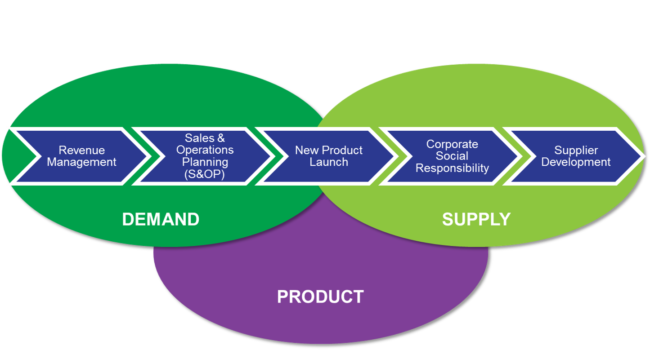
As you think about the differences, take a hard look at this picture of the silos. Think about your organization. The focus of the last decade was on making vertical silos more efficient. This goal is at odds with making the supply chain more effective. Transactional systems are vertical by definition.
In contrast, the supply chain is horizontal in nature. Companies that achieve balanced scorecard results–above their peer group in cost, growth, customer service, inventory, and asset management–are good at horizontal processes (revenue management, S&OP, new product launch, and supplier development). The focus is outside-in, from the customer back, and demand-orchestrated across the silos to guide procurement decisions. In these organizations, demand is not managed as a functional process. Instead, it is a river that flows through and connects and aligns the silos.
Figure 1. Horizontal Processes
What Is a Connected Supply Chain?
Let’s compare the concept of the integrated supply chain with one that I call the connected supply chain. By definition, the integrated supply chain is linear and tightly coupled. In contrast, I have defined a connected supply chain as having six characteristics:
- Outside-In. The use of channel data to translate market shifts without latency.
- Synchronized (versus Integrated). The harmonization and synchronization of data across functional silos.
- Horizontal (versus Vertical) Process Excellence. A focus on business process alignment across functions, through horizontal processes like Revenue Management, Sales and Operations Planning (S&OP), Inventory Management, New Product Launch, and Supplier Development.
- Data at the Speed of Business. Not all processes move at the same speed. In the connected supply chain, data can move at the speed of business. In the integrated supply chain, data moves through batch processing.
- Data-Driven Insights. The building of business processes based on data-driven insights. The use of analytics to manage business decisions. In the integrated supply chain, the core of the data were the solutions for vertical process excellence (CRM, SRM, APS, WMS, TMS, ERP, etc.).
 In the connected supply chain, there is an analytical layer designed to enable the streaming and pooling of data, along with the use of cloud-based solutions to overlay and interact across systems.
- Sensing before Response. The traditional supply chain operates in rote with very staid processes. It does not sense. The connected supply chain senses and then responds.
When supply chain leaders complain to me that their supply chain is not agile, and then they share a supply chain strategy that outlines an integrated supply chain, I laugh. I then say, “You got what you asked for.” The tightly integrated ERP system to planning is just too restrictive.
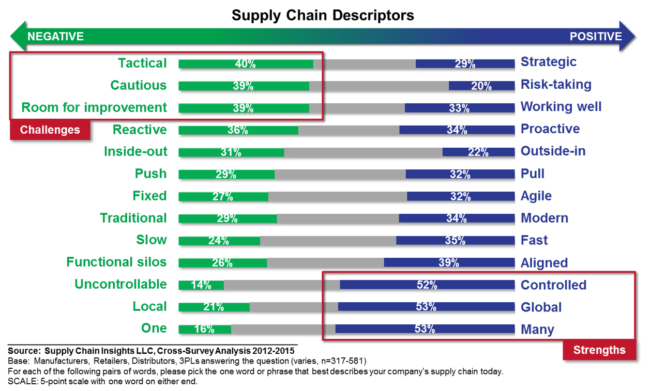
Planning is a decision support technology. The design is to help companies make trade-offs for supply chains which are complex nonlinear systems. In my view, over the past decade, the market was held hostage by transactional and linear thinkers who profited on exploiting a vision of the integrated supply chain. This thinking is one of the reasons why 90% of companies are stuck in the delivery of supply chain improvement on the balance sheet. As shown in Figure 2, today’s supply chain leaders see their supply chains as reactive, lacking agility, and needing improvement.
Figure 2. Supply Chain Attributes
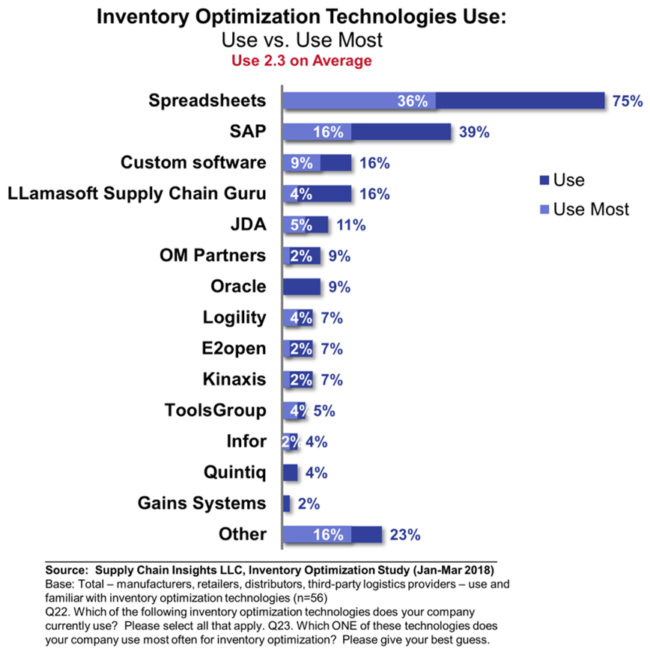
Because of the limitations of this model, the number one technology used to manage the supply chain is Excel. Around the world today, employees are happily working in Excel ghettos, grinding out complex macros to solve supply chain problems which should be addressed in supply chain planning. Most companies have 2 to 3 supply chain planning solutions but use Excel. See Figure 3. It is a view of the use of technologies for inventory.
Figure 3. Use of Technologies for Inventory
Why? The majority of supply chain planning solutions were deployed to make vertical silos more efficient versus driving outside-in end-to-end thinking.
What Is The Digital Supply Chain?
The digital supply chain is the transformation of the flows of the supply chain based on digitized data streams. Digitization is very different from the digital transformation. The difference is the intent. Most strategy documents that I am currently reviewing are looking to digitize data to make integration more effective. When I see these decks, I throw up my hands. A mistake is putting tight integration on steroids. So, if you are working on a digital supply chain transformation strategy, I think now is the time to step back and rethink the goal. Let’s not repeat the mistake of the last decade.
These are my thoughts. I welcome yours.