“What did you learn?” asked the client. I smiled and reflected. It was a thought-provoking question.
The ROI study on supply chain planning was completed. We were reviewing the data that is showcased in the blog post Three Questions People are Afraid to Ask. The data is clear: best-of-breed supply chain planning solutions are faster to implement, have a better ROI and yield higher satisfaction than planning systems from ERP providers.
When I finished the blog post last week, I sent the research to fifteen supply chain leaders in manufacturing and asked for their opinions on the study. These were large multi-national manufacturing companies with very senior supply chain leaders. Their response surprised me. They said, “I am surprised that companies in your study rate themselves so highly on the use of supply chain planning technologies. For us, the results of supply chain planning solutions are disappointing. We struggle to find solutions in the market that meet our needs. We don’t think that anyone is happy.”
So, I answered the question from the client in a dry, understated tone, “ I don’t think that we have met the needs of large multinational manufacturers in the design of supply chain planning as we know it today. I think that vendors are largely competing with each other, and not able to see the true needs of users.
There have been many obstacles. Initially, the market was over-hyped and the first generation of solutions under-delivered. The second generation solutions (extended ERP footprints) made this even worse. As we can see from the research, these solutions were more expensive, harder to use, and required larger teams to run (30-40% more people). In parallel, supply chain planning talent became more scarce and the attainable market for software vendors contracted as 38% of their targeted customers went through M&A. The merger mania created a more complex IT environment.
Today, the gray-hairs of the first and second generation are retiring. We have the opportunity to build solutions that can better meet the needs of large manufacturers (greater than 5B$), but to do this, we have to get past the historical baggage of this market evolution to accomplish this goal.” It was an answer that the client did not want to hear. It is also an answer that I really do not want to tell. I was a part of the evolution of supply chain planning solutions; and today, we have a quagmire. I firmly believe that the next generation of supply chain planning will come from new best-of-breed providers in the Third Act.
So, what should a global manufacturer do? Here are five actions to consider:

1) Stabilize Current Investments. The first step is to stabilize current investments. My recommendation is to not rip and replace software at this time. Instead, I would invest in software tuning. Many software companies offer an audit that you may also want to consider.
Use your current platform as a planning system of record to add planning functionality for S&OP, deeper forms of predictive analytics and what-if analysis tools.
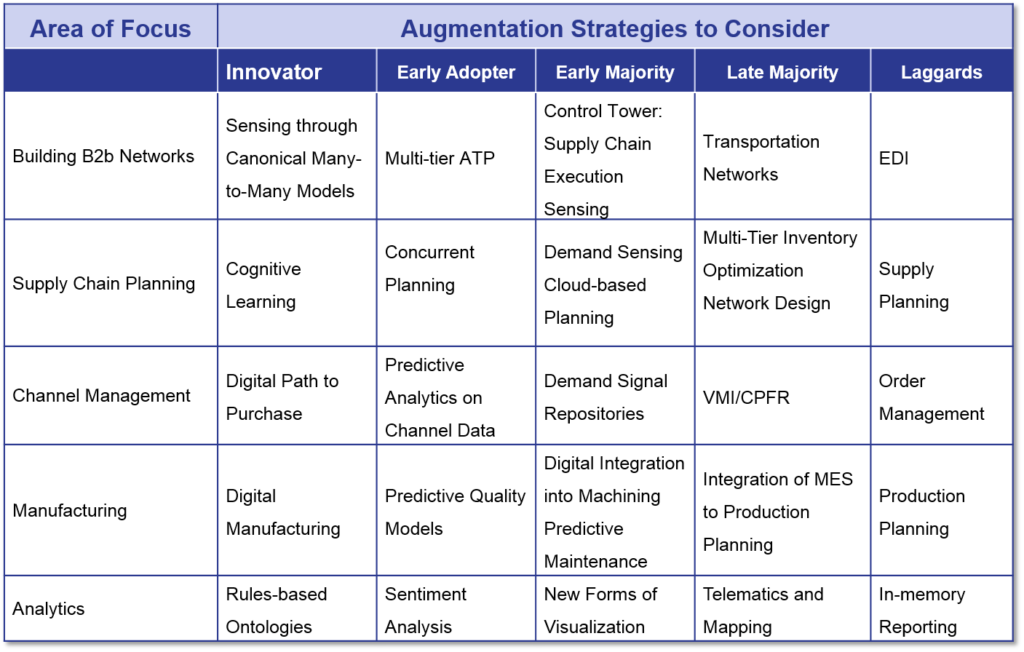
2) Augment Current Functionality Based on Risk Profile. Using the standard maturity model for technology adoption, consider augmenting the current functionality based on risk aversion. To help, I have built a chart outlining where I see the market. My heart is with the innovator, and in much of my writing, I will advocate the emerging solutions; but in my head, I know that most of the market is a late majority buyer. The market has become more and more conservative in my time as an analyst.
3) Build Planning Talent. Talent is the missing link for many organizations. The average time to fill a demand or supply planning role is five months. Start now to build a planning organization. Train a new generation of employees to understand planning.
4) Experiment with New Forms of Analytics. Build a small group to test and learn with new forms of analytics. Provide funds for this group to experiment with tools like Tableau, Spotfire and Qlikview. One of my favorite discussions of this approach was a podcast with Fran O’Sullivan of IBM. IBM is one of the few organizations that I have worked with that focuses on seed capital for small analytic projects and encourages the line-of-business leaders to test and learn.
5) Closely Follow the Evolution of the Next Generation of Solutions. You may not have the organizational risk profile to step out and text cognitive learning, new forms of B2B networks or Digital Manufacturing, but you can actively follow the industry pilots and learn from those doing the testing.
These are my thoughts this morning over a cup of coffee. I would love to hear from you.
Please join us for our webinar this week. The focus is on the adoption of new technologies and processes in digital business in the Race for Supply Chain 2020. In the webinar, I am featuring a panel of thought leaders. Marty Kisliuk, Global Operations Director at FMC and Chris Clowes, Supply Chain Manager at Costa Enterprises (think Costa Coffee) are going to share their plans for digital business. When you think about the decades, I think that we all can agree that it is a time of change. I penciled this timeline on my notebook this morning:
- 1970-1980: Definition of MRP and DRP. Power of Computing.
- 1980-1990: Definition of Supply Chain Planning. Rise of Client Server Technology.
- 1990-2000: Race for Y2K. Rapid Advances in Connectivity.
- 2000-2010: Dawn of eCommerce and B2b Networks. Race for the Global Supply Chain.
- 2010-2020: Digital Business.