Education is the lifeline for supply chain talent, but is it working? Are we doing a good job of training the next generation of supply chain leaders in today’s academia? This was the question for a recent podcast that I co-hosted with Supply Chain Now. The dialogue was with an esteemed panel of three academics: Chris Gaffney, now at Georgia Tech with decades of experience at Coca-Cola; Jake Dean, at the University of Wisconsin at Madison and previously at Cisco; and Matt Waller, with years of experience advising Wal-Mart and now at the University of Arkansas.

Reflection
Going into the podcast, I prepared by listening to the podcasts I recorded in 2025, when I asked eleven supply chain leaders, “What would you have told your twenty-five-year-old self?” I learned a lot through these interviews. (The eleven videos of supply chain leaders are available on YouTube.) I thought hard about what I heard from senior leaders as I formed answers to the interview questions.
The Widening Gap
Scott’s first question in the podcast was, “How would you grade the supply chain academic programs today?” The three academic leaders unanimously answered B+. I listened intently, and then it was my turn. Scott asked, “ Lora, how would you rate the programs?” I replied with a C- or D+.As I spoke, I held my breath, not knowing how the panel would receive the bad news.
But no worries, the panel took it in stride. Despite our different perspectives, I found the dialogue on how to drive improvement more aligned than divisive. I even thought there were brilliant moments when we learned from each other as a group.
A Meaningful Learning Environment Matters
College is expensive, and the need for supply chain talent is high and growing. Aggregate industry acumen, diluted by retirement and turnover, is declining. As the impact of our industry consortia weakens, the academic discussion becomes more relevant. The gap needs to close. This is especially true for supply chain planning and network design roles.
The ideal talent profile combines work experience with education. This is easier said than done. But as students told me on a recent Penn State trip, when I strongly advocated supply chain co-op programs, the goal should not be to elongate the college experience. Rather, the objective should be to make the most of the time that a student is in school.
Most companies manage their relationship with academic institutions as an extension of recruitment. The first change starts with redefining business and academic partnerships: if your primary goal is recruitment and you manage your relationship with academia through your HR department, your first action should be to identify your top three to five academic programs and build strategic partnerships to develop talent.
With this background, here are some thoughts I shared on the podcast:
Stop Spinning a False Narrative. First, prepare students for today’s reality. Within an organization, companies are not aligned; corporate politics reigns, and there is no clear definition of end-to-end supply chain processes. While companies have implemented transactional technologies and improved order-to-cash and procure-to-pay, planning processes still don’t effectively span make, source, and deliver together. Logistics and procurement operate largely in isolation, with no trade-off between source, make, and deliver constraints. Many of our students, digitally enabled in their personal lives, enter the workforce to struggle through days of meetings and attempt to wrestle insights from systems that lack interoperability.
Start the Process of Redefining Students’ Relationship with Data. Unfortunately, bad data has become the whipping boy for program ineffectiveness. Project failed? Blame it on bad data. Academia needs to start helping students redefine their relationship with data. 80% of supply chain data goes unused. This begins with exposing students to the nuances of all data types—unstructured, structured, and streaming—and training classrooms to use machine learning and AI techniques to embrace all data types.
Historic Practices May Not Be Best Practices. Today’s programs are backward-looking and give students a historical perspective. How do we upskill programs to look forward and document the shortfalls of the practices that we currently, and falsely, define as best practices? This limits creativity. The goal should be to help students define future possibilities by helping them see today’s shortfalls clearly.
The Efficient Supply Chain is not the Most Effective. Companies have largely focused on minimizing functional costs while unknowingly increasing waste as measured by the bullwhip or impact on operating margins. Focus on helping students to understand the language of finance and the need for a balanced scorecard. Go past playing the beer game to helping students minimize the bullwhip.
Focus on identifying the Problem, then Evaluate the Solution. Unfortunately, many lessons start with a student opening a book, working on a problem, and then flipping to the back to see the answer. A good place to start is helping students learn the nuance of a good plan. What is the value of planning, and what makes a good plan? Ask an industry partner to let students listen to and follow an S&OP process and analyze a plan in vitro. In the classroom, measure forecastability, inventory health, Forecast Value Added (FVA), and the bullwhip. Have the students prepare a series of what-if analyses and lead a mock after-action review.
Critical thinking is not the Same as Design Thinking or Systems Thinking. Today’s programs primarily focus on critical thinking and lack the emphasis and understanding of systems thinking. The supply chain is a complex, non-linear system. Leaders need to understand and embrace systems thinking, which is a major gap in current organizations. As a result, many industry programs are too simplistic.
Figure 1. Current state of the industry on thinking styles.
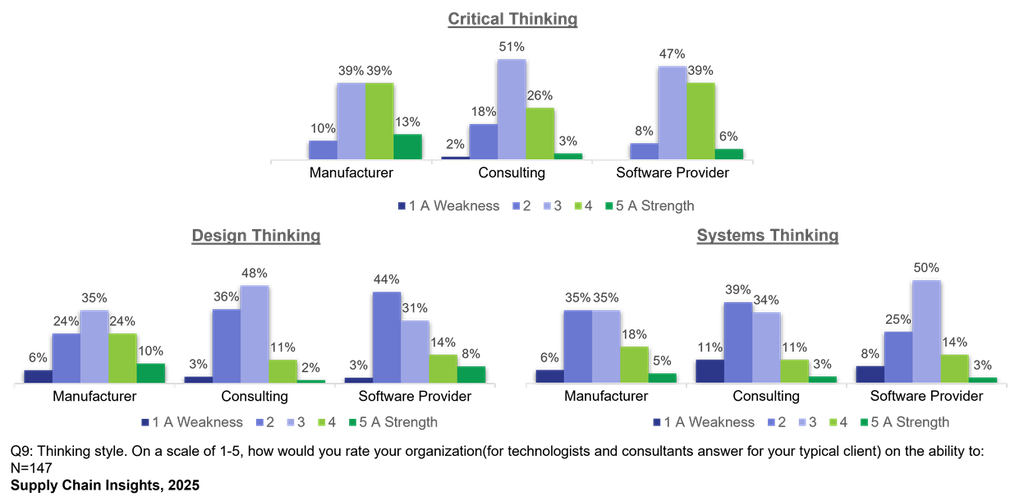
While critical thinking evaluates the quality of decisions and ideas, systems thinking evaluates how functions and processes work together and how changes in one area affect the whole. Both are essential for solving complex business problems, but they approach problems from different perspectives. To clarify the differences, I summarized key concepts in Table 1.
Table 1. Differences Between Critical and Systems Thinking
| Area | Critical Thinking | Systems Thinking |
| Focus | Evaluating ideas and assumptions. | Understanding the relationships and interdependencies within an organization. |
| At the core | Are we thinking about the problem correctly? | Is the focus holistic? |
| Perspective | Challenges assumptions, evidence, and logic | The focus is holistic and interconnected |
| Approach | Challenges assumptions, evidence, and logic | Examines feedback loops, dependencies, and behaviors |
Build Soft Skills. A major gap in student preparedness is building interpersonal skills. Storytelling and influence management should be integral pieces of the program. The supply chain team of the global multinational is increasingly political. Help students develop the skills to work through conflict. Group projects are a great learning opportunity to build leadership and manage conflict. Build this skill through capstone project presentations, group projects, and work with industry.
Your Thoughts?
Do you see the gaps? If so, how do we close them?