I answer every inquiry that I get on LinkedIn. In this blog post, I reply to one that I got last week. As always, I change the names to ensure anonymity. Let’s just call this a question from Joe. He works for a large consulting company that will remain nameless.
Hi Lora, hope you are well. I increasingly believe that APS companies (BY, o9, Kinaxis, etc.) as they exist today will disappear. The untidy application overhead to invoke solver(s) doesn’t justify APS’s inclusion in the enterprise landscape going forward. Their only path to survival is to become either “headless” solvers or a true enterprise platform. I don’t see them in the latter category given the limited understanding of the overall enterprise ontology, master data management, and scalability. Even their claims of Agentic AI are not grounded, given their lack of full understanding of how work is performed (functional and cross-functional) in an enterprise and how decisions are actually made and executed.
Am I thinking this all wrong?
I just attended a conference last week and saw the company positioning their platform as a cross-functional enterprise decision-making framework – a big order for any APS vendor.
Interested in your thoughts?
My Reply: Unveiling What I Believe is the Future of APS

Hi Joe, yes, Advanced Planning Systems (APS) as an enterprise platform is a pipe dream. The reason? Within an organization, functions aren’t aligned, and without metrics/goal alignment, employees are happier not working together. You may laugh, but as you know all too well, it is true.
Most CFOs see the supply chain as a series of processes to squeeze for cost reduction. The concepts of using APS to drive growth through better order reliability and minimizing the cost of capital through constraint management are not well understood.
Historically, APS solutions were designed to deliver functional excellence, which underpins team reward systems. Each function has an optimization engine trying to improve reliability and efficiency, but ironically, improving one function’s efficiency can reduce the effectiveness of others because the supply chain is a complex, non-linear system. Few business leaders have enough cross-functional experience to understand this reality, and few companies have deployed digital twins to see how functional excellence affects waste—bullwhip, higher inventory levels, and reactive, knee-jerk behavior with trading partners. While many have responded by investing in control towers and risk management, we know these investments largely address the symptoms, not the root issue. Until metrics align, an APS platform that tries to span revenue management, manufacturing, procurement, and transportation systems is a pipe dream.
So, what is the value of an APS solution? For me, the value of an advanced planning system is three-fold:
- Driving Growth. Improvement of order reliability
- Alignment. Aligning the organization to a plan for execution. It serves as a planning system of record.
- Constraints. Managing trade-offs among manufacturing constraints.
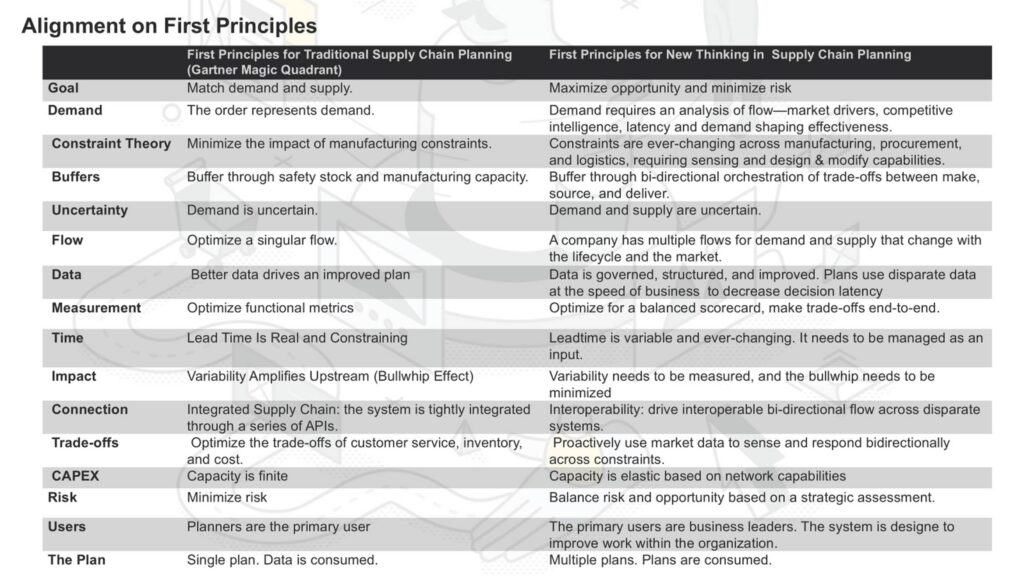
The future of APS should start with first principles based on today’s business environment, which has radically changed since the invention of APS process flows in the 1980s. While requirements have changed, few have redefined processes and aligned outcomes. I define a good plan as one that improves the Forecast Value Added (FVA), right-sizes inventory buffers, and minimizes constraints,
As you know, I have written extensively about how the first principles of planning requirements have changed, but we have not seen architectures redefined. Supply chain planning providers keep pumping out sales pitches and marketing, selling tactically, putting a lot of lipstick on an old pig. Drives me nuts, and I know that you feel the same.
Figure 1. Alignment to First-Principle Shifts Requires a Redefinition of APS Architectures
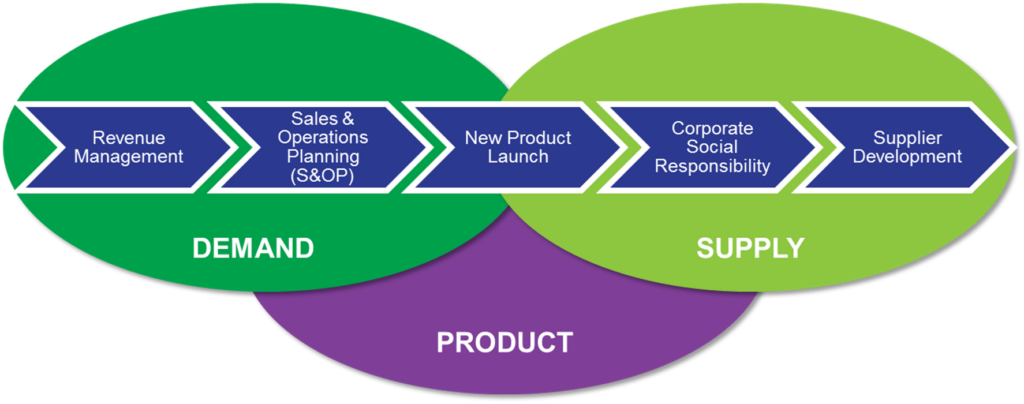
For many years, I advocated linking tactical horizontal processes using interoperability principles by building a common data model (as shown in Figure 2) and redefining the supporting data layer. I have given up. I do not believe this will guide the evolution of Advanced Planning. It is just too hard for companies to move past the goals of functional excellence to drive balance sheet outcomes more holistically across functions.
Figure 2.. Theoretical Linkage of Horizontal Processes in the Tactical Planning Horizon (The model I used in the AMR Research Days of 2005-2010.)
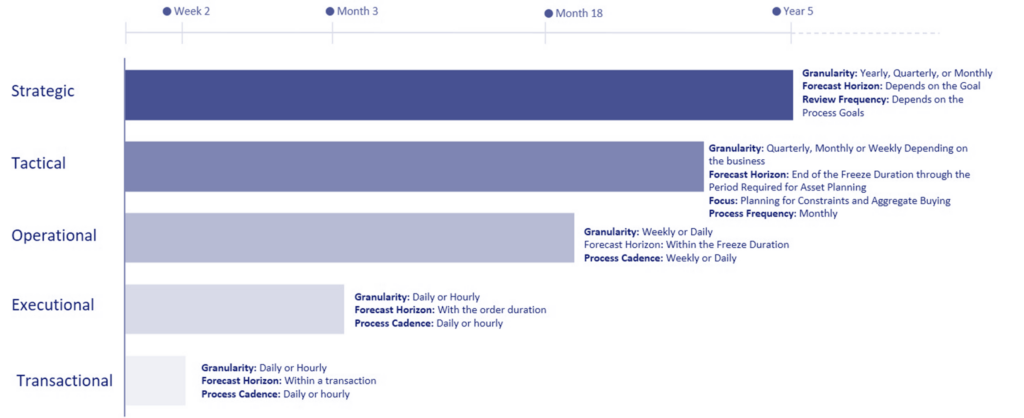
In addition, companies often deploy APS from a technology- or project-based perspective. Few can effectively define what makes a good plan. Most of my clients struggle to define the cause and effect of trade-offs to drive business outcomes. Governance around planning time horizons—as shown in Figure 3– is lacking, and many companies focus on implementing tactical processes (designed to be deployed outside the lead time) within the operational time horizon (within lead time). Few measure lead time which is a problem with increasing variability. You and I often laugh that most supply chain teams should have a Dalmatian as a mascot because they love being reactive and chasing issues within the operational horizon with a hero mentality.
Figure 3. Data Latency in Operational Processing of an Order
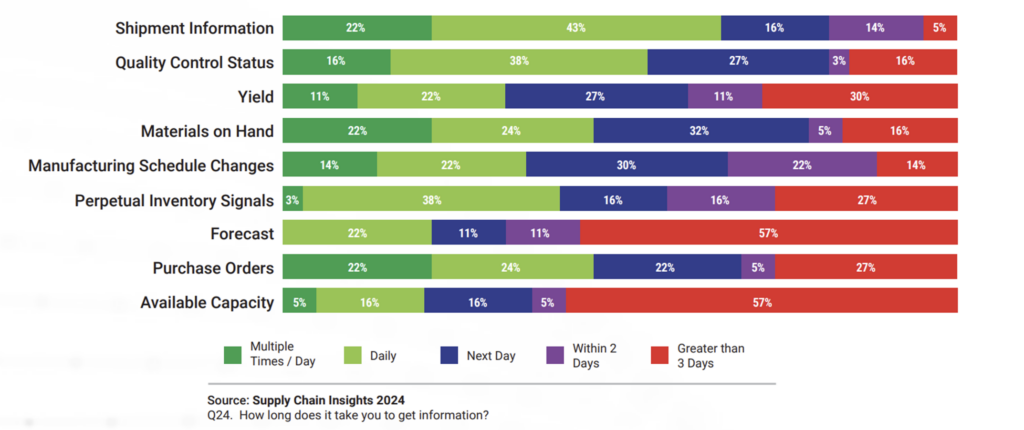
The world of agents and agentic AI is attracting more and more companies to solve business problems in the operational horizon. However, the scalability of current solutions is an obstacle to moving from tactical planning optimization to operational decision-making. I also find that few understand the issues of process latency. While consultants wave their hands and speak of real-time data, only 30-40% of warehouse management data or contract management data is available the same day. Data and process latency is a growing issue as warehousing and manufacturing are outsourced. My POV: Don’t we need to account for data latency and align to outcomes before we try to automate with agents?
Figure 4. How Long Does It Take for a Brand Owner to Get Data from a Contract Manufacturer?
A World of Possibilities
There’s growing pressure to slow down the AI frontier, but as you know, new models keep coming out that are cheaper and better than the last. It’s fair to ask whether anyone could hit the brakes at this point, even if they wanted to.So, I think that companies need to experiment. My recommended focus is on the data layer—unified data model, semantic reconciliation, machine learning for insights, and ontological frameworks.
I also don’t think the answer is to roll your own and build it yourself. This approach creates future code maintenance issues. And it assumes companies are good enough at writing supply chain planning code to hit the mark. I think both are an issue.
I believe we need to focus on redefining work. Today’s approach is planner-centric. In large organizations, a planner centric approach is very limiting.
I think that we need to use design thinking to focus on the organization as the user. I would like to reframe this redefinition not as an enterprise application, but as an outside-in value network. This would include:
- Using outside-in data and improving sensing for both demand and supply.
- Modeling of business outcomes through digital twin platforms to help companies realize the potential of managing the supply chain as a complex system.
- Implementing the plan of plans. An all-encompassing platform for plan consumption across the planning horizon. Machine-generating many plans across the strategic horizon that can be consumed and whittled down as answers become more certain.
- Organizational business collaboration platform for insights. Use of unstructured text mining and Large Language Models (LLMs) to facilitate business leader collaboration with planners.
- Typing and managing demand flows to align demand and supply models and cycles.
- Bi-directional orchestration across source, make, and deliver. Recognition of logistics, manufacturing, and procurement constraints with trade-off optimization.
Joe, I hope that this helps. Give me a call and let’s continue the dialogue.
For Additional Reading on This Topic:
As many of you know, I have written a lot about these concepts in the past. Check out my writing and testing in these reports.
Builiding Outside-in Processes: https://online.flippingbook.com/view/832492025/
Redefining Supply Chain Planning. Need for a Reset. https://online.flippingbook.com/view/1000061967/
Contract Manufacturing in a Value Network: https://online.flippingbook.com/view/607863239/
Update on Ask Lora
If you haven’t checked-out my Large Language Model, Ask Lora, to ask for help and insights on your strategy documents, building orbit charts or getting benchmarking data, I encourage you to do so, and while you are there, interact with the LLM on the uploaded osirisai.live data feed on incidents and deviations to flow. We are adding all of the supply chain indexes on top–Baltic Index, PMI data, Fed Pressure Index, Caps Freight Index, and the Commodity Indexes to give you perspective on the impact of outside-in data on risk and opportunity tied to the benchmarking. Play around with us as we build it out. Let us know what your favorite indexes and sources of data are.
Very cool stuff.