In November, I drove to Philadelphia to have dinner with a friend. Let’s call him Joe. He was a network contact considering a new position, and he wanted to discuss the evolution of the supply chain.
Over dinner, the dialogue was heated and intense. We discussed how the first principles of supply chain planning are changing, and that forward progress was not about AI for AI, but about driving improvement. We both agreed that the need state has changed at a first-principles level with the evolution of the global supply chain in a chaotic world. We discussed how AI techniques can help companies achieve the goals of these shifts by applying first principles to complex, non-linear, distributed systems that need to be adaptive.
Before we realized it, we had closed the restaurant. The waiter quietly and politely escorted us out of the restaurant.
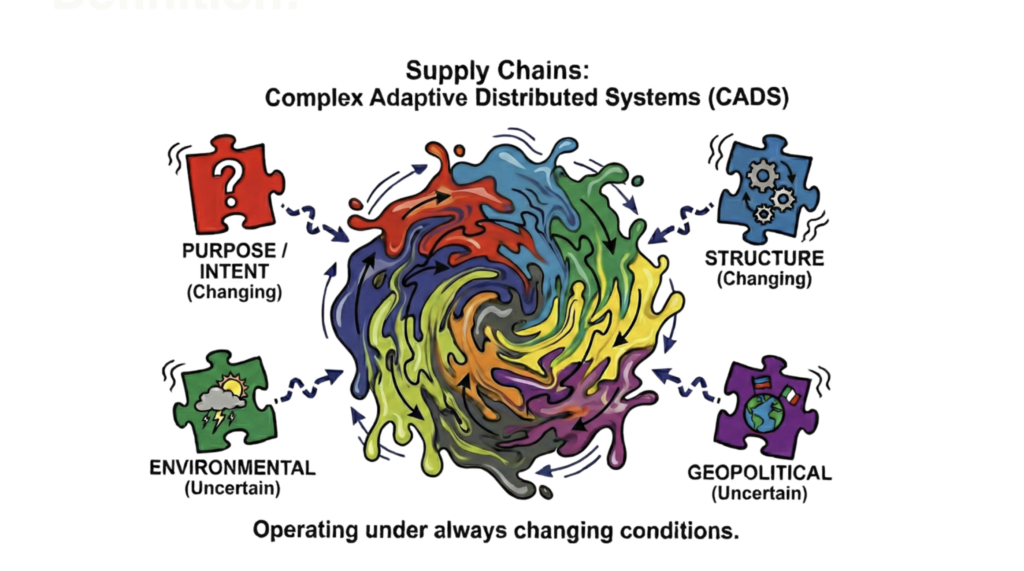
This model is so central to today’s news. Uncertainty reigns.
First principle thinking breaks down a complex problem into its most basic elements. This type of thinking allows teams to identify what is absolutely true and discard assumptions, leading to the development of innovative solutions. The discussion with Joe centered on the details of Table 1.
| Current Supply Chain Planning Taxonomy (What you find in the Gartner Magic Quadrant) | Evolving Supply Chain Planning Solutions | |
| Focus | Match demand and supply. | Maximize revenue and customer service through bi-directional orchestration. (see definition) |
| Measurement/The How. | Optimization to improve functional metrics. | The combination of heuristics, machine learning, and optimization to drive value as measured by a balanced scorecard. |
| Outcome | A single plan with data consumed across time horizons. | Multiple plans, with consumption of the best-fitting plan across the next time horizon. |
| Input | Better and cleaner data drives improved outcomes. | Data is governed, structured, and improved. Embrace the world of disparate data, including unstructured, structured, synthetic, and streaming data, to drive pattern recognition. |
| The What | One flow | Alignment of multiple demand and supply flows based on uncertainty and segmentation. |
| Constraints are ever-changing, requiring sensing and design-and-modify capabilities. | Minimize risk | Balance risk and opportunity based on strategy. |
| Design | Ad-hoc and periodic design of the supply chain. | Design and modify at the same cadence as tactical planning. |
| Boundary | Minimize the impact of constraints. | Constraints are ever-changing, requiring sensing and design & modify capabilities. |
| Boundary | Variability amplifies upstream (Bullwhip Effect) | Measure and minimize the bullwhip effect. |
| Uncertainity | Demand is variable. | Demand and supply are variable. |
| Limitations | Assets are fixed. | Assets are somewhat elastic based on network relationships and outsourcing strategies. |
| User | The user is the planner. | The users are business leaders and planners working collaboratively. |
| Time | Lead time is real and constraining. | Leadtime is variable and ever-changing. It needs to be managed as an input. |
| Focus | Inside-out. | Outside-in market to market. Customer’s customer to supplier’s supplier with bi-directional flows. |
Note: Bi-directional orchestration enables the matching of demand shaping levers–marketing, advertising, social/digital efforts, price, channel strategies, promotions, and new product launch– with supply strategies of alternate sourcing, choices in bill of materials, alternate manufacturing strategies, postponement, shifts in logistics modes, and late stage differentiation to orchestrate demand across make, source, and deliver. Effective engines sense and shape supply chain flows at the speed of business.
The Prologue
At the end of the dinner, I was exhausted. I had a two-hour drive home. The fall evening was dark and damp, and the headlights were wrapped in a dense fog. Yawning, I slowly navigated the winding roads.
Out of nowhere, during the ride, a large deer jumped across my hood onto my windshield. BOOM! in an instant. The shock deployed the airbags and destroyed the car’s frame. I could barely drive the car home. At 1:00 AM, I crawled out of the back of the SUV at my destination.
The vehicle was totaled. I received a check from the automotive insurance company for 40% of what I paid for the car three years ago, and was forced to buy a new vehicle. Thirty thousand dollars later, I had new wheels.
I liked my old car. It was comfortable. I knew how to use the dash. We had a relationship of sorts. I am slow to bond with my new vehicle. We don’t have a positive relationship. It isn’t that I don’t like the car; it is just too complicated to use.
The new car’s software automation has a lot of bells and whistles I don’t want or need, which delays my user satisfaction. My learning curve is slow, while the capabilities are vast. My new car is safe and smooth to drive, but I hate the experience.
As I looked at cars, I was bewildered by the array of electronics (features that greatly outstripped what I need) and surprised by how this barrier keeps me from loving my new car. I miss the days of knobs and buttons.
The new car also spews false alarms. When this happens, the car, connected to the dealer network, sends mandatory alerts for forced maintenance. However, I cannot see the issue (the codes aren’t visible to the driver, but a generic alert is sent to my phone as a text), nor can the shop tell me what is wrong until the car’s computer is analyzed. I try to ignore the alarms, but the shop is diligent on follow-up, mandating that I return to maintain the warranty. As a result, I have spent three unnecessary afternoons in the repair shop.
Which brings me back to the world of supply chain planning. As I listen to briefing after briefing in which technology providers are excited about new AI-enabled features, I hear many pitches of tech for tech. Amidst many, I want to raise my hand and ask, “Where are we at in the redefinition of the user experience based on design thinking? And what are the first principles of design? And why are we talking about making traditional processes faster rather than driving value? And, how do you define value?”
In essence, we are not questioning the first principles of planning and driving improvement for outcomes or designing to improve the user experience. Which brings me to emphasize the meaning of design thinking:
Design thinking is a human-centered approach to innovation that combines the needs of people, the possibilities of technology, and the requirements for business success. It involves understanding problems deeply, brainstorming creative solutions, and iterating through prototyping and testing to develop effective products and services.
designthinking.ideo.com
The Epilogue
So, if you are a leader of business teams implementing supply chain planning, here is some advice. Focus on design thinking and first principles. Push this discussion hard to the point of discomfort for the team, because many have never thought about planning at a first-principles level. Do this before you EVER engage with a technology provider or issue an RFP.
In the purchase and implementation of software, reverse the focus. Today, 70% of a team’s focus is on software selection and implementation, and 30% on adoption. Shift the mindset from software selection to driving value through evolution. Sidestep the bells and whistles, and stop the love affair with shiny objects. Don’t embrace AI for AI.
To drive value, take the following steps:
Making a Decision:
- Governance. Get clear on how to make a decision in the selection process. The selection of software is less important than driving value through deployment. RFPs and demos are less important than testing the available options with your data and your scenarios.
- Focus on First Principle Thinking. Before talking to a technology company, use first-principle thinking to define process flows. Consider supply chain planning as a dot within a set of dots in your enterprise software portfolio. Focus on interoperability and process flows within and through the dots: integration is not sufficient. Train your teams on the differences between integration and interoperability, linear and bi-directional flows, and synchronization and harmonization of data.
- Side Step Shiny Objects. Don’t fall for Technologist mumbo jumbo. For example, there are no end-to-end solutions in the market. However, in the process, don’t undervalue the importance of a unified data model for demand, inventory, deployment, and manufacturing planning. Map these flows to synchronize the underserved areas of procurement and logistics.
- Business Led. The most successful planning implementations are business-led. Don’t let the deployment be led by IT.
- Carefully Select a Boutique Implementor. The greatest success happens when the technology provider partners with an experienced boutique implementor. Sidestep partnerships with larger firms without the software expertise.
- Define Goals. Before you implement and align the teams to answer the questions:
- What does success look like?
- What is a good plan?
- What are our constraints?
- How frequently should we plan?
- Governance: Who should plan and who should make final decisions?
- What should be measured?
- How do we define roles and work?
Through the Evolution:
- Use Design Thinking to Guide the Implementation. Use design thinking to align functionality with process design and capabilities. Avoid bells and whistles that you do not need. Delay upgrades: let others work out the bugs of releases. Upgrade only when mission-critical.
- Thread Value Through Your Lifecycle. Ask software providers how they deliver value through the lifecycle. This includes conferences, training, benchmarking, and insights on how to design work. Post-implementation, consider hiring a coach for the team (someone familiar with the technology involved) to audit software usage at 3-, 6-, 9-, 12-, 18-, and 24-month intervals. (The timings are not cast in stone, but a recommendation.) For example, this is Reveal’s business model with SAP deployments.
- Train, Train, Train. Focus on the user experience and reward innovation in work process development. Measure value through a balanced scorecard and reward innovators. Build a large language model (LLM) to help planners understand their own data–leadtimes, conversion rates, schedule adherence, quality of conformance, Forecast Value Added (FVA), customer service reason codes, etc. Enable discovery.
- Build a Successful Center of Excellence. Supply chain centers of excellence come in many shapes, forms, and flavors. The most successful focus on the delivery of corporate value. Success varies by cultural differences. Center the group on first principles and design thinking.
The End
At the end of the day, a solution is not successful if it is not used and does not deliver value. Don’t fall prey to the current AI Stupid mindset of layering agents on traditional supply chain architectures. The reason? The first principles that shaped the first generation of planning for small and regional supply chain teams do not serve global multinationals well. The solution is not designed for the current level of uncertainty, nor to drive a great user experience. It is for this reason that 94% of planners use spreadsheets as their primary planning tool, and over 90% of companies are dissatisfied with their supply chain planning deployments. (Source: recent research by Supply Chain Insights.)
The venture capital firms and Private Equity partners are pushing their companies hard to AI Stupid layering agents on top of traditional architectures without rethinking first principles or the user experience. As a business leader, be emphatic and educate the investors, but don’t fall prey to the market hype.