The term ‘orchestration’ is the new supply chain two-step: a dance with a continuous beat in my LinkedIn feed. The term is rolling into marketing materials, maturity frameworks, and models like parmesan cheese from the shaker as I eat my pizza.
The problem is that the word carries many different definitions, and as a result, drives different outcomes.
The Rise of the Orchestrator
Let’s start with a discussion of the Edouardo Thieuleux’s recent post on the rise of the supply chain orchestrator. (Reference ABCSupplychain.com) The article describes the rise of the supply chain orchestrator– the AI augmented manager. Intriguing you might say. I thought so too, but then I dug in.
I don’t know Edouardo, and he does not know me. I hope that when he reads this article that he does not see this as an attack. Rather, I hope that it sparks an industry debate.
My issue? While I celebrate someone painting a vision of the redefinition of work with AI, this vision centers on transactional efficiency; and as such, I find it to be limiting. (With that said, no one has THE answer. We need debate on the redefinition of work. Before we lay down hard guardrails in an ever-changing world of Artificial Intelligence and paint a definite future, I think that we have to ask ourselves many questions.) Here are some that come to mind as I read this article.
- Governance. Vibe coding creates software based on the use of a Large Language Model (LLM) based on prompts. The developer does not review or edit the code. In this case the manager will accept the output without human review. The supply chain is a complex non-linear system. In one discrete company I recently interviewed, there were 750 material planners at global assembly plants. Imagine if they were all vibe coding without clear governance and definition of supply chain excellence. Even, if we reduced the number of material planners to one per plant, there would be over 250 vibe coders managing inbound supply.
- The Future Role of Planning? Most of the actions depicted in Eduordo’s model are within lead time in the operational and executional time horizons. I think before we automate, we have to question, can we eliminate? Why should we focus on a single plan when we can build digital twins that continually simulate options of bi-directional trade-offs of make, source, and deliver developing paybooks using Native AI Supply Chain Planning platforms? These plans could be consumed as we move from tactical planning (outside of lead time) to operational planning (inside of lead time where we manage factory schedules, material work orders, and inbound supply). In my vision, this would be like the many models that are built before a hurricane and consumed as the path of the storm becomes clearer. The consumption of these playbooks would then be automatic to align the organization to move from the tactical to operational time horizons. We would move past the traditional view of batch-based linear optimization, and the material planners would get better signals that are aligned across the organization.
- The Redefinition of Work Cannot Focus on Role Redefinition in Isolation. And, if every manager is spinning up agent-based models, what drives governance and defines supply chain excellence? We need to differentiate between the use of AI in the supply chain planner and supply chain manager’s role and redefine work for the director, supply chain leader and the supporting roles within marketing, sales, and finance.
Figure 1. Edouardo Thieuleux Postulates the Supply Chain Orchestrator
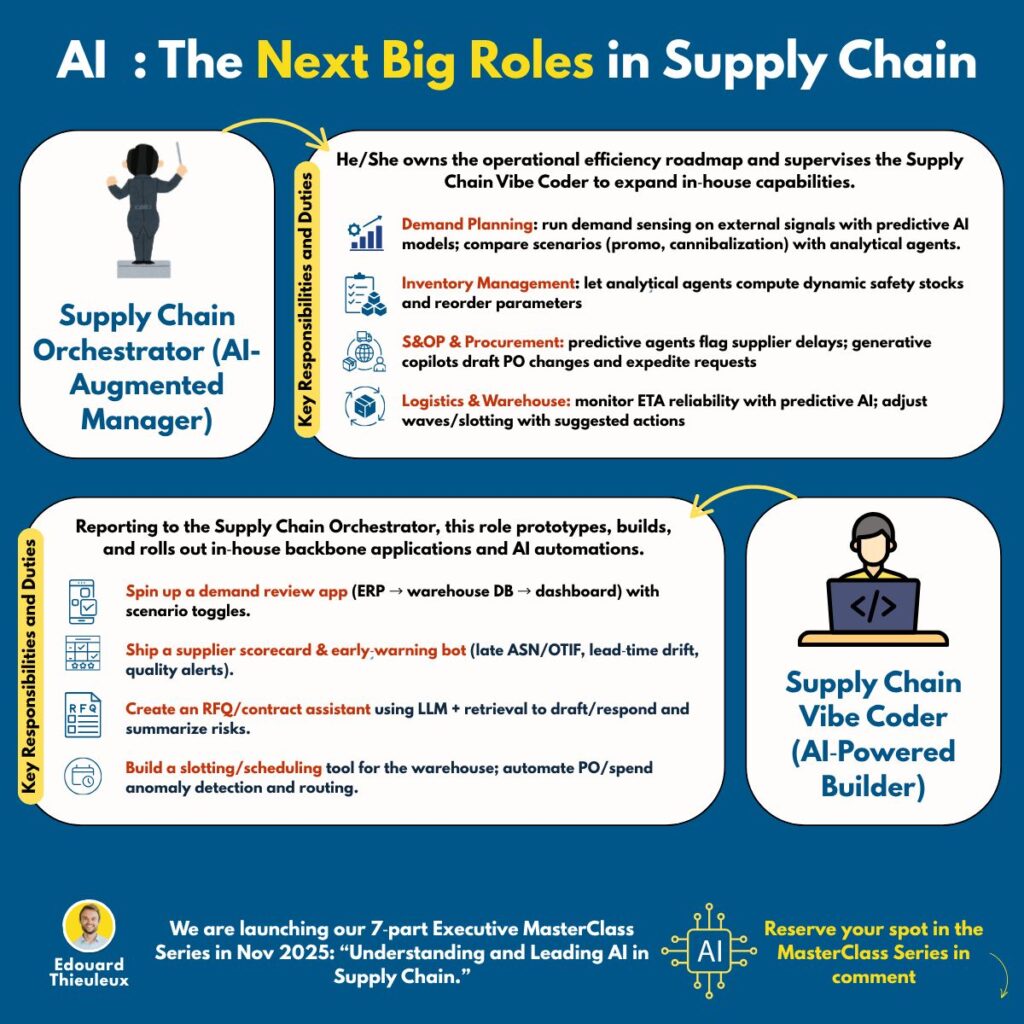
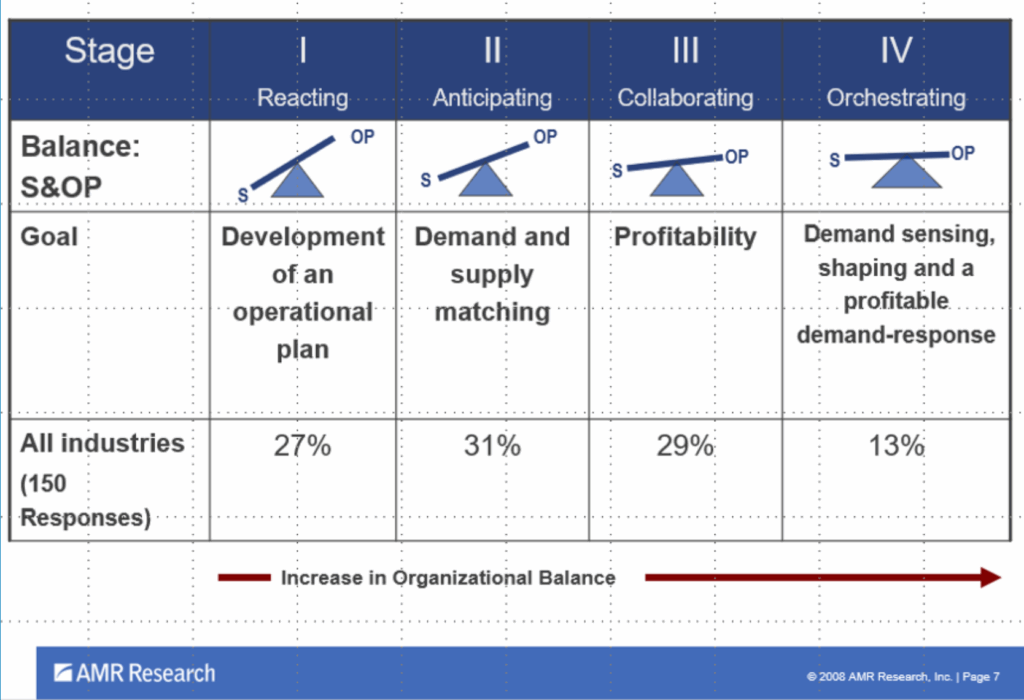
Eduardo’s model in Figure 1, assumes that source, make and deliver are aligned. If you reference the model that I built in 2008 at AMR Research, only 13% of organizations were aligned. Today, I find it to be 2%. (Assessment from teaching over 300 students in my outside-in planning courses.) Items are less forecastable, variability is higher, and organizational politics reign.
We have gone backwards not forward. Large companies are not clear on the definition of excellence or strategy.
Figure 2. S&OP Maturity Model Published by AMR Research in 2008. Lora Cecere Author.
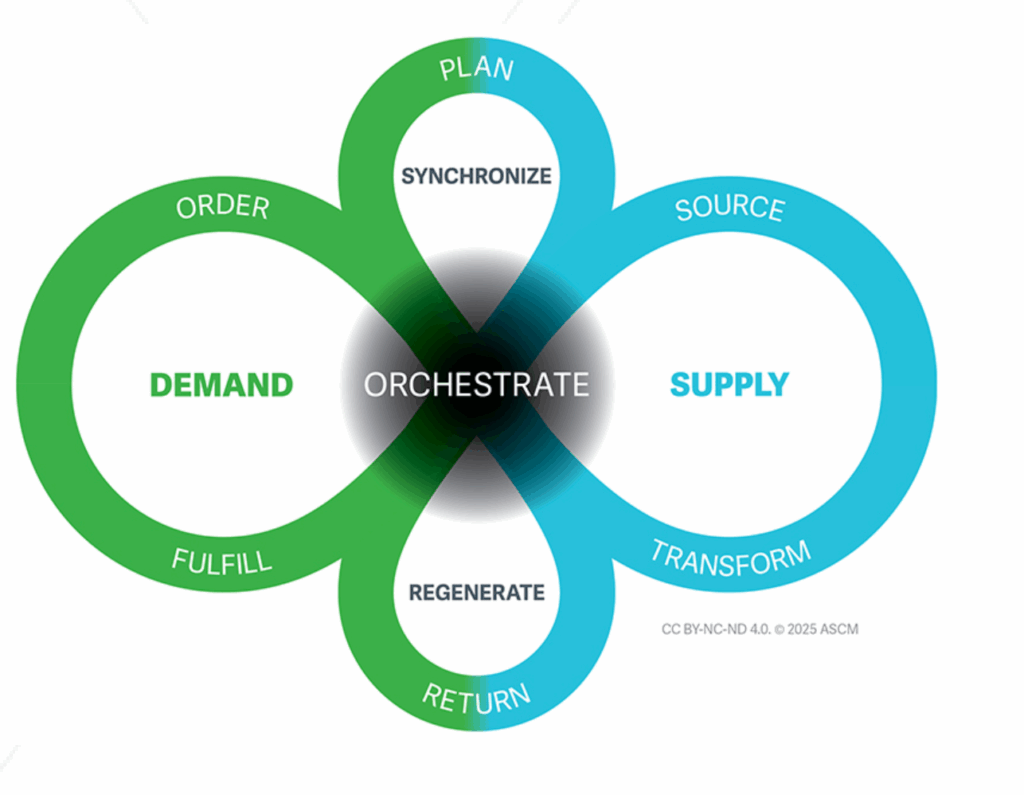
This brings me to the ASCM SCOR DS model. Notice the big word orchestrate in the center of the model in Figure 3. The definition is: “Orchestrate is about managing the big picture across the entire supply chain—setting goals, aligning teams, and making sure all the moving parts (planning, sourcing, delivering, etc.) are working toward the same strategy. It’s like the role of a coach who doesn’t play in the game but makes sure the team works together, follows the game plan, and adjusts when needed. For example, a smartphone company uses real-time data from suppliers, factories, and sales to shift production from one model to another if it sees higher demand or a delay in a specific component.” SCOR DS, 2024
ASCM made a mistake supporting Deloitte’s Digital Transformation model. The model was never aligned to support the SCOR DS model. And digital transformation was never well defined. However, there is an opportunity for ASCM to build a model that is a primer for supply chain leaders to redefine work based on orchestration in the world of AI.
We should build this vision with a common voice, not one-off concepts from social influencers, analysts, consultants, academics, and technologists. What voice will rise to help the industry paint this vision? ASCM this is your opportunity to lose.
Figure 3. Depiction of the SCOR DS Model
Next Steps
So, how do we evolve to outside-in processes while redefining our relationship with data, code, and models? The answer is evolving, but it starts with a clear vision of what is possible. We need to step away from the current definitions of work and redefine organizational workflows holistically. Role redefinition should not be defined in isolation.
AI can quickly drive many decisions quickly. But who questions, “Are they good decisions?” Without governance and alignment, this increases nervousness in the complex system we call a supply chain and decreases value.
I certainly don’t have the answers, but I want to help. If you are reading this research, I would love your help to participate in research on the redefinition of supply chain platforms. My goal is to give to you through my writings when you give to me by filling out research studies. I will share the results openly through the research. Here is the link to share your insights. The survey is open to all–business users, technologists, and consultants. All respondent data will be shared confidentially without attribution.