Lora's Latest Post

The Courage to Jump

Supply chain leaders are in the middle of implementing digital transformation programs. For many organizations, digital transformation is untethered hype. There is a veiled promise for improvement. Here I ask, “Whether we can change course to drive more value in supply chain management?”

“Vieled: not openly or directly revealed or expressed. “

Free Dictionary

What Is Digital Transformation?

I first encountered the term “digital transformation” in 2011. The term is a spin-off of the “Big Data” work from the open source innovation of the last decade. The terms digitization and digital transformation are often used interchangeably even though they are separate and distinct.

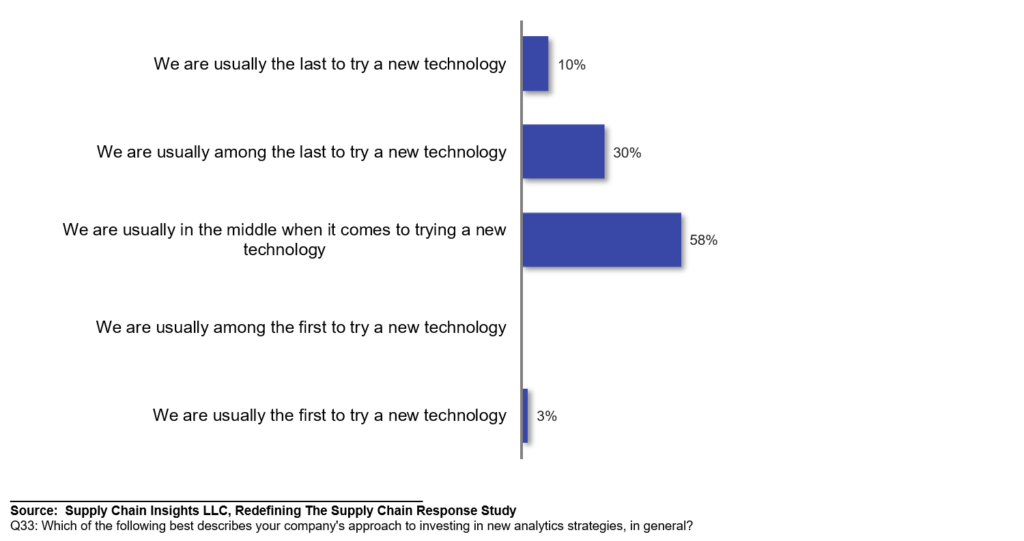
Ironically, supply chains are big data problems where the buyers have little understanding of the new technology approaches. Legacy investments are based on relational database technologies, the engines to improve decisions are “set it and forget it”, and the IT standardization restrictions to mitigate cost moves companies to spend millions on old approaches that drive little value. Ironically, this happens sadly in the face of unprecedented variability and risk to business continuity. As shown in Figure 1, only 3% of companies consider themselves innovators. The obstacles for innovators are intense. Not much has changed in the past five years.

Figure 1. Innovation Openness
I liken this story to penguins standing together on an iceberg after a long walk across blinding winter conditions. How so? The hungry penguins stand on the icebergs staring down at the water’s edge wanting to jump but fearful of being eaten by a seal. So, they stand together and watch the first penguin jump, and if the first one does not get eaten, they will slowly jump themselves. This is even though the penguins are starving and the only food source is in the water.
How do companies get the inspiration and courage to jump? I don’t know. Only 1/3 of manufacturing companies feel that they are equal to current disruptions.

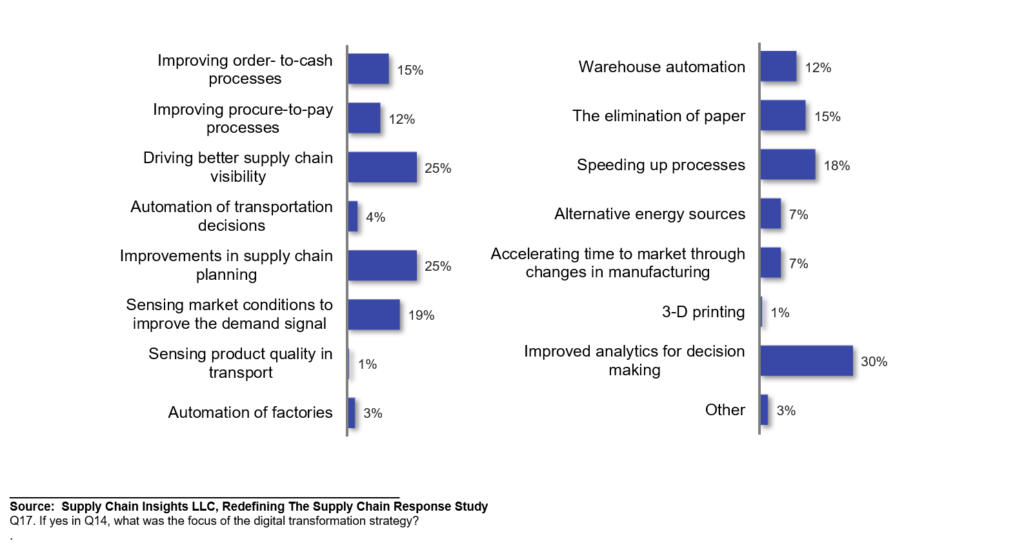
Digital means different things to different teams. (These definitions are shared in an earlier post.) The most successful investments with the highest satisfaction are manufacturing automation and descriptive analytics/data visualization.

Figure 2. The Focus of Digital Transformation Programs
The journey requires investment and training teams on the promise of new technologies. I believe that many of these new approaches drive value. My belief fuels my need to host events like the Supply Chain Insights Global Summit, facilitate the network of networks group, and challenge technologists to test new approaches in Project Zebra.

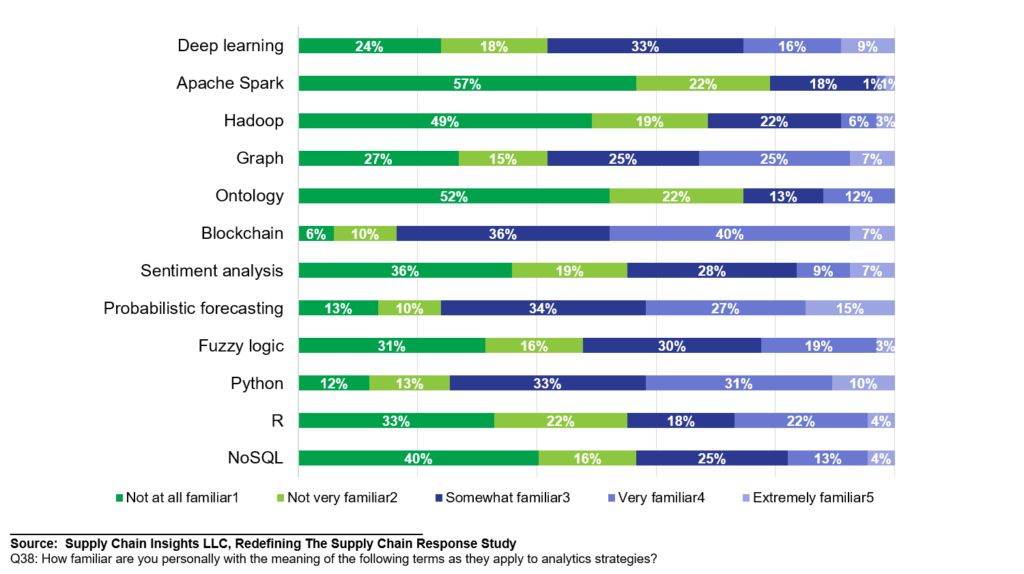
To drive forward, cultures need to change to embrace failure as success–the value of learning needs to equal the drive for Return on Investment (ROI). The current state shows that only three-five percent of supply chain leaders are familiar with the new approaches/terms, and 97% of companies lack the culture to test and learn to drive process innovation. The gaps between IT and business leaders are a major roadblock.

Figure 3. Familiarity with New Analytic Approaches
Final Thoughts

We are in an endless cycle. Companies want proven solutions but chase shiny objects. In this journey, leaders use many terms lacking well-grounded objectives.

Despite the proliferation of many new and promising technologies, the tolerance for testing and learning is low. The current approaches using relational databases and traditional models are not equal to today’s challenges. Today, two out of three companies feel that their current technology solutions are not equal to the challenges of the current environment, but will they jump? Will they test new approaches? Sadly, I don’t think so.

I welcome your thoughts.

Search the Archives
Search
Share this Post
Email
Twitter
LinkedIn
Facebook
Pinterest
WhatsApp
Featured Image
Recent Posts

My Answer to Joe. The Future of APS

Traditional Advanced Planning Systems (APS) are unlikely to become true enterprise platforms because organizations remain functionally siloed, metrics are misaligned, and current APS architectures were designed for an environment that has fundamentally changed. Here I share how I think that APS systems can adapt to drive more value.

Read More »

Teaching Your Organization to Jump

Remember the story of the frog in the pot of water? If the water temperature rises slowly, the frog doesn’t recognize the danger until it is too late. Put the frog directly into boiling water, and it jumps.

I think the analogy applies to today’s supply chains.

Companies are absorbing increasing volatility and complexity without fundamentally redefining how work gets done. Companies have confused historic practices with best practices. They are now taking those same processes and attempting to automate them with agents and agentic AI—without first stopping to ask a more fundamental question: Is it time to jump? Here I give a five-step action plan.

Read More »

Navigating Supply Chain Economic Downturns

In 2007, the average company took six months to sense market shifts and adapt its supply chain. My estimate, based on work with clients, is that if a downturn happened today, the average company would take 20-30% more time to adjust than in 2007. Here I give insights on preparedness.

Read More »

Warning: Sidestep the Narrative of the Misguided Goldiggers

Ten years ago, I started writing a book titled Stories of the Misguided Gold Diggers. The book was a collection of stories from two decades of stories of technology leaders perpetuating the myth of integrated end-to-end supply chain planning.

I dusted off the manuscript on Saturday. I think that we have a new chapter. Companies focused on putting Artificial Intelligence (AI) on top of existing architectures are putting AI Stupid on steroids.

Read More »

The Myth of End-to-End Planning

Supply chain planning, supply management, supply chain execution, network design, and transportation/logistics management operate in silos. Not much has changed over four decades. The connections flow back through transactional systems: order-to-cash and procure-to-pay. There is a myth that companies can buy an end-to-end supply chain management solution. This is largely a myth. Here we explain.

Read More »

Lead Time: A Broken Gossamer

If you are struggling with supply chain planning, dancing in the light of shiny objects, and scratching your head, please read on. My goal is to help you.

Please do not AI Stupid. What do I mean? AI Stupid is putting agents and agentics on top of existing architectures believing that making them faster and hands free add value. To me, this is fools play.

I love AI. I am excited about new technologies. To this end, I want to shine a light on how new technologies can help address the black holes and inconsistencies in today’s supply chain, which largely stem from the limitations of the first generation of supply chain planning and execution technologies. In this blog, I give you three places to start.

Read More »