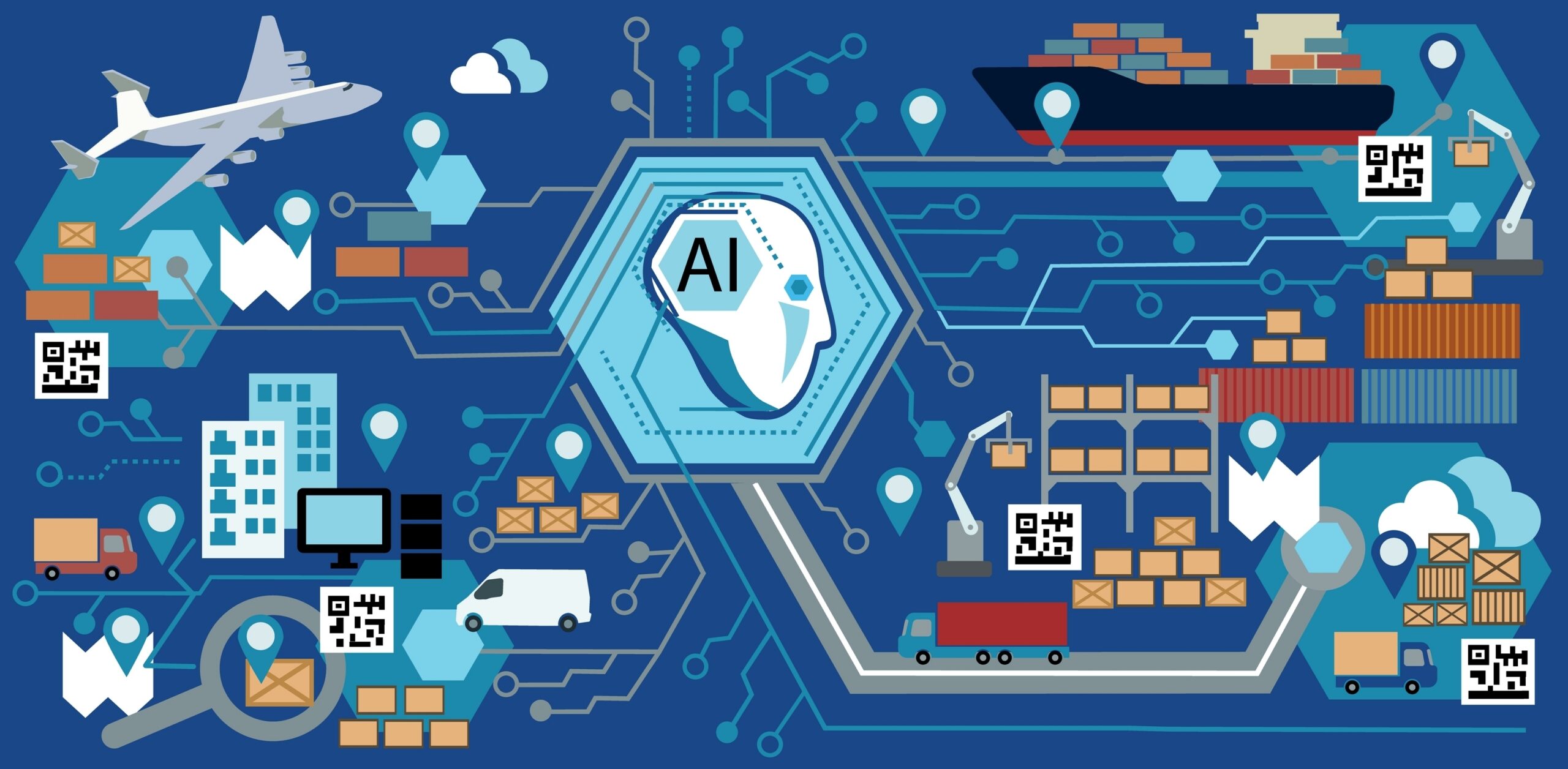
 Hyperledger. Blockchain. New concepts? Yes. Get used to it. They are here to stay.
I think defining the future of Supply Chain technology means that we, as supply chain leaders, need to take a hard left. We are moving at a steady pace down a road that is well-known and safe, but is not sufficient. What do I mean? Let me explain. Today’s supply chains use closed and proprietary technologies. I believe we need to move to Open Source tech. The reason? There are dark holes in the supply chain which I believe will not be closed with the current approaches.
What is a dark hole? These are typically the handshakes, or interface points, between applications. At the hand-off points, data does not flow. The flow stops data translation and visibility in the network. It could be unloading a container from a ship, receipt of a shipment, transfer of ownership, a return, or a change in status. The dark holes usually happen with the transference of ownership or change in status between two parties.
The product road maps of conventional technology providers are not closing the dark holes. Instead, the focus is on refining today’s enterprise applications. It is unrealistic to think that vendors like Infor, Microsoft, Oracle, and SAP will ever work together to erase the dark holes of information in the supply chain. Likewise, it is very clear that ERP will be the backbone or system of record for transactions within the enterprise, but it is insufficient as the backbone or system of record for a value network. It is also clear that through globalization, value networks aren’t linear. Instead, they are a set of complex interactions which are increasing in speed and depth of the interaction.
Background
This realization hit me after completing two years of research. After publishing a series of reports on visibility, I facilitated a dinner between two major manufacturers. Each had E2open, Elemica, GTNexus and SAP Ariba and were unable to drive interoperability between the networks. Onboarding new suppliers took three to four months with integration requirements into 10s to 100s of systems with over 65% of the the process in email and Excel. We laughed at the mess we are in, and drew options on napkins on how to unstick the supply chain. One dinner participant laughed as he said, “The more efficient we try to make procurement, the more we screw it up!” I nodded my head in agreement.
This transition from closed and proprietary solutions to open source capabilities will not happen quickly. I see adoption over the next five years; and if it works, I think that blockchain will be embedded in all of today’s current technologies (much like we require REST APIs today).
Before I continue let me confess. I am not a technologist. I cannot write code, and when I worked for a software company, I quickly discovered that writing software requirements was not the best use of my skill sets. I like to paint big pictures and help others to fill in the gaps. In these sessions I am a facilitator of bright minds who are clear that today’s path takes us down blind alleys. A connector of sorts.
As a result, this blog is not a technology dissertation. I do not know if anything here is possible. Instead, I question the status quo, paint some possible use cases, and prod the industry to consider a different path. Here are some case studies I developed through talking to technology experts.
Use Cases for Hyperledger
The Hyperledger project is an Open Source blockchain platform. Started in December 2015 by the Linux Foundation, it enables blockchain-based distributed ledgers. While many may know blockchain as an engine powering bitcoin in the dark web, the use cases are far more pervasive and powerful for the value network.
The Hyperledger project aims to bring together a number of independent efforts to develop open protocols and standards, by providing a modular framework that supports different components for different uses. This would include a variety of blockchain technology variants with their own consensus and storage models, and services for identity, access control, and contracts. In the Networks of Network testing in the spring of 2017, we will be using the IBM version of blockchain to test the use of Hyperledger to improve network onboarding. Our goal is to test the open source version from IBM in the digital sandbox/lab environment at Schneider Electric. We are hosting a call for participants in a webinar on January 11, 2017. Our goal? We are hoping to ignite a movement to transform value networks. (We will ideate as a group of technologists and manufacturing visionaries during the next Network of Networks Session on April 13-14 at the Grande Lakes Ritz-Carlton Hotel.)
What are the possibilities? Today we don’t know what will work. It is clear the networks we have today–each progressing down separate and proprietary paths– will automate private networks of one-to-many architectures, but never drive effective networks that are many-to-many. As you think about Hyperledger, and the possibilities and the work that we are starting, here are some concepts we are considering testing as a group:
- Community Registry. Today network registration is onboarding to every network as an individual or as a company. It lacks the system of reference of division/company or company/industry. What if we could have a community registry where we have a single sign-on which could be accessed by all value networks? (Analogous to network DNS.) This numbering schema would be carried in blockchain messaging, enabling writing information once, and safe/secure communication across the network.
- Replacement of EDI. Today EDI is the workhorse of the supply chain. Messages are transmitted and opened safely and securely. However, it is batch, and there is latency as the message is opened. In addition, the passage and receipt of EDI requires sophisticated IT groups. As a result, it is more costly. (This is not always a reality for small companies in emerging economies.) Could blockchain replace EDI? This is a stretch objective, but I think it’s possible.
- Lineage. Track and Trace. Track and trace across multiple parties is cumbersome and lacks reliability. Blockchain offers the ability to embed the origin and transfer points in the chain to encode lot codes, origin points and destinations. This could help in food track and trace, the management of gray market goods to eliminate counterfeit items, and the assurance of origin for tracking social responsibility goals for fair labor, Congo metals, etc. This will enable compliance and could streamline recalls.
- Safe and Secure Supply Chains. As goods pass through the supply chain, multiple parties handle the goods. Blockchain technologies enable a chain of custody. In the process, the requirements of each product for handling are communicated on receipt. Why is this an issue? We discard 1/3 of perishable items. What if the use of blockchain, along with temperature sensing, could redefine code dates real-time based on handling for perishable items like fruits/vegetables and chicken? And, in extreme cases of temperature or handling abuse indicate disposal? (This is extremely important in pharmaceutical cold chains.) Or, what if the conditions for handling could be read on receipt to enable safe put-away for flammables?
- Improving Social Responsibility Goals. Tracking carbon and point of origin for compliance is difficult. One thing is clear: audits do not work. As we tackle issues like fair labor, clean water, Congo metals, and carbon consumption, blockchain can track the code of custody and help us to better understand and measure energy consumption, carbon emissions and other social responsibility goal tracking
- Supply Chain Finance. The origin of blockchain is safe and secure payment. Could we disintermediate banks as we know them? Each time a supply chain transaction passes through a bank, there are charges. Could we drive a massive restructuring of world banking to reduce bank charges for credit cards, wire transfers, and EFT/ACH payments?
- Document Sharing. I think the world has too many lawyers. In supply chain, we spend hours upon hours negotiating terms and conditions of contracts. After completion, the filed contracts are never used again. We do not connect the contracts to supply chain execution. So, what if contracts could accompany a PO, and as conditions change, rules change the cost based on delivery conditions? Or delivery conditions, based on availability (dynamic dock scheduling) and weather? I think this is all possible. I think blockchain allows the connection of supply chain documents to transactions in a real-time basis using blockchain along with cognitive computing.
Today we do not know what is possible. However, the more I study this technology at the beginning of its hype cycle, I think that it is very promising. I am excited to be a part of the group who is going to do some serious testing. We will be sharing the results publicly at the upcoming Supply Chain Insights Global Summit on September 5-8, 2017. We hope to see you there!
Also, join our webinar on January 11, 2017. We are also looking for companies to test with us.
Let me know your thoughts. Did I miss any important use cases? Any experiences to share?