Supply chain management, as a practice in commercial operations, is now thirty years old. Early 2012 marked the end of the third decade and 2013 finds us into the fourth.
When we look backwards and use the results on corporate financials as a litmus test on supply chain excellence, we find that:
- We have made Improvements in Productivity. Due to improvements in connectivity, 90% of industries have made improvements in productivity (revenue/employee). The chemical and consumer electronics industries have made the most progress.
- Balance Remains an Issue. Companies are stalled on improving customer service and forecast accuracy.
- Complexity has Grown. It comes in many flavors–increase in inventory, changes in sales policies, new product lines– all add to the complexity. Supply chains have not morphed to manage the complexity at the same cost, quality and level of customer service.
- Cycle Management is Stalled. The only industry that has made progress in inventory management is consumer electronics.
Today, I spoke at the Chief Supply Chain Officer conference in Chicago at the Eye for Transport event on the results of the research. When I finished the presentation (the materials are available on slideshare.) I asked for questions. The person in the audience asked me “Why did I believe that this happened? Why do supply chain professionals believe that they have made improvements when they really have not?” Here I share my answer:
1) Accountability. When it comes to supply chain processes, companies have not held themselves accountable to the balance sheet. Most companies are surprised when we share their results on the Supply Chain Effective Frontier. (The ability of a company to balance and improve growth, profitability, cycles and complexity in the value chain over the decade.)
2) Definition of Supply Chain as a Function versus a Way of Doing Business. The original intent of the supply chain was to build “end-to-end processes.” Over time the term has evolved to describe a “function.” Less than 1% of companies have a leader focused on the building of end-to-end processes. Most of the opportunity lies in the crevices between functions within the organization and between companies.
3) Leadership. Many executives lack an understanding of the supply chain as a complex system and how to manage trade-offs. There is a lack of understanding of the basics of agility and responsiveness.

4) Need for Strong Horizontal Processes. Companies have focused on vertical processes. There is a need for cross-functional alignment through horizontal processes. Companies with strong horizontal processes of revenue management, new product launch, Sales and Operations Planning (S&OP), Supplier Development and Corporate Social Responsibility have higher performance.
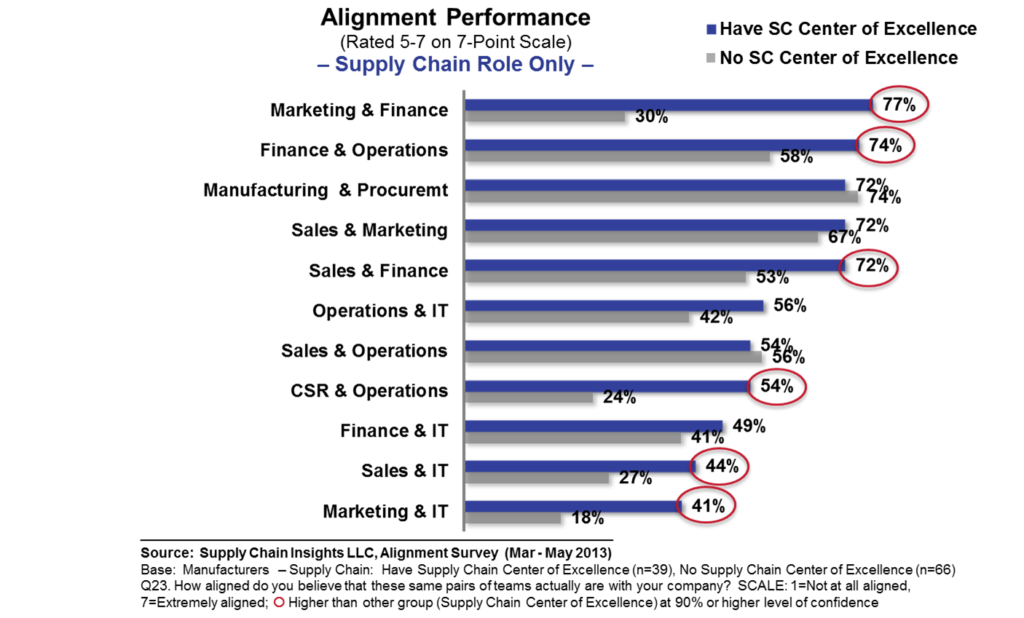
5) Alignment. By and large, organizations are not aligned to drive cross-functional performance. Based on recent research, we find that companies that have invested in Supply Chain Centers of Excellence, as shown in figure 1, rate themselves higher on cross-functional alignment. The presence of these centers is relatively new. Without them, the gaps are large.
6) Project Focus versus Systemic Improvements. I believe that we have made progress on projects, but that we have not translated these projects into holistic improvements.
7) Belief that we had Best Practices. I strongly feel that we have evolving practices. I have seen too many companies adopt practices that were not a good fit because they were recommended as best practices. Examples include one-number forecasting, consensus forecasting without bias and error accountability, CPFR without measuring forecast accuracy of the downstream partner…. The list could go on and on.
What do you think? How would you have answered the question? Anything you would add?
Next week is the first time that I am home in three months. WHEW!!! It will be nice to be home and to have time to write on this second book, Metrics that Matter. If you have a story of supply chain excellence that you want to share for my book, please drop me a line.