
Lora's Latest Post

Conquering the Effective Frontier

On Wednesday, Supply Chain Insights will host our first conference. It is designed as an annual event for supply chain leaders. We are proud of the line-up of speakers.
The event will open with the sharing of research of how supply chain leaders have made trade-offs on Conquering the Supply Chain Effective Frontier. (We have been analyzing balance sheets and studying the financial performance of companies for the last sixteen months. We wanted to understand how companies have made the trade-offs of growth, profitability, cycles and complexity.) In the morning session, leaders from P&G, Intel and Merck will be sharing their insights behind their numbers.  We look forward to hearing their perspectives.
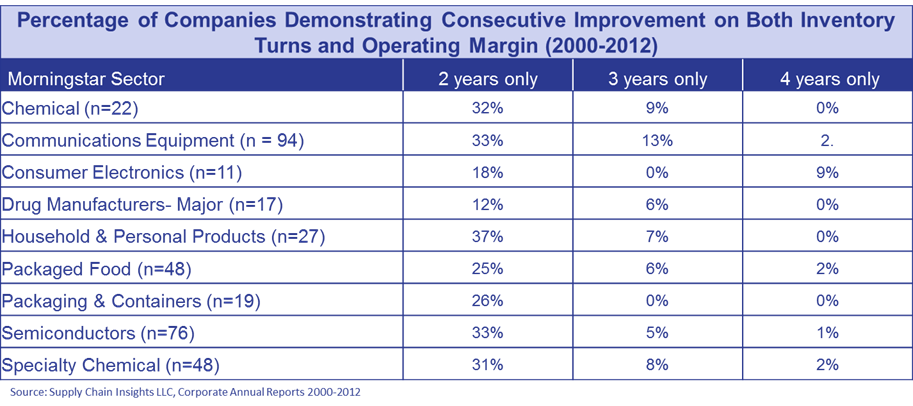
We find that nine out of ten companies are stuck.. Complexity has risen and progress on margin and inventory is stalled. While 1/3 of companies have been able to drive progress for two consecutive years over the last decade, no company has been able to sustain this for more than four years. In Table 1, we share these results. Attending the conference, and making improvement in both inventory cycles and operating margin for two consecutive years, are Colgate, Dow Chemical, and General Mills.
Table 1.
figure_1-consecutive_improvement
As shown in figure 1, ironically, the greatest improvement, and the toughest work, was at the end of the last two recessions. We believe that it is a case of when the going gets tough that the tough get going.
Figure 1.
figure_2-recessions
Today, many companies are stuck. We believe that to improve supply chain potential, companies need to adopt new technologies and processes and build supply chains outside-in. When we asked the attendees to imagine their supply chains of the future, and to rank the supply chain trends that they were the most excited about in the race for Supply Chain 2020, their answers are shown in figure 2. It will be interesting to see how their perspectives change, with the sharing of insights from global leaders, over the course of the conference. We will be sharing these insights on our upcoming webinar that will happen post-conference. Register for the webiner at our Upcoming Events page.
Figure 2.
figure_3-Top_3_Supply_Chain_Trends
If you are not able to make the conference, tune in to see their response live. You can follow the conference on our USTREAM channel at http://www.ustream.tv/scisummit13 and follow the action on Twitter via the hashtag #SCIsummit.  Once the Summit has ended we’ll be archiving the presentations and the video for six months.
Also, just because you will not be there in person does not mean that you will miss out on the action.  If you have a question for our speakers just send it to us on twitter using the #scisummit hashtag and we will ask it to the speakers during the Q&A sessions. So, join in the conversation and share the presentation with your team. We are convinced that it will be unlike any other supply chain conference.
 

Search the Archives
Search
Share this Post
Email
Twitter
LinkedIn
Facebook
Pinterest
WhatsApp
Featured Image
figure_1-consecutive_improvement
Recent Posts

Lead Time: A Broken Gossamer

If you are struggling with supply chain planning, dancing in the light of shiny objects, and scratching your head, please read on. My goal is to help you.

Please do not AI Stupid. What do I mean? AI Stupid is putting agents and agentics on top of existing architectures believing that making them faster and hands free add value. To me, this is fools play.

I love AI. I am excited about new technologies. To this end, I want to shine a light on how new technologies can help address the black holes and inconsistencies in today’s supply chain, which largely stem from the limitations of the first generation of supply chain planning and execution technologies. In this blog, I give you three places to start.

Read More »

Do You Need a Supply Chain Coach?

Supply chain is where the rubber hits the road. For a public company, over 40% of market capitalization is tied to the trade-offs between growth, operating margin, inventory management, and Return on Capital Employed.

The road for supply chain improvement is fraught with issues. Here we share some and offer some advice.

Read More »

Is your Supply Chain AI Ready?

A simple quiz to assess an organization’s AI readiness.

The pace of change is fast and furious. Every day, technology advances faster than we can digest. A great challenge to have.

Determining whether a supply chain is “AI-ready” is less about technology and more about the gray matter between the ears of supply chain leaders. Leadership, alignment, and clarity of goals matter.

Too few companies are clear on the definition of supply chain excellence. Measuring and rewarding functional metrics reduces the firm’s value. Putting agentics on top of today’s processes can make bad practices run faster, reducing value.

The toughest job for the supply chain leader is challenging existing supply chain paradigms that were defined by the limitations of decades of supply chain technologies. As the curtain lifts on the potential of new forms of technology, process redefinition is our opportunity, but only if we are clear on what drives value. (Here, I link to the Supply Chains to Admire reports to help you define value. The next report will be published on June 23rd, along with my Dynamic Benchmarking Product, to help you define value in the face of your AI readiness. More information about the launch is at the bottom of this blog.)

Read More »

Case Study: A Scrappy Demand Management Approach

This study of Franklin Sports shines a light on the work that needs to be done at the sales account level to challenge a retail forecast, and also highlights the importance of a new technique for a forecast engine — reinforcement learning.

Artificial intelligence comes in many forms — large language models, generative AI, machine learning, unstructured text mining, deep learning, neural networks, reinforcement learning, agents, and agentics. While the industry is wigging out about agentics, I think reinforcement learning is a great step forward in the journey of Artificial Intelligence.

Read More »

Can We Side-Step the AI Spin Cycle?

When it comes to combining tech, 1+1+1 should equal more than 1. The impact should be exponential. Unfortunately, today, the answer is 0.

What do I mean? Let me explain.

I find that the supply chain technology market moves slowly along traditional technology lines. Conferences are usually focused on the use of technology, not on redefining work. This bothers me. I want it to bother you as well.

Here I share some insights to drive change.

Read More »

Supply Chain Health Check: The Power of an Orbit Chart

An orbit chart is a powerful tool for understanding the “health” of a supply chain and its potential for improvement. The supply chain is a complex, non-linear system with limited trade-offs. The relationship between trade-offs varies by industry, region, and size. The orbit chart is a diagnostic we use in the Supply Chains to Admire work. Here I explain the use case.

Read More »