I was in Austin running for an appointment and signaled for an Uber. A WAYMO vehicle showed up. The experience of an autonomous vehicle was new for me.

Accompanying me to dinner was a product development leader from a software company that will remain nameless. (He will know who he is. <smile>) For the purposes of this article, let’s call him Zac.
Zac said, “See if a car can run autonomously (without a driver), we can do it for the supply chain too!” I laughed and retorted, “A car knows where it is going. There is a map, and clear rules for intersections. These relationships can be programmed. The supply chain is different. The supply chain is a complex non-linear system often without clear goals or governance (how to make a decision.) Most supply chain leaders struggle to define what good looks like. We are caught up in a trap of rewarding functional behavior that throws the supply chain out of balance sub-optimizing the delivery of value.“
I continued, “I hate to see people talk about autonomous supply chains when they are not clear on systems thinking and supply chain dynamics, rely on spreadsheets, and are unclear on governance.” He laughed, and said, “Our clients are asking us for autonomous supply chain capabilities, do we say, NO?” And I responded, “You need to educate. We are not ready, nor is it any company’s BEST INTEREST to be discussing autonomous supply chains. Through education, we need to convince companies not to waste their money.”
He protested and disagreed vehemently. (I love people with passion.)
This blog post is dedicated to Zac.
My Open Letter to Zac
Dear Zac,
I pulled data from my research study on artificial intelligence and analytics investment from the field, and I want to use it to bolster my argument that no technology or consulting company should ever use the term AUTONOMOUS SUPPLY CHAIN in the delivery of planning. Just as planning should never be real-time, companies are not ready for autonomous or self-driving supply chains.
Let’s start with the facts.
Zac, why do you think that companies are SO DEPENDENT on spreadsheets are shown in Figure 1? This dependency, in my opinion, is due to the fact that the current definitions of planning are not sufficient. Over 92% of companies in this survey report the use of ERP and APS, but the technologies are not used as designed. Instead of using the expensive optimizers in these systems, planners work on spreadsheets and write the data to the planning systems as a system of record. Sad, isn’t it? But we should not try to WAYMO what is not working.
Uncertainty and variability reign in discussions, yet companies are focused on transactional efficiency with some focusing on the concepts of supply chain physics (theory of constraints). We are not embracing systems thinking. I find systems thinking is seldom taught in schools and very few of my students in my outside-in planning classes are familiar with the concepts.
Figure 1. Dependence of Supply Chain Planners on Excel Spreadsheets

Take a look at the data in Figure 2 and the low marks the respondents give themselves on critical thinking, design thinking, and systems thinking. Isn’t this sad?
All this tech, but such low ratings. The average acumen in the industry of business leaders and their understanding of planning is plummeting while in parallel technology possibilities are exploding. So much opportunity yet so much wasted effort because companies are not challenging their teams to unlearn and think differently.
Figure 2. Self-reported Data on Thinking Styles
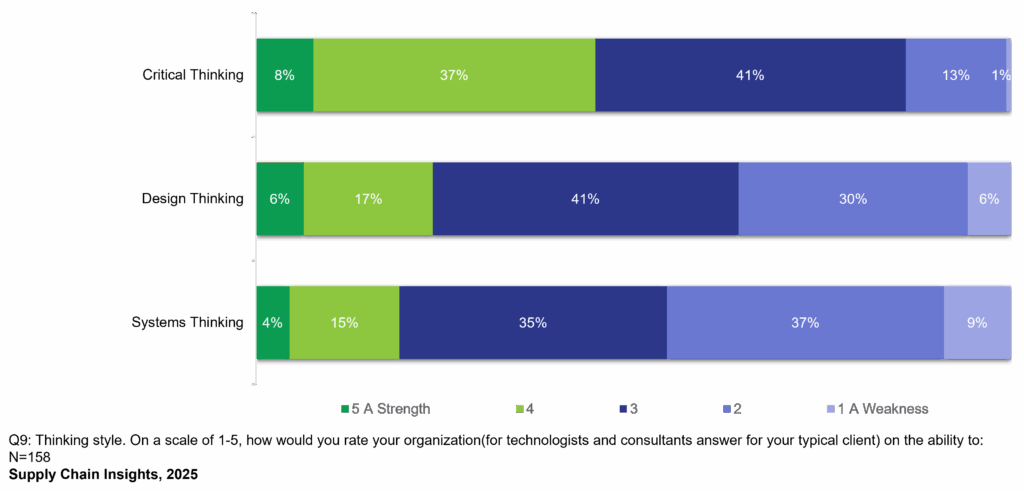
For clarity, all three of these thinking styles need to work together to make these programs successful. We are stronger on critical thinking than design or systems thinking, but many in supply chain teams lack this critical understanding. Most teams fall into the trap that historic practices are best to implement. It is hard for people to learn that supply chain excellence is more than transactional efficiency, and that we need to throw away many of the planning concepts of traditional planning taxonomies developed in the 1980s yet celebrated in frameworks like the Gartner Magic Quadrant.
Thinking Style Definitions

Zac, as we discussed, systems thinking is critical to modeling the supply chain as complex, non-linear system, and applying the concepts of supply chain dynamics. Here is a refresher on the definitions used in the class I taught you and the team:
- Transactional Efficiency: Transactional efficiency refers to the speed, accuracy, and cost-effectiveness of supply chain processes, aiming to enhance business transactions and focus on return on investment (ROI).
- Supply Chain Physics: Measurable mathematical relationships predicting the performance limits of the supply chain and how it will respond to both management action and external factors. The management of the supply chain requires recognizing constraints and designing three buffers: capacity, inventory, and time, with a focus on reliability. Supply chain physics concepts underpin the Theory of Constrain logic that is foundational to supply chain planning.
- Supply Chain Dynamics: Supply chains are stochastic, dynamic systems driven by variability and shaped by complexity. The focus is on reducing variability, managing the rhythms and cycles of flow, and minimizing the bullwhip—to drive value. The supply chain dynamics concepts are critical to reduction of the bullwhip and driving effective reinforcement learning.
Zac, unlearning is tough. But together, we need to educate companies through training and engaged delivery models. This step change in thinking needs to happen through focused collaboration of academics, technologists, and industry consortia.
The feeding of hype cycles with irresponsible rhetoric makes me weary and the failed implementations make me scream. So, much wasted money when the need is so great. If you obey and deliver systems that don’t yield value, aren’t you part of the problem?
Let’s fix it together. As we discussed, companies need to start with what defines supply chain excellence, gain clarity on what makes a good decision, and clearly define governance. (Good governance defines who should make what decisions when.) We never redefined planning processes in the move from local to regional to multi-national to global supply chains. As a result, many companies are unclear on governance, and don’t know how to measure a good plan. So, Zac, how can we automate something this messy? And what is your organization as a tech leader doing to educate the market? It is tough to sell to ill-informed buyer. Yet, I see no technology marketing leader leading in this area.
Figure 3. Decision Governance in Demand Planning

Summary
In summary Zac, words are easy to say, and installing tech is relatively simplistic. The major barriers for the step change in supply chain planning automation are rethinking work based on embracing these three thinking styles together while clearly defining the goals and governance.
So, Zac, did I win my argument?
What do others think? Please let me know in the comments
Thanks!
And, if you participated in this study thanks! I am so deeply dedicated to helping my audience of over 340,000 readers.
I am currently working on the cross tabs and correlations and will share more in the blog. Respondents will be invited to a roundtable. I love these discussions because I get great insights! Stay tuned.
And, meanwhile, delete the term autonomous from all of your strategy decks and planning requirements. Don’t try to WAYMO what you cannot clearly define and control.
Planning should not be real-time or autonomous. Instead, decisions should be made at the speed of business based on a clear definition of strategy and the delivery of value based on clear governance. For most, this is hard work. Let’s work together to make this journey easier.