

Y2K was ending when I posed in front of a camera for my Gartner ID card. This year marks my twentieth year as an industry analyst. I spent two years as an analyst at Gartner Group, six years at AMR Research, two years at Altimeter Group, and the remainder as the founder of my own independent analyst company, Supply Chain Insights.
What is an industry analyst? I like to tell folks that a consultant knows the answers, while an industry analyst is searching to formulate the right questions to ask to improve business outcomes. As those who read my blog regularly know, I take this job seriously. I write for business leaders seeking first-mover advantage.

Reflection
I left Gartner because I did not believe in the business model. I watched as ERP providers influenced fellow analysts to push ERP II concepts myopically. I protested, but found my differing views were a hard slog up a long hill. Most operated in an efficient transaction paradigm.
Here we are, twenty-five years later, making little progress in supply chain planning, facing the same issues I cited in our Gartner meeting rooms during analyst discussions. I felt then, and I feel now, that analysts’ perspectives were hijacked by ERP vendors’ spending on analysts and by most analysts’ lack of understanding of supply chain planning.
For reference, here is the Wikipedia summary of ERP II.
“ERP II” was coined in 2000 in an article by Gartner Publications entitled ERP Is Dead—Long Live ERP II.[15][16] It describes web–based software that provides real–time access to ERP systems to employees and partners (such as suppliers and customers). The ERP II role expands traditional ERP resource optimization and transaction processing. Rather than just manage buying, selling, etc.—ERP II leverages information in the resources under its management to help the enterprise collaborate with other enterprises.[17] ERP II is more flexible than the first generation ERP. Rather than confine ERP system capabilities within the organization, it goes beyond the corporate walls to interact with other systems. Enterprise application suite is an alternate name for such systems. ERP II systems are typically used to enable collaborative initiatives such as supply chain management (SCM), customer relationship management (CRM) and business intelligence (BI) among business partner organizations through the use of various electronic business technologies.[18][19] “, Wikipedia
The definition held several false assumptions. I argued these to no avail with my fellow analysts:
- False Assumption #1. Transactional Efficiency is Sufficient to Drive Value. No doubt about it, ERP architectures improve the efficiency of order-to-cash and procure-to-pay transactional sets. We would not have built global supply chains without these capabilities. The investment in ERP sets the stage for an efficient supply chain, but misses the need for buffers, decoupling points, and policy shifts to improve agility. Excellence in supply chain planning requires constraint visibility and flow modeling to maximize value-based outcomes as we move from a focus on math to physics to understand supply chain dynamics. (For a better understanding, see the definitions below.)
- False Assumption #2. Tight Integration of SCM with ERP Improves Value. Tight integration of transactional data with planning models introduces nervousness and increases the bullwhip effect. (Don’t believe me? Measure it.) While ERP architectures are essential as a system of record, tight integration with planning limits the ability planning capabilities to model scenarios like what-if analysis and discrete-event simulation.
- False Assumption #3. The Integrated Supply Chain Improves Outcomes. While business leaders speak of the need for the integrated supply chain, the need state is interoperability. Tight integration without a unified data model and semantic reconciliation is a problem to drive data understanding and use cases like substitution, phase in/phase out of products, bill of material translation from PLM to SCM, and clarity on the selling unit.
- False Assumption #4. Enterprise Data Is Sufficient to Drive Excellence in Supply Chain Planning. The issues are many. In mature supply chain planning deployments, enterprise transactional data only represents 40-60% of the requirements. The reason? Enterprise data is not sufficient in three areas.
- Newness. Brands grow through excitement and newness — creating excitement through new markets, products, and platforms. Enterprise data is backward-looking. Modeling newness in ERP-centric architectures is an issue. There is no good way to account for newness in tight integration of supply chain planning to ERP.
- Market Data. When compared with market data (channel and supplier data), enterprise data has a latency of weeks or months. As a result, there is no place to put market data in ERP-centric architectures. Organizations that only use ERP data are always on the back foot seeing market shifts weeks or even months before reacting.
- Network Data. The focus on enterprise-centric architectures was a barrier to building networks. By definition, ERP is not a good building block — it is linear and not bi-directional, and it lacks a many-to-many canonical — to define network flow.
Mistakes Made Over and Over Again
The market moves through shifts and hype cycles, repeating the same mistakes. In the 2000-2010 decade, the focus was on tight integration with ERP. Early in the next decade, the focus was on big data (use of unstructured and streaming data). There was then a shift to digital transformation, and now to AI. Over the last two decades, we have made little progress in supply chain planning.

Teams get caught in a hype cycle — failing to define terms and outcomes — falling prey to buzzword bingo. Alas, pretty words and pictures do not drive successful projects. Chasing shiny objects is a recipe for failure. Clarity on business objectives, definitions, and outcomes is essential. For example, today, AI is everywhere but nowhere in planning architectures. There are examples of agents and early forms of agentics, but the use cases are primarily to reduce planning workload, not to redefine work. The use of machine learning, reinforcement, and deep learning techniques is core to planning, but with all planning implementations, companies need to test and verify outcomes by backcasting, Forecast Value Added Analysis, Calculation of the Bullwhip, and testing plan feasibility.
The larger the company, the greater the gap in using insights to make decisions. As shown in Figure 1, consultants and technologists recognize the gap between data and decision-making, but few are working to close this gap. Instead, companies continue to chase shiny objects.
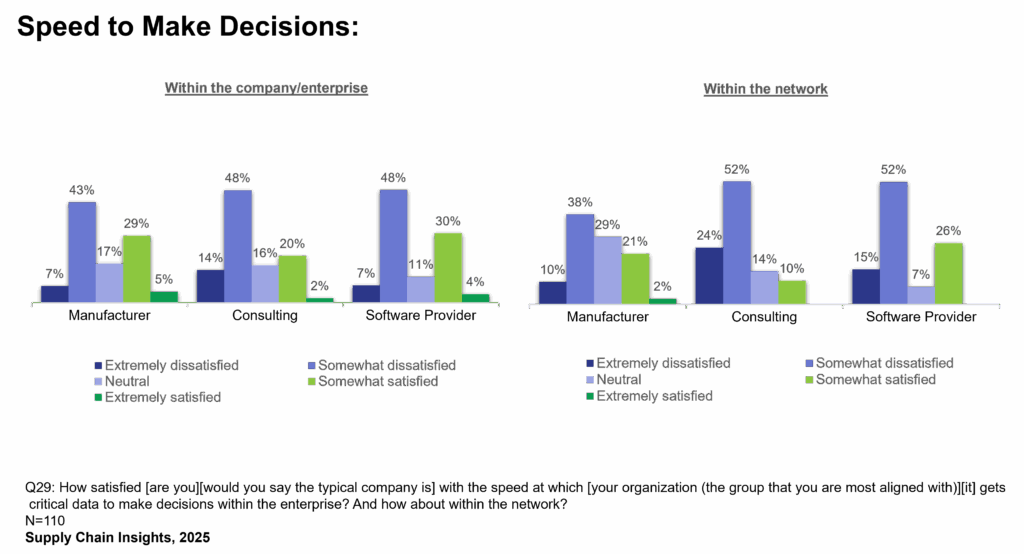
As a result, larger multi-nationals with a strong dependency on ERP-centric architectures face:
- Dependency on Spreadsheets
- Latency in Getting Data to Make Decisions
- Gaps Between Consultants/Technologists and Business Leaders/Information Technology (IT)
Frustration abounds. The pace of technological change in our personal lives, driven by digital transformation and artificial intelligence, is fast and furious. As hard as business leaders try, this shift cannot be duplicated in enterprise applications. The gaps are growing. The issue? Foundational architectures are a barrier to redefining work to unleash new levels of value. Just like a house cannot be built on a bad foundation, our current definitions of planning architectures need to change to take advantage of new capabilities.
In a recent research project, I asked, “What can we learn from digital transformation that we can apply to the testing of artificial intelligence projects?” In the research, we find that the most successful initiatives had the following characteristics (correlation at a 80% confidence-level):
- A business case using clear definitions with a focus on outcomes (absence of vagaries, hype, and shiny objects).
- Reporting to the line of business leaders (as opposed to IT leaders).
- Strong understanding of systems and design thinking.
- Inclusion of data scientists and supply chain finance talent on project teams.
- Test and learn mindset (versus a tight project plan based on a Request for Proposal (RFP)).
- Naturally curious: Questioning of historic architectures.
- Very little dependency on classical implementation consulting
These projects avoid vague terms like control tower, digital twin, continous planning and real-time decision making.
Learning from the Past
Last night, Jon from Clorox posted on LinkedIn about the need for continuous planning: a concept heard at an analyst conference. Thirty-eight people commented.
Similarly, at a conference last week, a business leader asked me for recommendations on real-time planning solutions.
This type of half-cocked discussion is not helpful. Planning data is never real-time. Instead, in a good implementation, data is available at the speed of business with zero latency.
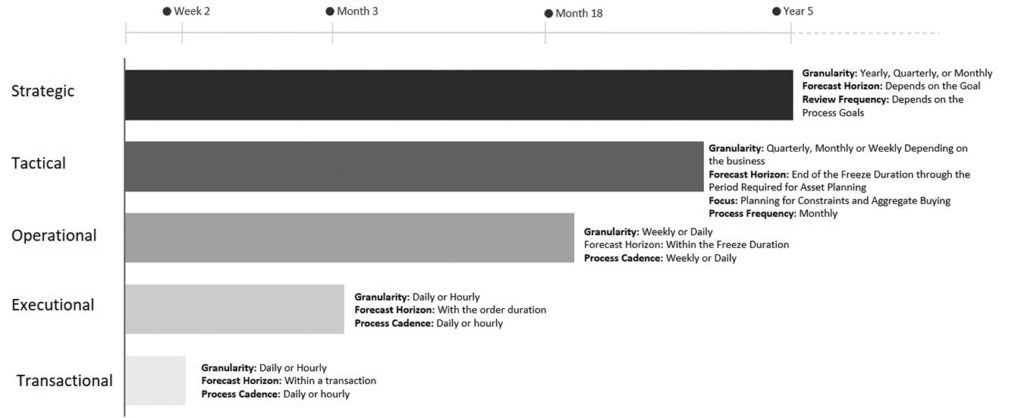
Successful planning requires discipline and governance. The goal is to match the required data-acquisition speed to the definition of the planning horizon. By definition, tactical planning is a plan defined outside lead time (usually as part of Sales and Operations Planning). Lead time should be the sum of the source, transformation, and logistics lead times. It will vary by item and should be updated with each batch job using a planning master data layer.
Real-time data or continuous planning would only be a fit for the transactional planning horizon and should interface with Available-to-Promise and Allocation logic. This is often termed “sensing.” (Definitions matter.)
If companies do not adhere to manufacturing freeze durations in the operational horizon, noise and waste will result. Prove it to yourself. Measure outcomes.
Figure 2. Planning Horizon Definitions
If you go to a conference and you hear a new term or concept, clearly define it and test it before advocating deployment. (I tested the concepts of outside-in planning for three years and wrote on my insights.)
Wrap-up
There is no clear definition in the market for terms like control towers, digital twins, real-time planning, or continuous planning. And, just like I fought and lost the battle for ERP II as a Gartner analyst, you will need to fight within your organization to drive clarity.
My advice is simple. Take responsibility to train yourself.
Sidestep the hype, avoid word salad, get clear on outcomes, test and learn before deploying, and train teams on the principles of planning. Clearly define what makes a good plan and who should make it when. Measure planning effectiveness and evolve.
I would love to hear your thoughts. And, sorry, Jon, I don’t think the answer is continuous planning, despite the analyst group’s advice.
Definitions:
A key to understanding this article is the understanding of key terms:
- Transactional Efficiency: Transactional efficiency refers to the speed, accuracy, and cost-effectiveness of supply chain processes, aimed at enhancing business transactions and improving return on investment (ROI).
- Supply Chain Physics: Measurable mathematical relationships predicting the performance limits of the supply chain and how it will respond to both management action and external factors. The management of the supply chain requires recognizing constraints and designing three buffers: capacity, inventory, and time, with a focus on reliability. Supply chain physics concepts underpin the Theory of Constraints, which is foundational to supply chain planning.
- Supply Chain Dynamics: Supply chains are stochastic, dynamic systems driven by variability and shaped by complexity. The focus is on reducing variability, managing the rhythms and cycles of flow, and minimizing the bullwhip—to drive value. Supply chain dynamics concepts are critical to reducing bullwhip and driving effective reinforcement learning.