In the 1990s, I worked for a software planning technology provider. As a part of my position, I was asked to teach complex selling. Not knowing what I was signing up for, I gleefully said, “YES!” Over the course of sixteen months, I learned and taught technology sales teams the principles of complex selling. The process is fascinating. It was a great experience.
Background
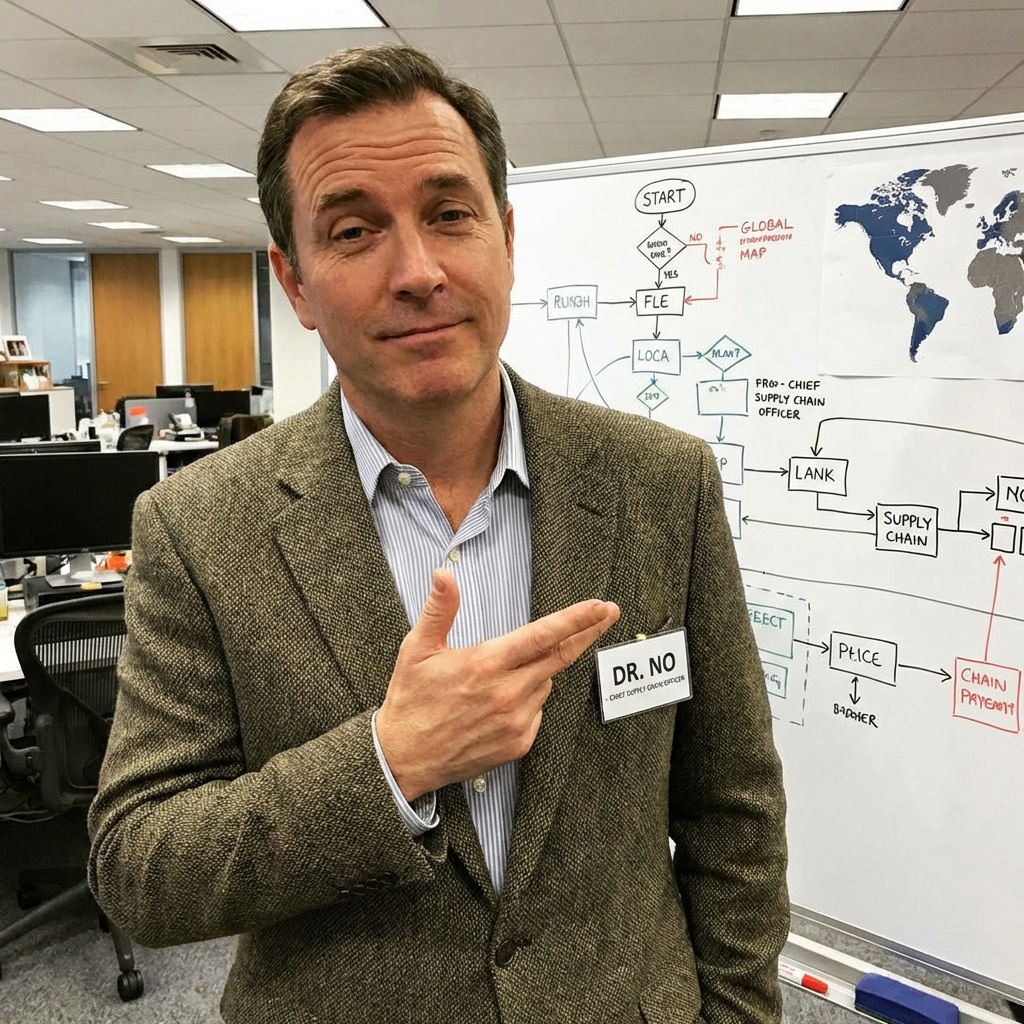
“Complex selling” is a sales approach used when deals are high-value, involve multiple decision-makers, take longer to close, and require tailored solutions. The focus is on navigating multiple stakeholders to say “YES” in longer sales cycles. There is usually a political element, and the technique requires both Art and Science. In the deployment of complex selling techniques for supply chain planning, we often labeled the Information Technology (IT) group as “Dr. NO.” I taught the teams how to neutralize Information Technology Groups (IT) in the complex sale.
Today, if I were teaching complex selling to Native AI and the new generation of AI platform vendors, I would label the supply chain team and the supply chain planners as “Dr. No”. Sadly, I see that many of these teams, steeped in traditional thinking, have become the blockers, not enablers, to adopting new ways of work and embracing new forms of tech.
The Winding Path
The supply chain is a complex, non-linear, distributed system that must be adaptive to meet business needs in an uncertain world. Unfortunately, today, most deployed technologies amplify and distort the signal to improve reliability and drive growth in a world that is becoming more uncertain. Companies talk about the symptoms with a lot of handwaving and acronyms, but don’t know how to roll up their sleeves and embrace uncertainty.
Closing the performance gap is seldom a single factor. The answer is not a single technology or a simple change of approach. While business users are enamored of AI hype and experimenting with agents and agentics, embracing the full value of artificial intelligence requires an AI-enabled architecture, from data architecture definition to solution delivery.
Most supply chains have multiple flows—an efficient flow that can be managed at the lowest cost, an agile flow that requires a focus on reliability of cost, quality, and customer service despite variability and uncertainty, and a responsive flow that requires a focus on short cycles. Prior solutions were unable to recognize and manage the flows and automate the rules for customer and product segmentation. As a result, there were many workarounds, black holes, and spreadsheet dependencies.
While many social influencers push different narratives emphasizing “autonomous,” “self-healing,” “real-time planning, “” continuous planning,” or “self-driving” planning. This is not me. I try to sidestep this hubris and hype. My goal is to help companies understand real and tangible use cases to redefine/improve work.
The World is Grayer and Less Certain. Companies Have Not Adapted.
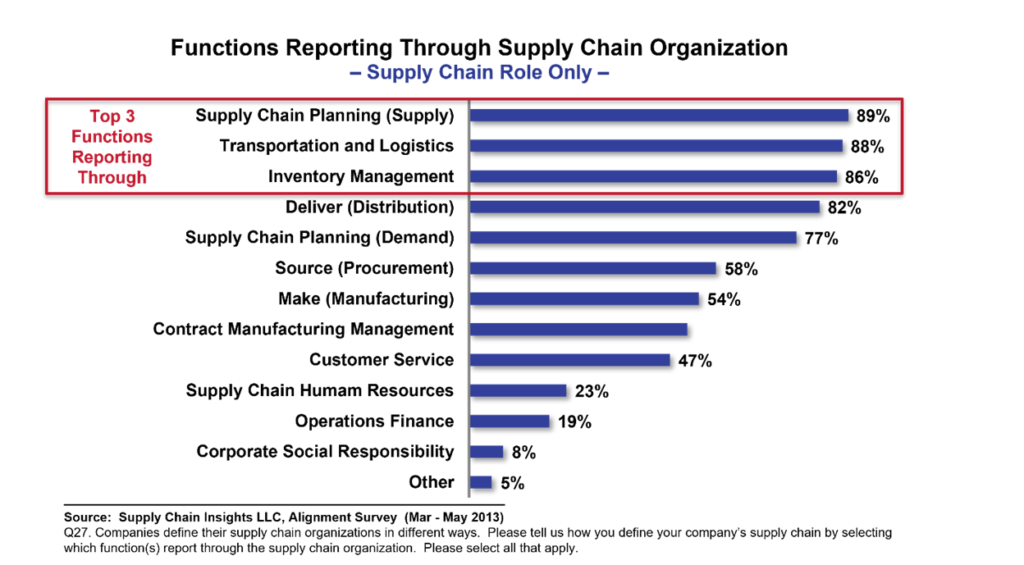
Over time, in my role as an analyst, organizations have become more fragmented, with few companies having purchasing, distribution, and manufacturing reporting to a common leader. We find that reporting relationships matter in the analysis of the Supply Chains to Admire.
We find each leader purchasing systems for their own functional silos, creating a barrier to interoperability. The opportunity is to redefine the architecture to drive interoperability and drive holistic workflows, better aligning the organization with value-based delivery. (The measurement of functional objectives tied to bonus incentives creates waste when companies need to align to drive reliability.)
Figure 1. Supply Chain Organizational Definition
Today, there are more unknowns than knowns. The traditional approaches to supply chain decision-making focused on known inputs, using known models to drive known outcomes. In the world of unknowns, generative AI, What-if Simulation, and What-if Optimization grow in importance. The benefit is quicker, role-based insight, along with workflow collaboration, to answer questions, increase awareness, and drive action.
Traditional APS solutions focused on known inputs, known models, and known outputs. I laughed this week with the publication of the Gartner Magic Quadrant. The Reason? Fifty percent of the solutions listed as top performers with both vision and execution do not scale for the global multi-national. Most focus on optimization in an architecture that is only a good fit for smaller, regional teams.
A New Dr. No Is In Town
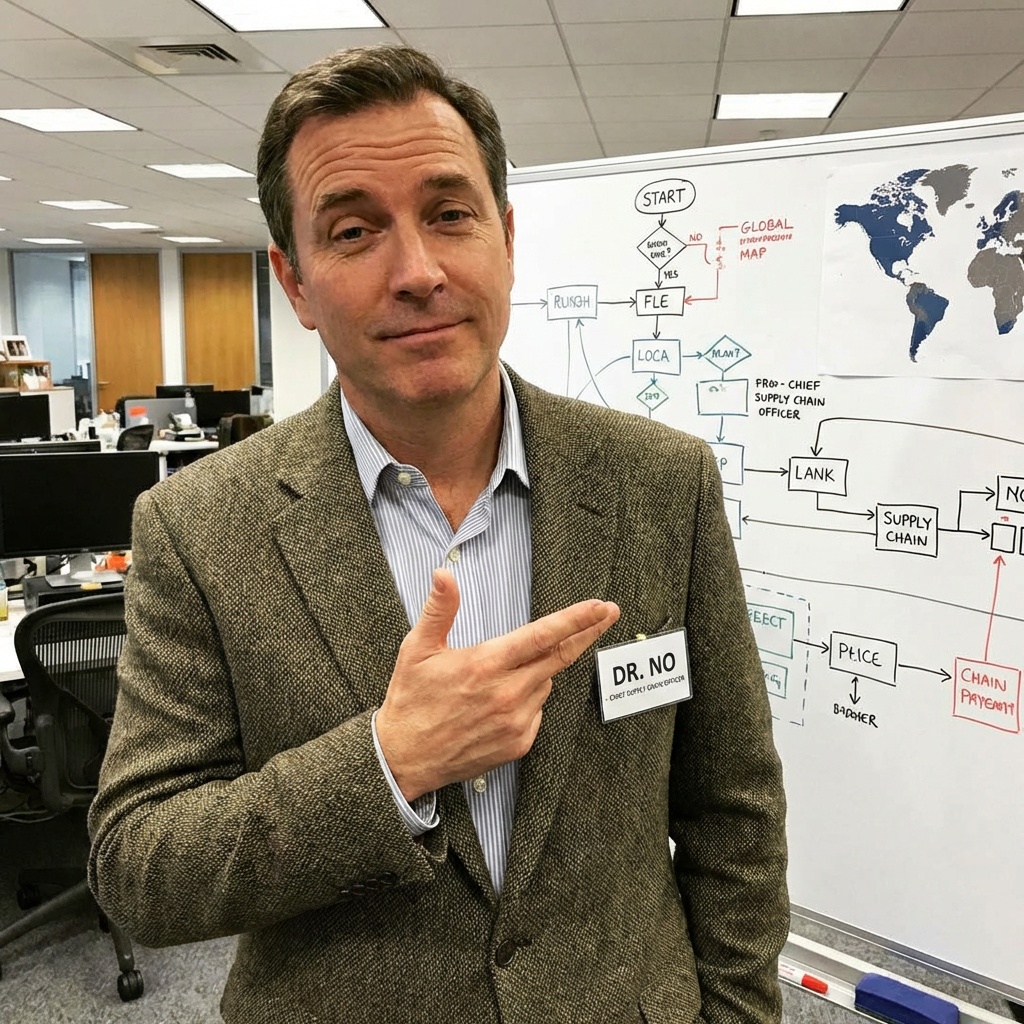
The buyer today for supply chain planning is more conservative. The leaders — Chief Supply Chain Officers — are hardened and conservative, with many becoming “Dr. Nos” during sales cycles while pushing traditional definitions of technology. They have not invested in reskilling.
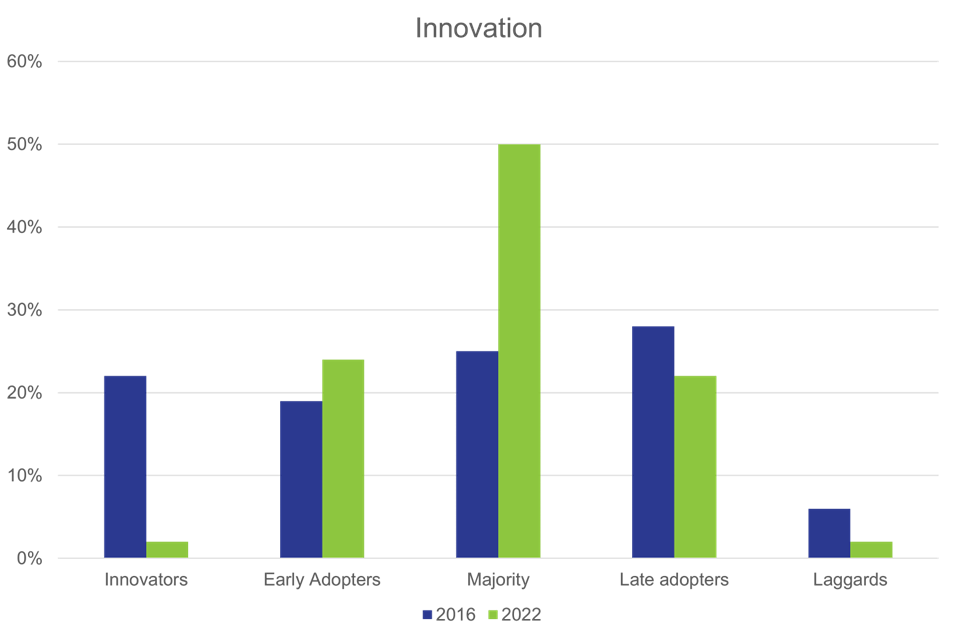
The reason? The deployment of new approaches requires the learning of a new language, rethinking first principles, and being open to new outcomes, all of which fly in the face of tradition. In Figure 2, when potential buyers of Supply Chain Planning were asked the question, “In your opinion, what is your company’s preference in the purchase of new technologies? Would you classify your company as an innovator, early adopter, mainstream adopter, late-stage adopter, or laggard? The market shows marked change. The innovators and early adopters accounted for 42% of the market in 2016 and 24% in late 2025. When tested for demographic consistency, this result is significant at an 80% confidence level.
Don’t you find it interesting that innovation at scale is the new reality, but organizations are more cautious?
Figure 2. Shift in Innovators
So, how is it that answers at scale and relevancy are now available, and companies have become less innovative in using new technologies?
If you are a business user, look around your organization for the Dr. Nos. You will know them when they embrace historic practices as best practices, or when they spout hype-based word salad from their tongues. They are usually the members of the team who get excited about the use of agentics in spreadsheets or are quick to buy based on the Gartner Magic Quadrant.
The Path Forward
As a business leader, in your talks with your analytics teams, the path forward is to redefine the architecture with the goal in mind from the data up, with a focus on value.
Measure and Understand Variability. To understand the world of possibilities, make a list of supply chain issues and data available–all forms structured, streaming, audio, text, images–and make a visit to your data science teams and explore the building of a semantic layer with a graph (for relationship and semantic reconciliation), along with an ontology to drive flexibility in decision support architectures. Layer this underneath your current architectures to gain insights into planning master data — inputs into planning systems that are variables but treated as constants. These include lead times, conversion rates, yields, price, run rates, etc. Use machine learning and pattern recognition techniques to understand the impact of these inputs on plan outputs.
Define and Measure a Good Plan. As you analyze your plan, focus on the balanced scorecard metrics of growth, operating margin (not cost), inventory turns, and Return on Capital Employed (ROCE). Then measure, with the help of your data science teams, the reliability of the plan by analyzing:
- Forecast Value Added (FVA). An analysis of the value of demand-stream forecasting based on forecastability and flow characteristics.
- Inventory Health by Form and Function of Inventory with an Analysis of Inventory Value Added (IVA).
- Raw Material Value Added. How much improvement did the plan make in the purchase and storage of raw materials? (RVA)
- Customer service: On-time and In-full measurements with reason codes.
- Schedule adherence. The adherence of the manufacturing teams to production plans.
- Bullwhip Effect.
- The Effectiveness of Demand Shaping Programs: Shaping versus Shifting.
- Asset Utilization
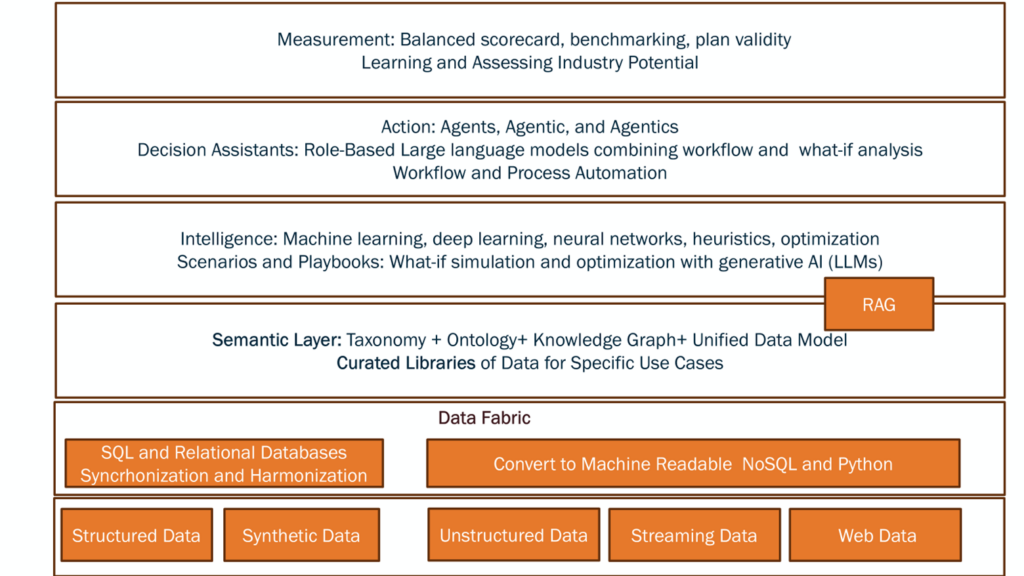
In Figure 3, I share a high-level architecture perspective as a starting point for the data science conversation.
Figure 3. High-level Architecture
Summary
Embrace innovation to define new opportunities, develop better process capabilities, and redefine work. Traditional supply chain planning approaches are not sufficient.