 This week, E2open announced a definitive agreement to acquire Zyme. For readers of this blog that do not know Zyme, the company focuses on the management of channel data in the high-tech industry. The company is a CRM solution. The Zyme solution improves revenue management, warranty, and rebate processes. This source of channel data is very industry-specific to the high-tech market (high-tech works through distributors and is more focused on price erosion).
This is not a small acquisition for E2open. At 30-40% the size of E2open, this is a big bite. It is a larger acquisition than the prior purchases of Terra Technology, Steelwedge, or SCM-Icon.
The press release and websites are full of pretty rhetoric, but this old gal is worried. Why? The buyer for the Zyme products is different from the buyer of the E2open products. While many E2open’s legacy customers in the high-tech space have overlap with Zyme customers, the buyers are worlds apart. This is about much more than integration. The vision for the Zyme acquisition requires the rethinking of business processes beyond the siloed walls of the enterprise. This is happening at a time when there is employee turnover within the E2open organization from the Terra and Steelwedge acquisitions.
Historically, the acquisition of software products by technology vendors only provides value for the venture capitalists or the owners of the companies. There are few acquisitions that add value to the end-user. Mergers of near equals, as in this case, are especially problematic since it requires the rethinking of all of the back-office processes.
A Look Back at History
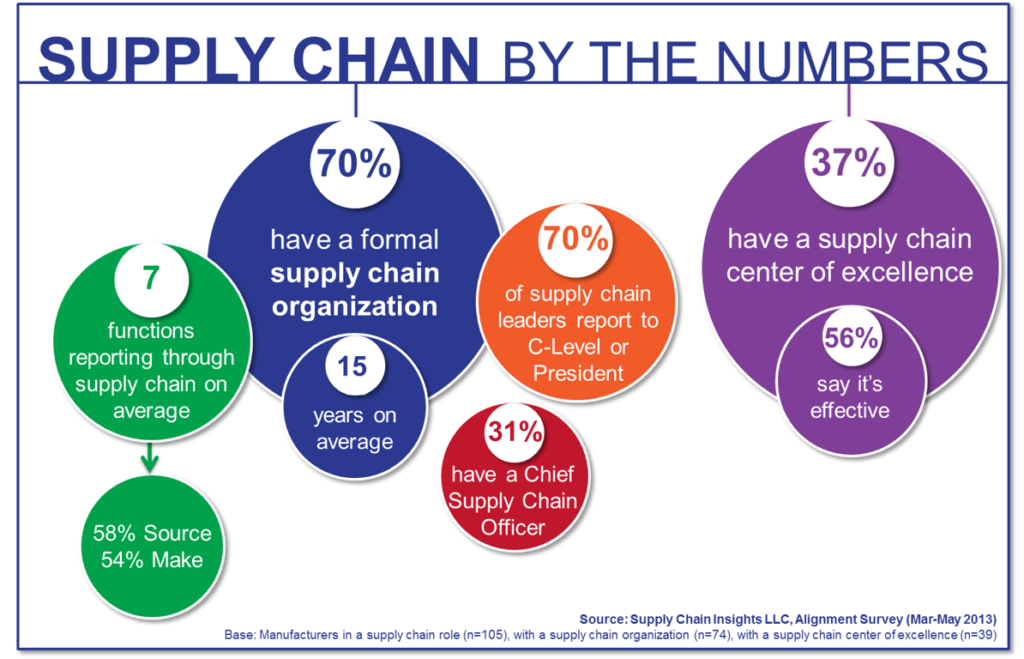
Founded in 2000 as a consortia exchange by IBM–along with Hitachi, Matsushita, LG Electronics, Nortel Networks, Seagate Technology, Solectron, and Toshiba–E2open has weathered the challenges of time. The original platform technologies were Ariba and i2 Technologies. The company was one of a handful of exchanges to survive the market hype of 2000-2003. The original goal of the electronic marketplace was to bring together thousands of computer, electronics and telecom companies around the world to do transactions over the Internet. The focus was on automating procurement. The historic buyer of the E2open solution is procurement. As shown in Figure 1, approximately 50% of procurement buyers report through supply chain organizations. Procurement does not equal supply chain. Procurement and supply chain solutions are quite different.
Figure 1. Reporting Relationships within the Supply Chain
In the evolution of E2open, there were many twists and turns with management teams and public offerings. E2open’s initial public offering in July 2012 was 4,687,500 shares of its common stock, including 3,750,000 shares from the company and 937,500 shares from the selling stockholders, at a price to the public of $15 per share. The stock hovered near $30 per share for many months in 2014. On March 26, 2015, Insight Venture Partners (“Insight”) purchased E2open for $8.60 per share. Investors moaned. Taking E2open private put a black mark on the company in the public markets that the current management team is trying to shake off by improving profitability.
Taking the company private, the investment by Insights gives E2open capital to purchase companies. They acquired the undervalued assets of Orchestro, ICON-SCM, Serus, Terra Technology, Steelwedge, and now Zyme. While the public announcements are always upbeat, they are trying to digest a lot of very different applications in a short period of time. Within three years the company has acquired six very different assets. The question is will E2open be an aggregator of assets or an innovator? I fear that this is a bridge too far.
It reminds me of Greg Owens’ purchase of revenue management by Manugistics in September 2000. At that time, I was a Gartner analyst and I wrote a cautionary note about companies’ willingness to connect front- and back-office applications. In hindsight, I should have written a stronger note. I think that this acquisition by Manugistics was pivotal, and a bad decision that forced the downward spiral of the company. I question if this move by E2open will do the same.
Aggregator versus Innovator?
This move makes E2open the largest cloud-based provider of supply chain planning solutions, with projected revenues neck-and-neck with those projected by Kinaxis. The open question is what will happen next at E2open? I am not optimistic. I question if it is a bridge too far.
At the same time, I need to give kudos to Michael Farlekas, the current CEO. After the investment by Insights, E2open cut operating expenses and focused on profitability to improve the balance sheet. They were successful. The company greatly improved the profitability of operations, but the current focus is very sales driven. The architecture to connect the applications is slow to evolve. For all, it is a lot to digest.
Historically, software aggregation reduces the market value for all. Across the decades in the supply chain market, when a company aggregates assets and does not innovate, they lose market appeal. For example, Infor and JDA both aggregated supply chain assets with heavy debt burdens, and used maintenance revenue collected from customers to fund the company. Neither company has been able to drive innovation with mounting frustration from business users.
My Advice for Business Users?
My advice for business users is three-fold.
- If you are an innovative high-tech company, this acquisition could be good news for you. Invite E2open to your offices and ask them to explain the business flows. Judge for yourself. Get past the pretty rhetoric.
- If you are a business user of E2open in the consumer products industry, I fear that this is not good news. The company’s solution is increasingly becoming more focused on the high-tech industry. The business requirements between high-tech and consumer products are very different. While E2open purchased Orchestro and Terra Technology, the ability to drive business results for consumer products companies through innovation is slowing. The recent departure of Stas Grishin, prior CTO of Terra Technology worries me. If you are a business user of these solutions, don’t do anything quickly. Get close to E2open and carefully watch the evolution of the solution. Force the discussion past the hyperbole in the current marketing speak into a practical solution discussion.
- If you are a prospect, trust but verify. Remember, software acquisitions usually only drive value for the technology owners, not for business leaders. It will take a while for the market to sort itself out.
And, if you have any questions or comments, please send them my way.