Lora's Latest Post

How Can I Drive Lights-Out Planning?

Inquiry is increasing. Company dissatisfaction with supply chain planning is growing. The goal is to improve insights while decreasing the number of planners. The growing dissatisfaction is on the inadequacies of today’s technologies.
Yesterday, I facilitated a group of business leaders attempting to drive innovation in supply chain practices. The last five years were tough for the group. With five serial years of Draconian cost-cutting efforts and downsizing, the team has been heads-down trying to survive. For many years, the focus was overcoming day-to-day hurdles. In addition, the company, for the first time in a decade, is struggling to grow. As a result, there has been little time for reflection. Conferences, external training, or educational forums took a back seat.
Five years is a long time in the technology space. The team is waking up to realize SAP APO for supply chain planning is being sunsetted.  Worried by the risk of technology obsolescence, the team is looking for a replacement for SAP APO (SAP has given mixed messages on the life of SAP APO in the market). Their goal is to find a replacement. The recommended SAP IBP is not seen as a viable alternative. The group is searching for an answer, but they are out of touch with the market. Sadly, the consultants hired to help the group are out of touch as well. The supply chain market is in flux to a greater degree than in the past decade. What consultants have sold in the past is not the answer today.
Reflection
I have been an industry analyst for two decades now. I have never seen a time where there is as much innovation and confusion in the supply chain market. While the group wanted to drive innovation, the consulting practice recommended mature technologies on the plateau of productivity. I questioned the disconnect and found the consulting partner was not aware of many of the emerging technologies.
The software market is moving through the final rounds of consolidation of client-server technologies. A confluence of technologies is redefining decision-support technologies. This includes the Internet of Things, Cloud, Cognitive Computing, Blockchain, Additive Manufacturing, Robotics, and open source/big data analytics. As a result, the givens are no longer givens, and the possibilities are exponential. However, the DNA of the culture drives the rate of adoption.
Figure 1. Hype Cycle
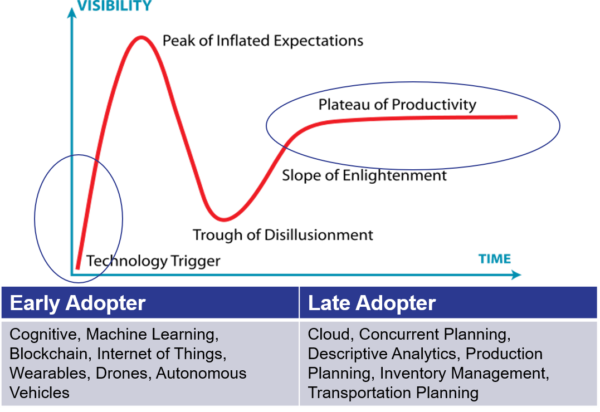
 

To better understand the market, my categorization of technology providers on this hype cycle is in Table 1. The solutions evolving for innovators are emerging, but the architectures are still in flux. For the innovator, the rewards are greater, but the solutions require greater co-development and partnering with the technology firm. Many of the innovators do not understand the requirements of enterprise-class architectures. Not all organizations are equal to this task.
The early adopters are testing solutions, and the late majority are finalizing the approaches while Late Majority and Laggard buyers want proven solutions with a well-defined Return on Investment (ROI). They are less willing to accept risk. The group was an Early Majority adopter. As a result, I recommended that the group consider using the engines from innovators to improve the outcomes of more mature decision support technologies. My recommendation is to break down the problem into requirements for inputs, engines, outputs, user interface, scenario planning, and data model fit.
Table 1. State of Supply Chain Planning Solutions
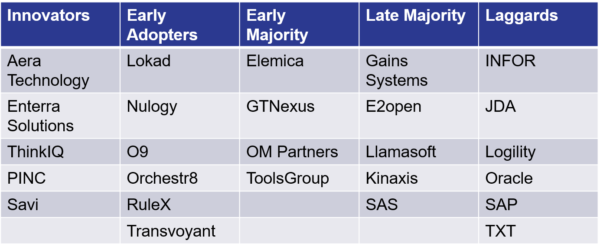
 
table1 adoptions
The Mirage of Outside-In Processes.
The group wants to drive a digital transformation. The goal is outside-in. They want a touchless system. However, the discussion in the room was very inside-out. Unfortunately, inside-out thinking is what they know. It is hard to learn from the past, to unlearn, to relearn. The “unlearning” is the toughest part.
The consultants believe it is possible to turn an inside-out process to be outside-in. This where we had a disconnect. I do not believe this is true. Instead, I believe that outside-in processes need to be defined with the goal in mind, and that an inside-out process focused on the organization and transactional flows is not suitable for an outside-in digital transformation. The reason? Simply put, an inside-out process is about the company. It is insular. An outside-in process starts with the channel and provides synchronization of data across flows from market-to-market. The inputs, outputs, and flows are different. It is about synchronization of data versus integration. The architectures are also very different. As a result, I believe the consultants in the room were painting a mirage for the group. What is a mirage? It’s an optical illusion. A frequent analogy is an appearance of a sheet of water in a desert or on a hot road, caused by the refraction of light from the sky by heated air, when there is no water present.
I know of no group that has been able to take an inside-out process and make it outside-in. I also cannot find a successful use of an ERP architecture to build an outside-in process. However, many of the decision-support tools listed in Table 1 can be outside-in. The key is in the definition of the implementation. The data models, flows, and inputs are different.
Table 2. Driving The Digital Outside-in Transformation


In addition, organizations today love to touch data. They do not trust planning engines. As a result, organizations have fostered an Excel Ghetto environment. The move to outside-in process re-engineering is a lightning rod to take action.
Designing Outside-in
How to get started? I think that outside-in is a wonderful impetus to redesign planning and strive for lights-out planning. Start by drawing the outside-in flows on a whiteboard on the wall. Think of the data and signals in the channel that can inform systems and drive a better response. Then list the data and flows in the supplier base. Align them against the business goals. (For example, redefining Estimated Time of Arrival through GPS and Telematics. Or quality data and availability to ship from contract packaging companies. Track-and-trace information is also a requirement for many businesses.) As a next step, list the goals and the new requirements by the customer. Build the flows by listing all of the forms of data–structured, unstructured, streaming, and federated data sources–that can inform the decisions. Then define the potential outside-in processes. I think you will find them quite different from the inside-out approach.
This is literally thinking out of the box. The box most supply chain leaders find themselves in is striving for innovation, and then limiting their thinking to traditional enterprise-based processes. The four walls of the enterprise are the box. The future of digital innovation is not enterprise thinking.  We must learn from the past, to unlearn, to relearn. The “unlearning is the hard part,” and unfortunately most consultants are not able to help. Like many of my clients, they are also on their journey to “unlearn” as well.
For the lights-out supply chain, start with the engines, and then start the redefinition with technology innovators. Realize that it will take time and organizational change management.
Good luck in your journey. I welcome your comments.
Search the Archives
Search
Share this Post
Email
Twitter
LinkedIn
Facebook
Pinterest
WhatsApp
Featured Image
Recent Posts

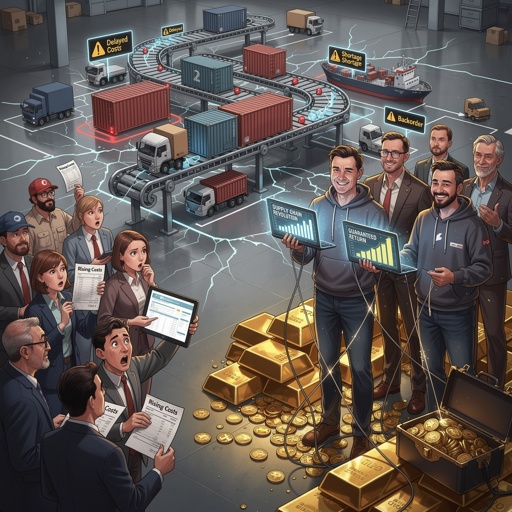
Warning: Sidestep the Narrative of the Misguided Goldiggers

Ten years ago, I started writing a book titled Stories of the Misguided Gold Diggers. The book was a collection of stories from two decades of stories of technology leaders perpetuating the myth of integrated end-to-end supply chain planning.

I dusted off the manuscript on Saturday. I think that we have a new chapter. Companies focused on putting Artificial Intelligence (AI) on top of existing architectures are putting AI Stupid on steroids.

Read More »

The Myth of End-to-End Planning

Supply chain planning, supply management, supply chain execution, network design, and transportation/logistics management operate in silos. Not much has changed over four decades. The connections flow back through transactional systems: order-to-cash and procure-to-pay. There is a myth that companies can buy an end-to-end supply chain management solution. This is largely a myth. Here we explain.

Read More »

Lead Time: A Broken Gossamer

If you are struggling with supply chain planning, dancing in the light of shiny objects, and scratching your head, please read on. My goal is to help you.

Please do not AI Stupid. What do I mean? AI Stupid is putting agents and agentics on top of existing architectures believing that making them faster and hands free add value. To me, this is fools play.

I love AI. I am excited about new technologies. To this end, I want to shine a light on how new technologies can help address the black holes and inconsistencies in today’s supply chain, which largely stem from the limitations of the first generation of supply chain planning and execution technologies. In this blog, I give you three places to start.

Read More »

Do You Need a Supply Chain Coach?

Supply chain is where the rubber hits the road. For a public company, over 40% of market capitalization is tied to the trade-offs between growth, operating margin, inventory management, and Return on Capital Employed.

The road for supply chain improvement is fraught with issues. Here we share some and offer some advice.

Read More »

Is your Supply Chain AI Ready?

A simple quiz to assess an organization’s AI readiness.

The pace of change is fast and furious. Every day, technology advances faster than we can digest. A great challenge to have.

Determining whether a supply chain is “AI-ready” is less about technology and more about the gray matter between the ears of supply chain leaders. Leadership, alignment, and clarity of goals matter.

Too few companies are clear on the definition of supply chain excellence. Measuring and rewarding functional metrics reduces the firm’s value. Putting agentics on top of today’s processes can make bad practices run faster, reducing value.

The toughest job for the supply chain leader is challenging existing supply chain paradigms that were defined by the limitations of decades of supply chain technologies. As the curtain lifts on the potential of new forms of technology, process redefinition is our opportunity, but only if we are clear on what drives value. (Here, I link to the Supply Chains to Admire reports to help you define value. The next report will be published on June 23rd, along with my Dynamic Benchmarking Product, to help you define value in the face of your AI readiness. More information about the launch is at the bottom of this blog.)

Read More »

Case Study: A Scrappy Demand Management Approach

This study of Franklin Sports shines a light on the work that needs to be done at the sales account level to challenge a retail forecast, and also highlights the importance of a new technique for a forecast engine — reinforcement learning.

Artificial intelligence comes in many forms — large language models, generative AI, machine learning, unstructured text mining, deep learning, neural networks, reinforcement learning, agents, and agentics. While the industry is wigging out about agentics, I think reinforcement learning is a great step forward in the journey of Artificial Intelligence.

Read More »