
Lora's Latest Post

What Is the Value of a Scorecard?

It is about the right balance of the carrot and the stick.
Progress happens when you measure.
Relationships happen faster when there is more carrot than a stick. Over the last decade, scorecards have become more of a stick than a carrot.
 
retail scorecards
Reflections
Some days, in my coverage of consumer value networks, it seems like we are making slow progress. So slow, that I often feel like I am watching paint dry.  We talk collaboration, but we automate buy/sell relationships.
Then I go to a conference like Logimed USA, and I get immersed in another industry—like medical devices—which is a decade behind CPG/retail, and I get a reality check. It is useful to get perspective.
In the medical device industry, they have no scorecards with hospitals and they are just starting on the adoption of the GS1 standards. (Reference my article on Throwback Thursday.)
Impacts of Customer Scorecards
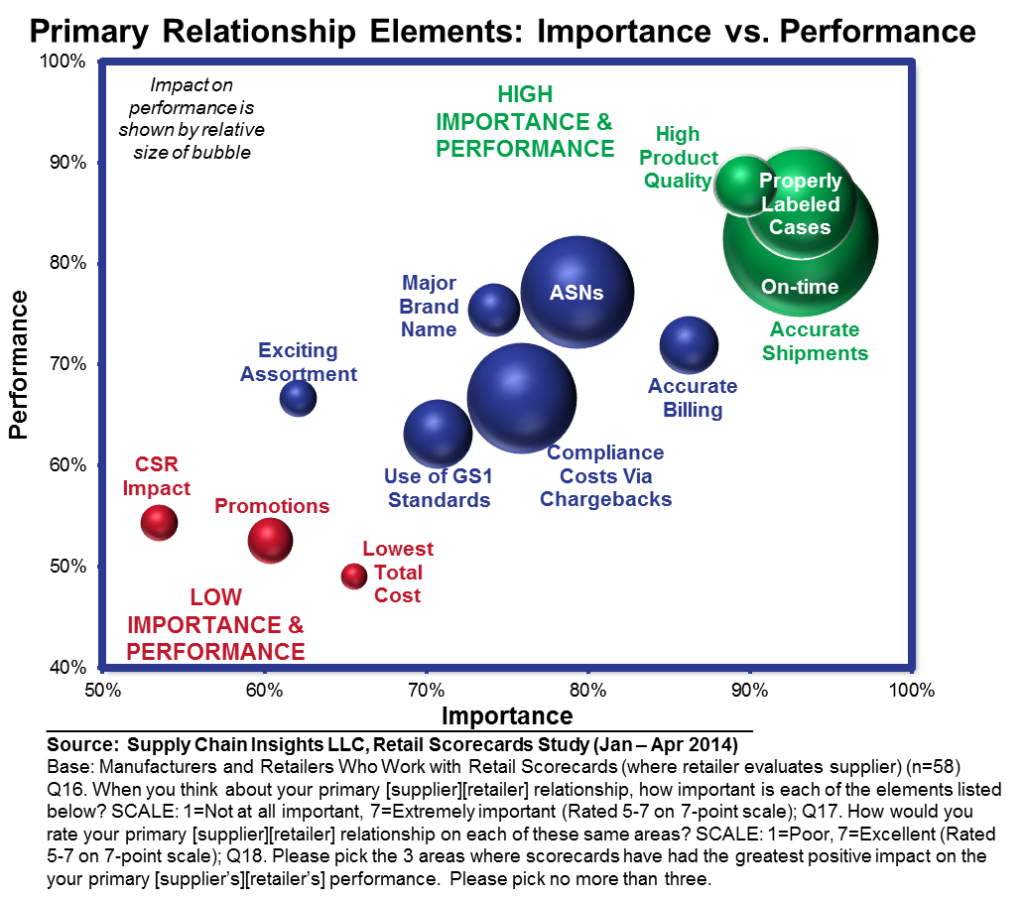
Consumer value networks are now in their second decade of scorecard automation. In most relationships there is more than one scorecard. The most common one is a scorecard for supply chain.  Today the focus is on physical movement. As shown in Figures 1 and 2, labeling, on-time shipments, and Advanced Shipment Notification (ASNs) have improved through the use of scorecards.
benefits of retail scorecards
However, the Scorecards Are Anything but Balanced. The use of scorecards has improved customer service. Shipments are now on-time and there is progress on in-full shipments. Why? Primarily because of better communication on the retail requirements and the tracking of the shipments. However, the use of scorecards has not improved cost or assortment. At a rVCF conference that I attended this week, one of the retailers asked me why an on-time and full shipment was not representative of the lowest cost. Yes, there is still much work to be done.
What Is Preventing Us from Making Greater Progress? In short, it is about alignment and incentives. The gaps between sales and operations is a barrier on the supplier side, and the gaps between merchandising and operations for the retailer are equally as bad. Additionally, the incentives are not aligned to serve the shopper. Consumer packaged goods companies are paid when the goods land in the retailer’s warehouse, not when they cross the register, and trade funds can distort the demand signal. Too much dependency on trade promotions and deep discounts is an addiction and disruptive for some relationships.
The studies for the VMI and the Retail Scorecard surveys are still open. We would love your input. It is our plan to correlate maturity in consumer relationships to the Supply Chain Index over the summer.
We are also finishing up the project on supply chain planning maturity. It is close to completion.We would love your insights. As always, we keep your responses confidential.
This morning, I am writing from Istanbul. The book, Metrics That Matter, is almost finished. I will be speaking at the Integrated Supply Chain Conference on Thursday. Lots of interest in the Supply Chain Index. People cannot get enough on metrics.
 

Search the Archives
Search
Share this Post
Email
Twitter
LinkedIn
Facebook
Pinterest
WhatsApp
Featured Image
Recent Posts

Warning: Sidestep the Narrative of the Misguided Goldiggers

Ten years ago, I started writing a book titled Stories of the Misguided Gold Diggers. The book was a collection of stories from two decades of stories of technology leaders perpetuating the myth of integrated end-to-end supply chain planning.

I dusted off the manuscript on Saturday. I think that we have a new chapter. Companies focused on putting Artificial Intelligence (AI) on top of existing architectures are putting AI Stupid on steroids.

Read More »

The Myth of End-to-End Planning

Supply chain planning, supply management, supply chain execution, network design, and transportation/logistics management operate in silos. Not much has changed over four decades. The connections flow back through transactional systems: order-to-cash and procure-to-pay. There is a myth that companies can buy an end-to-end supply chain management solution. This is largely a myth. Here we explain.

Read More »

Lead Time: A Broken Gossamer

If you are struggling with supply chain planning, dancing in the light of shiny objects, and scratching your head, please read on. My goal is to help you.

Please do not AI Stupid. What do I mean? AI Stupid is putting agents and agentics on top of existing architectures believing that making them faster and hands free add value. To me, this is fools play.

I love AI. I am excited about new technologies. To this end, I want to shine a light on how new technologies can help address the black holes and inconsistencies in today’s supply chain, which largely stem from the limitations of the first generation of supply chain planning and execution technologies. In this blog, I give you three places to start.

Read More »

Do You Need a Supply Chain Coach?

Supply chain is where the rubber hits the road. For a public company, over 40% of market capitalization is tied to the trade-offs between growth, operating margin, inventory management, and Return on Capital Employed.

The road for supply chain improvement is fraught with issues. Here we share some and offer some advice.

Read More »

Is your Supply Chain AI Ready?

A simple quiz to assess an organization’s AI readiness.

The pace of change is fast and furious. Every day, technology advances faster than we can digest. A great challenge to have.

Determining whether a supply chain is “AI-ready” is less about technology and more about the gray matter between the ears of supply chain leaders. Leadership, alignment, and clarity of goals matter.

Too few companies are clear on the definition of supply chain excellence. Measuring and rewarding functional metrics reduces the firm’s value. Putting agentics on top of today’s processes can make bad practices run faster, reducing value.

The toughest job for the supply chain leader is challenging existing supply chain paradigms that were defined by the limitations of decades of supply chain technologies. As the curtain lifts on the potential of new forms of technology, process redefinition is our opportunity, but only if we are clear on what drives value. (Here, I link to the Supply Chains to Admire reports to help you define value. The next report will be published on June 23rd, along with my Dynamic Benchmarking Product, to help you define value in the face of your AI readiness. More information about the launch is at the bottom of this blog.)

Read More »

Case Study: A Scrappy Demand Management Approach

This study of Franklin Sports shines a light on the work that needs to be done at the sales account level to challenge a retail forecast, and also highlights the importance of a new technique for a forecast engine — reinforcement learning.

Artificial intelligence comes in many forms — large language models, generative AI, machine learning, unstructured text mining, deep learning, neural networks, reinforcement learning, agents, and agentics. While the industry is wigging out about agentics, I think reinforcement learning is a great step forward in the journey of Artificial Intelligence.

Read More »