In the movie Snow White, the Queen possesses a magical mirror that answers any question, to which she often asks: “Mirror, mirror on the wall, who in the land is fairest of all?” …to which the mirror always replies “You, my queen, are fairest of all.”
Companies want to know “who has the best supply chain?” Unfortunately, there is no supply chain magic mirror; however, each June we can get summarized financial data. While not a perfect mirror, it is a partial reflection. It is definitely more accurate than mistakenly believing that each supply chain is as good as it gets (e.g. the Queen’s magic mirror in Snow White).
The normal cycle of financial reporting makes June a perfect month to review the past year. So just as students gather around bulletin boards at the end of the school term and check their grades, in June, I scour websites to understand how supply chains stack up. Luckily, two articles –the CFO Magazine’s Working Capital Survey (http://www.cfo.com/article.cfm/14499542) and the CSCMP Annual State of Logistics Report (http://cscmp.org/memberonly/state.asp)– are published in June to serve as year-over-year guideposts to answer the question, who does supply chain best?
2009. A Year in Review
2009 was a true litmus test. It was the height of the recession. Aggregate volume declined 23% and fundamental demand shifted. Despite investments in technology, in aggregate, the supply chain response was slower in this recession than in the prior 2001 recession. There is a growing gap between leaders—companies that really understand and practice the concepts of supply chain management—and laggards. Companies that excelled at supply chain management sensed demand changes 5X faster and realigned network decisions than their peer groups (http://www.supplychainshaman.com/category/supply-chain-economic-recovery/).
For many, 2009 was a working capital hangover as companies reeled in the recession aftershocks. It was the worst year ever, in this writer’s history, for working capital management. For 68% of the Fortune 1000 companies, Days of Working Capital (DWC) grew. Facing new market obstacles in collections, payables and inventory management, companies buckled their belts and scrambled for cash. As inventory levels climbed during the first part of 2009, tension grew in supply chain discussions. This was the most problematic –even desperate– for companies when high asset utilization was mistakenly defined as supply chain excellence.
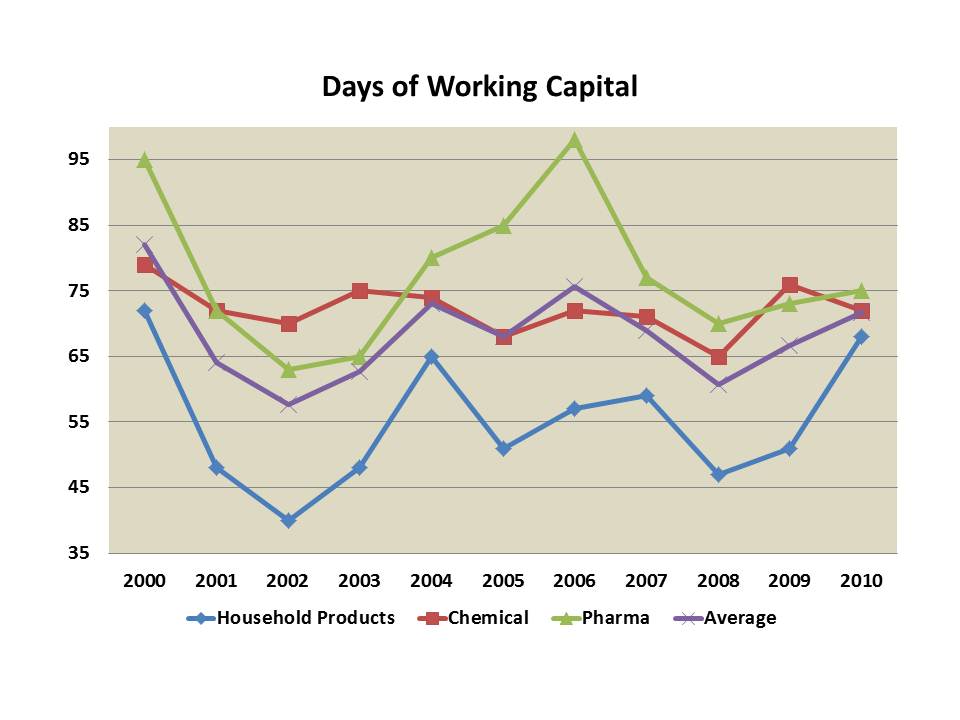
The tightening of credit through 2010 put the spotlight on inventory management (even for companies that had never cared about inventory before). The bloated inventories of 2008 through early 2009, sent a shock wave through executive discussions; and even though business inventories dropped for the first three quarters of 2009 and rebounded in the fourth quarter below pre-recessionary levels, executive teams remain on edge. As the curtain rises for the last half of 2010, the links in the supply chain are weakened. Capacity is tightening and prices will rise. The terms demand sensing, demand shaping, and demand orchestration have a new meaning for battle-weary supply chain veterans.
2009: How did we do?
The good met the test. The average and poor supply chain processes were not equal and succumbed. What made a difference? Companies focused on traditional supply chain planning and tight integration of planning processes to Enterprise Resource Management (ERP) did the poorest. Companies with an outward-focus on market drivers and building strong what-if analysis to understand demand uncertainty did the best. Leaders have the right stuff. Laggards have a new respect for supply chain excellence.
Let me preface this analysis with a caveat. I do not believe that you can throw all industries in a spreadsheet and declare a supply chain victor. Since value drivers within each industry are different; I think that true supply chain leadership can ONLY be seen when you compare companies within peer groups.
In this downturn, supply chains experienced a seismic shift. Using the earthquake analogy, it was an eight or nine on the rector scale. As I thumbed through the CFO magazine results, I considered many; but settled on three stories:
Containers & Packaging:
Suppliers, at the end of the supply chain, are whipped hard by economic downturns. When it comes to fighting this bullwhip effect, supply chain excellence matters. Contrast the stories of Sonoco Products and Owens Illinois. Sonoco Products, a 3.6 billion dollar company, located in South Carolina, manufacturers packaging film for the consumer products industry. The company has been on a four-year journey to become more demand driven with a strong focus on S&OP. Owens Illinois (OI), a manufacturer of glass containers with US headquarters in Ohio, has been more focused on transactional efficiency, procurement and IT standardization. Sonoco has outpaced OI in learning how to be a supply chain leader. Their 2009 numbers speak for themselves.
Table 2: Comparison of 2009 Results of Sonoco Products and Owens Illinios
| DSO | DIO | DPO | DWC | |
| Sonoco Products | 43 | 31 | 38 | 37 |
| Owens Illinois | 67 | 49 | 45 | 71 |
| Industry Average | 42 | 42 | 31 | 63 |
High Tech & Electronics
When it comes to high tech & electronics, my favorite story of a company successfully navigating the downturn is Cisco Systems. Cisco took its bumps in the 2001 downturn, did a mea culpa with a 2.25 billion dollar inventory write-off and swore never again. They redefined supply chain processes under the banner of Customer Value Chain Management (CVSM), successfully integrated 138 acquisitions over 15 years, and built systems to mitigate risks—simulation of 4300 inputs by a team of 10 people—and build supply chain resiliency in the supply chain from the outside-in. Motorola, on the other hand, has focused more on IT standardization and procurement excellence. The numbers speak for themselves.
Table 3: Comparison of 2009 Working Capital Results for Cisco and Motorola
| DSO | DIO | DPO | DWC | |
| Cisco | 48 | 11 | 7 | 52 |
| Motorola | 65 | 22 | 40 | 46 |
| Industry Average | 57 | 23 | 27 | 53 |
Semiconductor
Intel is my pick within the semiconductor industry. Their focus on supply chain talent development and steadily improving supply chain capabilities helped them through the recession. They made a conscious choice to not be aggressive on DPO to ensure a strong supplier base. This focus on supplier development built resiliency into the supply chain. Again, supply chain excellence matters. Contrast Intel with Fairchild Semiconductor. Fairchild Semiconductor has a strong focus on IT systems, is building supply chain talent and is early in the execution of S&OP. Likewise, while Texas Instruments has a deep legacy of supply chain planning excellence, their focus has been more vertical (source/make/deliver) than horizontal (e.g. Sales & Operations Planning, order to cash, etc). Consider the working capital impact of three companies in the same industry at very different points in supply chain maturity.
Table 4: Comparison of Intel, Freescale Semiconductor and Texas Instruments
| DSO | DIO | DPO | DWC | |
| Intel | 24 | 30 | 20 | 35 |
| Fairchild Semiconductor | 41 | 58 | 37 | 63 |
| Texas Industries | 45 | 42 | 18 | 69 |
| Industry Average | 50 | 44 | 33 | 61 |
What is next?
The only thing certain for 2010 is uncertainty. The litmus test—2009 results at the height of the recession—supports that true supply chain excellence matters. However, the best working capital numbers do not make the best supply chain. It is about conscious choice. Just as Intel made a choice about paying suppliers quicker to improve reliability, companies need to make similar choices about the alignment of working capital targets into supply chain strategy, setting targets for each and active management of the horizontal process that underlies each of the metrics. For leaders it is deliberate; for laggards it is largely uncontrolled.
These lessons are even more important as the recession hangs over us like a black cloud with the possibility of a double dip recession. No doubt about it, we are writing case studies in supply chain excellence. If only there was a magic mirror…. I hope that you do not become a supply chain casualty.
What do you think? Did I miss a great story in the data published by CFO magazine? Is there a story of supply chain excellence that you would like to share? Please share your thoughts with the over 2000 readers of this blog.
Footnote:
Definitions of Days of Working Capital (DWC), Days of Sales Outstanding (DSO), Days of Inventory Outstanding(DIO) and Days of Payables Outstanding (DPO) and the numbers contained in this article are sourced from CFO Magazine’s June 2010 article on Fortune 1000 company working capital performance.
The stories shared on these supply chain leaders are based on publically available information: investor calls, public presentations, and public forums. While I have personally worked with all seven of the supply chain teams listed in the article; and there is much more to share on each of these stories, I have limited my comments to publically available information.
The names of specific technology providers are deliberately omitted from this article.