Lora's Latest Post

Digital Path to Purchase: An Outside-in Opportunity

dig·it·al   ˈdijitl/adjective

digital  (of signals or data) expressed as series of the digits 0 and 1, typically represented by values of a physical quantity such as voltage or magnetic polarization. Relating to, using, or storing data or information in the form of digital signals.

Growth has slowed. Complexity has increased. At least this is the story for consumer packaged goods (CPG) companies  in North America. The complexity of changing product portfolios and the increase in demand-shaping programs (price and promotion) have distorted demand signals and made supply chain planning more complex.

As outlined in my recent Forbes article, the cost to bring a new product to market has increased four-fold in the last five years. The supply chain capabilities to sense market requirements and support new product launch successfully is a gap. There is just too much latency in the traditional order signal to effectively respond at the market cadence. What to do?

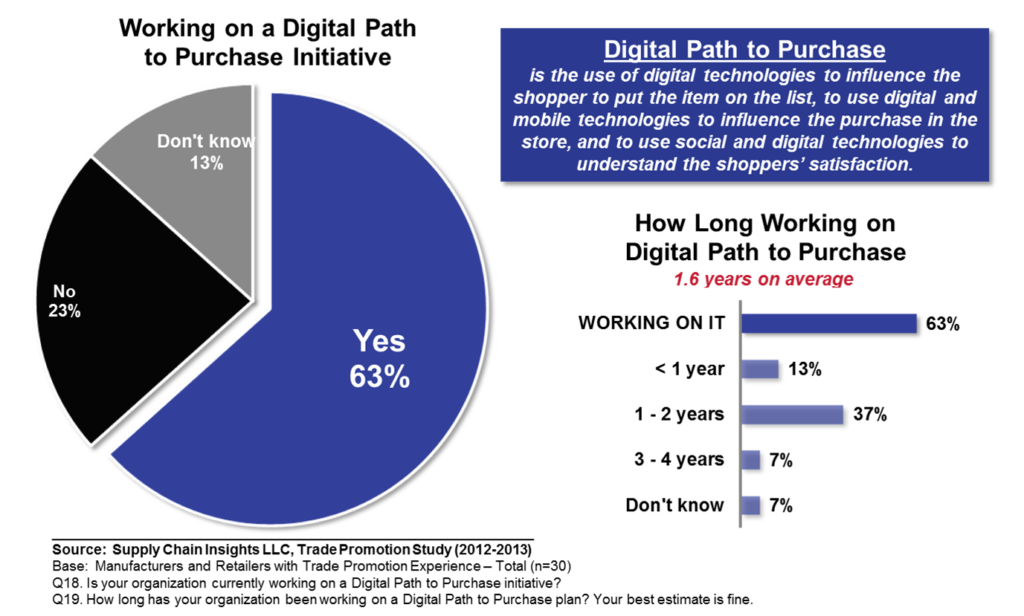
Today, 63% of consumer manufacturing organizations have a digital path to purchase initiative. This is a wonderful opportunity to design outside-in processes. Here are three steps to take:
1) Read Promotion and Price Effectiveness with Minimal Latency. Today, it takes 30 days for the consumer products organization to read the impact of a promotion. This might be sufficient for sales and marketing processes, but for the activities of replenishment, 30 days is too long.  Use downstream data (retailer Point of Sale and warehouse withdrawal data) to build outside-in processes to sense short-term demand requirements and translate them to the supply chain. This is the combination of demand sensing technologies in combination with channel data. Build these processes outside-in. Focus on data synchronization and harmonization.

2) Use New Forms of Analytics to Uncover Unlikely Inferences. Answer the questions that you do not know to ask. Text mining and sentiment analysis can be used to build listening posts to help companies listen to the voice of supply chain. Likewise, cognitive learning engines that use unstructured and structured data can listen and learn from multiple data types to better understand the right assortment in each market, and the reasons driving customer acceptance. (Many of which can be changed with the product launch.) Information from ratings-and-review data can help align the organization to better serve the shopper. Actively work on these initiatives to use the power of analytics to serve the shopper.

3) Test and Learn. Today, consumer products companies can sell in e-commerce channels directly to the shopper. Use these emerging channels to test and learn about the relationship of product attributes to customer attributes. Use test-and-learn strategies (either cross-channel or in vitro market testing) to better serve the shopper. The days of spray and pray are gone. The secret is to carefully design the test-and-learn strategies and to be careful in the execution to accurately read the market.

To do this, companies cannot operate in functions and the processes need to be designed outside-in. Supply chain leaders need to partner with commercial teams to drive a market-driven, not a marketing-driven, response. The key is listening, sensing and adapting to market signals with little latency. This cannot happen with the old inside-out processes. Use these new initiatives to build innovation at the edge and test new forms of analytics and use new forms of data.

For me, this is exciting. It is a wonderful opportunity to build outside-in processes to serve the shopper. What do you think? What do you see as the barriers?

All the best in your journey! Let me know your thoughts.

Search the Archives
Search
Share this Post
Email
Twitter
LinkedIn
Facebook
Pinterest
WhatsApp
Featured Image
Recent Posts

Warning: Sidestep the Narrative of the Misguided Goldiggers

Ten years ago, I started writing a book titled Stories of the Misguided Gold Diggers. The book was a collection of stories from two decades of stories of technology leaders perpetuating the myth of integrated end-to-end supply chain planning.

I dusted off the manuscript on Saturday. I think that we have a new chapter. Companies focused on putting Artificial Intelligence (AI) on top of existing architectures are putting AI Stupid on steroids.

Read More »

The Myth of End-to-End Planning

Supply chain planning, supply management, supply chain execution, network design, and transportation/logistics management operate in silos. Not much has changed over four decades. The connections flow back through transactional systems: order-to-cash and procure-to-pay. There is a myth that companies can buy an end-to-end supply chain management solution. This is largely a myth. Here we explain.

Read More »

Lead Time: A Broken Gossamer

If you are struggling with supply chain planning, dancing in the light of shiny objects, and scratching your head, please read on. My goal is to help you.

Please do not AI Stupid. What do I mean? AI Stupid is putting agents and agentics on top of existing architectures believing that making them faster and hands free add value. To me, this is fools play.

I love AI. I am excited about new technologies. To this end, I want to shine a light on how new technologies can help address the black holes and inconsistencies in today’s supply chain, which largely stem from the limitations of the first generation of supply chain planning and execution technologies. In this blog, I give you three places to start.

Read More »

Do You Need a Supply Chain Coach?

Supply chain is where the rubber hits the road. For a public company, over 40% of market capitalization is tied to the trade-offs between growth, operating margin, inventory management, and Return on Capital Employed.

The road for supply chain improvement is fraught with issues. Here we share some and offer some advice.

Read More »

Is your Supply Chain AI Ready?

A simple quiz to assess an organization’s AI readiness.

The pace of change is fast and furious. Every day, technology advances faster than we can digest. A great challenge to have.

Determining whether a supply chain is “AI-ready” is less about technology and more about the gray matter between the ears of supply chain leaders. Leadership, alignment, and clarity of goals matter.

Too few companies are clear on the definition of supply chain excellence. Measuring and rewarding functional metrics reduces the firm’s value. Putting agentics on top of today’s processes can make bad practices run faster, reducing value.

The toughest job for the supply chain leader is challenging existing supply chain paradigms that were defined by the limitations of decades of supply chain technologies. As the curtain lifts on the potential of new forms of technology, process redefinition is our opportunity, but only if we are clear on what drives value. (Here, I link to the Supply Chains to Admire reports to help you define value. The next report will be published on June 23rd, along with my Dynamic Benchmarking Product, to help you define value in the face of your AI readiness. More information about the launch is at the bottom of this blog.)

Read More »

Case Study: A Scrappy Demand Management Approach

This study of Franklin Sports shines a light on the work that needs to be done at the sales account level to challenge a retail forecast, and also highlights the importance of a new technique for a forecast engine — reinforcement learning.

Artificial intelligence comes in many forms — large language models, generative AI, machine learning, unstructured text mining, deep learning, neural networks, reinforcement learning, agents, and agentics. While the industry is wigging out about agentics, I think reinforcement learning is a great step forward in the journey of Artificial Intelligence.

Read More »